
Difficult Clients: Red Flags, Boundaries, and Firing
Difficult clients rarely start difficult — they show early red flags: haggling hard on price, treating routine boundaries as optional, or piling on "quick" extra requests. Solopreneurs who catch these signals early can set boundaries, price scope creep properly, and — when needed — end the relationship in a way that doesn't cost months of unpaid stress.
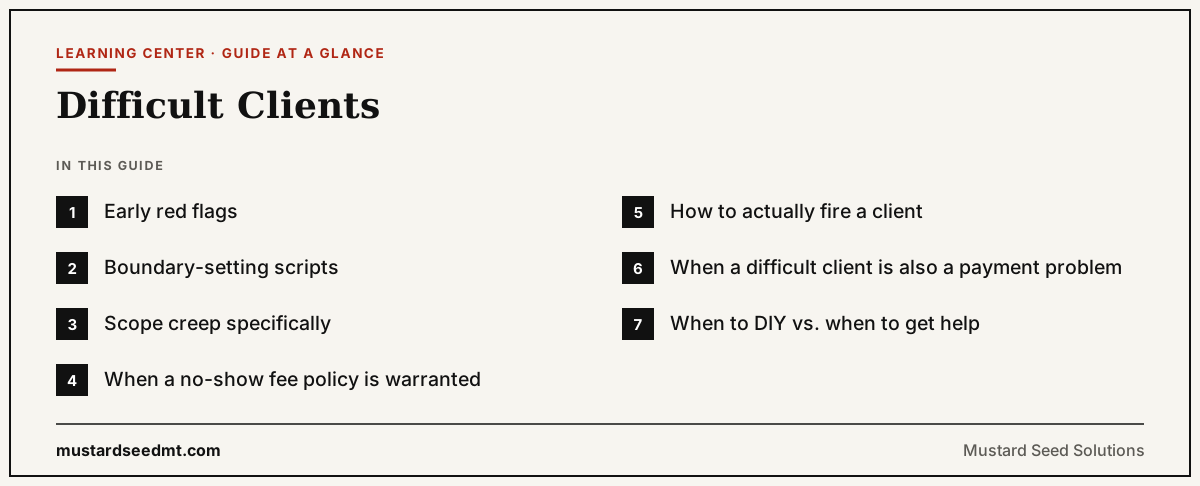
This guide is built entirely from real small-business accounts: a widely-read thread about firing a customer, another about a scope-creep spiral that ended in a public review dispute, and a detailed discussion of when a no-show deposit policy is actually worth introducing. The scripts and thresholds below are what solo operators describe actually using — not theory.
1. Early red flags
Difficult clients rarely start difficult. The pattern across dozens of small-business accounts is consistent enough to treat as a genuine early-warning signal, not just bad luck.
- Relentless haggling before work even starts — one founder who raised prices 40% noted the clients who haggled hardest were also the ones generating the most support tickets and late-night messages
- Charging low prices tends to select for the worst clients, not just less profitable ones — one owner described attracting people who were 'always rushing, always in a hurry, always super critical of every detail' at low rates, and saw it flip after a price increase
- Disrespect for basic hours from day one — expecting replies at midnight, or treating a stated boundary as something that doesn't apply to them
- A repeated finding across these threads: a small share of clients — often described as around 10-20% — generate a hugely disproportionate share of the total headache
2. Boundary-setting scripts
The solopreneurs who set boundaries successfully tend to do it the same way: short, neutral, and in writing — not an emotional case for why the boundary is fair.
- Decide response-time and hours norms before you need them, and state them once, clearly, rather than re-negotiating in the moment
- A short neutral line does more work than a long justification — commenters repeatedly favored something like 'that falls outside what we agreed, here's what it would cost' over an extended defense
- Put every scope or timeline change in writing immediately, not at the end of the project when it's hard to reconstruct what was actually extra
- How a client reacts to a small, reasonable boundary is itself useful information about how the relationship will go
3. Scope creep specifically
One of the clearest cautionary examples in the data: a $2,500 website project where a stream of 'quick' extra requests — a reservations button here, a PDF menu there — added up to 12 unbilled hours before the freelancer even totaled it up. The client felt blindsided when billed later; the freelancer felt blindsided by how much had accumulated.
- Track every out-of-scope request the moment it arrives — the freelancer in that case admitted the real mistake was not realizing how much extra work had piled up until it was already done
- Agree on a revisions cap and an out-of-scope hourly rate at kickoff, before the first 'quick' request arrives
- Bill or flag overage promptly instead of batching complaints — raising it after the fact reads as a surprise even when your case is fair
- If a client insists the site (or project) 'isn't done until I say it's done,' that's a scope conversation you need to have explicitly, in writing, not assume they'll infer
Free tool: Scope Creep Email Generator
Turn an out-of-scope request into a clear, professional email in seconds — no awkward back-and-forth.
4. When a no-show fee policy is warranted
No-shows come up constantly in service-business discussions, and the evidence is fairly consistent about when a deposit or fee policy is worth the friction of introducing it.
- It's warranted when no-shows are a recurring, measurable revenue leak, not a one-off — one family business tracked 13 no-shows in a month, roughly 25% of all slots
- Card-on-file tends to work better than a public 'no-show fee' announcement — one day-spa owner described eliminating around 98% of no-shows after switching to card-on-file, versus needing to actively enforce a fee after the fact
- A small deposit isn't the same protection as a full no-show fee — one provider explicitly kept the deposit smaller than the fee itself, calling it 'an easy out' for clients who'd rather go elsewhere
- Run it as a trial and measure the actual effect — a commonly repeated suggestion was testing the new policy for about 3 months and deciding with data instead of guessing at the backlash in advance
5. How to actually fire a client
Firing a client is described again and again as one of the hardest, then most relieving, things solo operators do. The accounts that go well share a process, not just a decision.
- Recognize the pattern first — most of the solopreneurs who describe firing a client point to a build-up (repeated boundary violations, chronic lateness, abusive behavior), not a single bad day
- Give clear, short, neutral notice in writing — one owner's go-to line was a version of 'I think you'd be a better fit with a different provider,' used sparingly and without an extended justification
- Reference your contract or agreement for any wind-down obligations (final deliverables, data handoff, final invoice) so the ending is clean, not just abrupt
- Don't get pulled into a rebuttal loop — several accounts describe ending the exchange after one clear message rather than re-engaging every reply
- Expect some fallout — a negative review or an angry message is a realistic possibility, and the people who've done this describe it as worth it far more often than not
A line worth remembering: one small-business owner's father put it this way — if the customer is always right, you'd better make sure you have the right customer. Treating every client as automatically right, regardless of behavior, is exactly what lets a small share of clients consume most of your time.
When a difficult client is also a payment problem
Scope creep and nonpayment tend to travel together in these accounts — a client who treats boundaries as optional on deliverables often treats invoice due dates the same way. If a difficult relationship is also turning into a collections problem, the escalation steps (and the realistic limits of what a contract or a judgment can actually recover) are covered in depth in our guide to getting paid.
Client relationships, cash flow, and boundaries are deeply linked in practice — a theme that runs throughout our research into the 50 biggest solopreneur challenges.
When to DIY vs. when to get help
Boundary scripts and a firing process are things you can run yourself with the templates above. Where solo operators tend to want outside help is upstream of the problem — attracting clients who are a better fit in the first place, so fewer of these conversations are ever necessary.
Want to attract better-fit clients from the start? Mustard Seed's Solo Business Marketing advisory helps solopreneurs position and price their services to filter for clients who respect the work.
Solo Business MarketingFrequently Asked Questions
What are the early warning signs of a difficult client?
The most consistent signals in real small-business accounts: relentless haggling before the work even starts, disrespect for basic working hours (expecting replies at midnight), and a pattern of treating stated boundaries as negotiable. Notably, clients who haggle hardest on price are also frequently the ones generating the most support requests and revision demands later — the price fight is often an early signal of a maintenance-heavy relationship, not a one-time negotiation.
Do low prices attract worse clients?
That's a common pattern in the evidence. Multiple solo-business owners describe low prices selecting for clients who are impatient, hypercritical, and prone to conflict — and describe the client mix visibly improving after a price increase. It isn't universal, but it's frequent enough to treat pricing as a client-quality lever, not just a revenue lever.
How do I set boundaries with a demanding client without losing them?
Keep it short, neutral, and in writing, stated once rather than re-argued each time. Real examples that worked well were plain statements of the boundary and the cost of going beyond it, without an extended emotional justification. If a reasonable boundary genuinely costs you the relationship, that's useful information about the client, not a sign the boundary was wrong.
What is scope creep and how do I stop it?
Scope creep is the accumulation of small, individually reasonable-seeming extra requests until they add up to real unpaid work — a documented case involved 12 hours of 'quick' extras on a $2,500 project before anyone tallied it. The fix is tracking every request as it arrives, agreeing on a revisions cap and out-of-scope rate at kickoff, and billing overage promptly instead of batching it into one uncomfortable conversation later.
When should I charge a no-show fee?
When no-shows are a recurring, measurable share of your schedule — not an occasional one-off. Real accounts describe no-show rates as high as 20-35% of weekend slots before introducing a policy, and card-on-file (rather than a public fee announcement) as the change that actually reduced it, in one case eliminating roughly 98% of no-shows. Running it as a trial and measuring the result beats guessing at the backlash in advance.
How do I fire a client professionally?
Recognize the pattern rather than reacting to one bad day, then give short, clear, neutral notice in writing — a version of 'I think you'd be a better fit elsewhere' comes up repeatedly and works well specifically because it avoids inviting a debate. Reference any contract obligations for a clean handoff, and don't get drawn into re-litigating the decision after you've stated it once.
Will firing a client hurt my reputation?
It can — a negative review or an angry public comment is a realistic possibility, and several real accounts describe exactly that happening. Almost all of them still describe the trade worth it: the ongoing cost of keeping an abusive or chronically boundary-violating client is described as higher than the one-time cost of a bad review from someone who was never going to be a good client anyway.
Should I always follow a strict 'the customer is always right' policy?
The solo operators in these accounts overwhelmingly say no — treating every customer as always right, regardless of behavior, is repeatedly described as the mindset that lets the worst 10-20% of clients consume a disproportionate share of time and energy. Being fair and professional doesn't require tolerating abuse or unlimited scope changes.
Related resources
Spend less time managing the wrong clients
Want a pipeline of clients worth keeping?
Mustard Seed Solutions helps solopreneurs position, price, and market their services to attract clients who respect scope, boundaries, and your time.
Book a consultation