
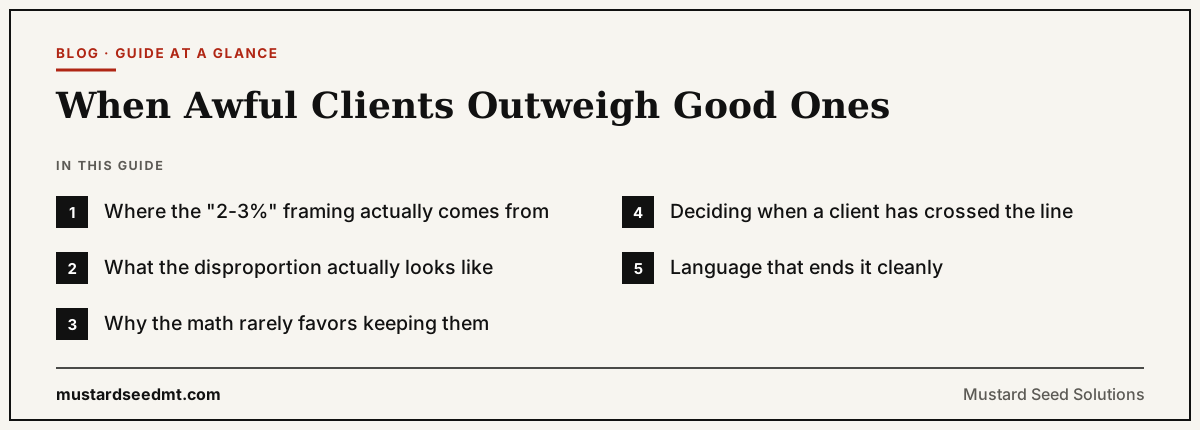
A tiny share of clients can cost more in stress, unpaid time, and dread than the rest of your book earns you combined — a pattern solopreneurs describe again and again, even if nobody agrees on the exact percentage. One business owner called it 2-3%. Others say 5%, or the familiar 80/20 split. The number moves; the shape doesn't.
That framing comes directly from a post titled almost exactly that — one owner's description of how a handful of "entitled, helpless, short fused" customers had started to outweigh the goodwill built by everyone else. It struck a nerve: hundreds of solopreneurs and small business owners piled on with their own version of the same math.
This isn't a call to distrust clients broadly — most of any book of business is fine, often better than fine. It's a case for noticing the minority that isn't, and treating that as a business decision rather than a character flaw to push through. For the fuller picture on managing this pattern day to day, see our guide to handling difficult clients.
Where the "2-3%" framing actually comes from
To be precise about what the data supports: the 2-3% figure is not a measured statistic pulled from a survey of solopreneurs. It's the headline of one small business owner's post, describing a felt sense that a small slice of customers had become disproportionately exhausting. It resonated because the shape of the claim — a small minority causing most of the damage — matched what a lot of other owners were already living.
In the replies to that post and others like it, the exact number shifts. One vacation rental host uses a "1 in 20" rule — about 5% of guests being, in their word, insufferable. Others reach for the classic 80/20 framing: 80% of problems from 20% of customers. None of these are competing scientific claims. They're independently-arrived-at heuristics that agree on the same underlying pattern: disproportion, not universality.
The honest version of the title, then, isn't "2-3% of your clients are awful, measured precisely." It's closer to: a small minority of clients — somewhere in the low single digits to maybe a fifth, depending on who you ask — can generate a share of stress and unpaid effort wildly out of proportion to their share of your revenue.
What the disproportion actually looks like
Across dozens of small business stories, the pattern shows up in similar shapes. A performance studio owner gave a client a steep one-time discount during a medical hardship, and was accused of "taking advantage" of her a year later when a much larger new project was quoted at full rate — a single act of goodwill treated as a permanent entitlement.
A different owner described a customer who repeatedly asked for a "bulk discount" despite barely clearing the order minimum, then berated a staff member after ordering the wrong item — again. Cutting the customer off drew near-universal support from other owners, several of whom noted that turning down business is one of the hardest instincts to build, precisely because "the customer is always right" is treated as gospel long after it's stopped being useful advice.
A third owner, after being sued once and hit with a fraudulent chargeback by a different competitor, canceled all future orders from that customer and described the decision as an easy call once the pattern was clear. The common thread isn't any single bad interaction — it's the same handful of behaviors repeating: rate disputes, escalating demands, disproportionate outrage over routine business decisions.
Why the math rarely favors keeping them
One of the clearest illustrations came from a solo marketing operator who raised prices 40% after years of undercharging. Seven of twenty-two clients left immediately — and by the owner's own account, they were largely the ones who haggled over everything and generated the most revision requests. Two clients negotiated a smaller increase. Thirteen said, in effect, that they were surprised the rate hadn't gone up sooner.
The result: revenue rose about 12%, while workload dropped by roughly 35%, because the clients who left were disproportionately the most demanding and least profitable per hour. That's the arithmetic behind the "2-3%" instinct made explicit — the clients causing the most friction were rarely the ones providing the most value once actual hours were counted.
A related thread told the same story from the discount side: an owner who stopped giving "just to be nice" discounts found that almost no legitimate clients left, while the people who'd pushed hardest for a price break were consistently the hardest to please anyway. Several commenters converged on a version of the same line — that clients who fight over price are frequently the same clients who cost the most in time later.
Deciding when a client has crossed the line
The stories above share a few recurring markers worth watching for, rather than any single dramatic incident:
- Repeated disputes over rates that were agreed to in advance.
- Escalating demands framed as routine — daily updates, constant scope changes, "quick" asks that never stop.
- A one-time act of goodwill treated afterward as a standing entitlement.
- Disproportionate reactions — reviews, complaints, threats — to normal business decisions like billing or turnaround time.
- A pattern that repeats across interactions, not an isolated bad day.
Owners who described "firing" a client rarely framed it as anger. The most common description was relief — one called it liberating, another said it felt like taking a weight off. The decision tends to get easier once it's reframed from "am I allowed to do this" to "what is this client actually costing me relative to what they pay."
If this pattern sounds familiar and you want to see how it stacks up against the other pressures solopreneurs report most often, our research report on the 50 biggest solopreneur challenges puts difficult clients in context alongside pricing, cash flow, and burnout.
Language that ends it cleanly
A recurring theme in these stories is that the actual words used to end a client relationship were shorter and calmer than you'd expect. One physician who runs a private practice described using a version of the same line for years: telling a client it seems their needs aren't being met here, and suggesting a specific alternative provider who might serve them better. A restaurant manager who told a similar story used almost identical phrasing — noting the customer hadn't seemed satisfied on recent visits, and that it was probably best they try somewhere else.
None of these framed the client as wrong. They framed the fit as wrong, which is both more accurate and far harder for the client to escalate into a public fight. One commenter's version of the discount-invoice trick applies here too: when a past exception is being treated as a new entitlement, spelling out the standard rate, the one-time discount, and the total due — in writing — does more to defuse the conversation than any explanation of why the old rate no longer applies.
The pattern across dozens of these stories is that owners rarely regretted ending a bad-fit relationship. The regret, when it showed up at all, was almost always about waiting too long to do it — tolerating the same behavior for months while telling themselves it was a one-off, until the cumulative cost became impossible to ignore.
The takeaway
Whatever the exact percentage — 2%, 5%, 20% — the pattern solopreneurs describe is consistent enough to act on: a small minority of clients can cost disproportionately more than they pay, and letting them go is usually a business decision, not a personal failure. The number is less important than the willingness to notice the pattern before it becomes the whole job.