
Your first hire almost certainly won’t do the job exactly the way you would — and that’s not a reason to keep doing it yourself. Solopreneurs who delayed hiring describe the same root cause repeatedly: not cost, not demand, but the belief that no one else could meet their own standard.
That belief is expensive. The founders who eventually did hire tend to say the same thing afterward, in almost identical language: they wish they’d done it sooner, the tasks they protected were quietly costing them more than a mediocre hire ever would, and the anxiety leading up to the decision was worse than anything that happened after.
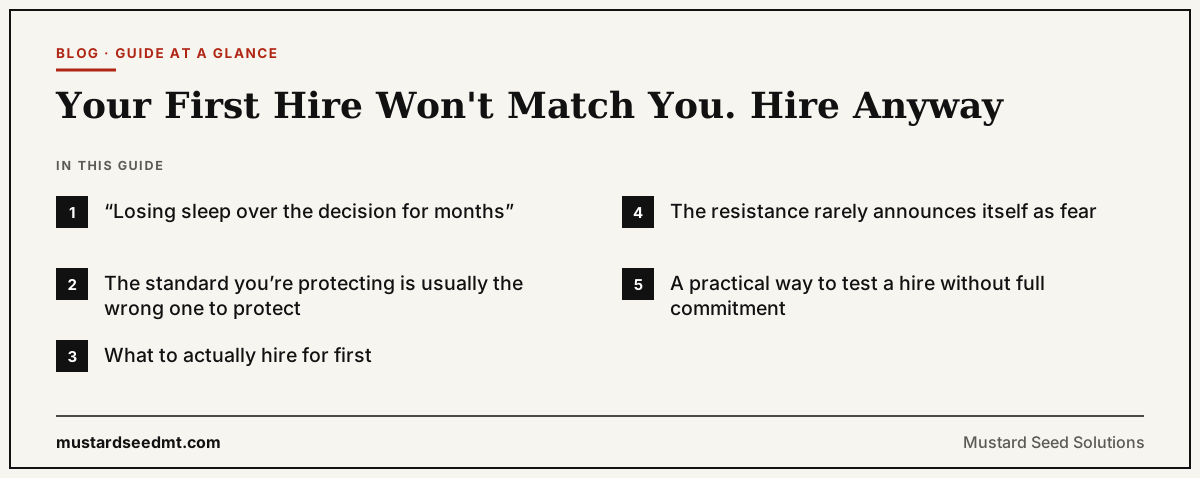
“Losing sleep over the decision for months”
One small-business owner, a solo criminal defense lawyer who’d prided himself on running lean with no employees, wrote about finally hiring administrative help after losing sleep over the decision for months. The relief was immediate and specific: he spent an entire afternoon doing actual legal work instead of paperwork, and called it one of the most satisfying afternoons he’d had in years. He admitted he didn’t know why he’d put it off so long — every other business owner he’d asked had said the same thing, that hiring help was one of the best decisions they’d made.
A painter running his own LLC described the specific fear directly: he was afraid to hire, on the belief that doing so would degrade his own standards and limit his production. That’s the perfectionism argument in its purest form — the fear isn’t that hiring will fail, it’s that it will succeed at a lower bar than the founder’s own.
The standard you’re protecting is usually the wrong one to protect
A widely shared post in a small-business community made a related point that reframes the whole question: you don’t need to be the best in your field to succeed in it, and you don’t need to be an expert in a task to hire someone for it. One commenter running a marketing agency said they’d built their business on their own paid-ads knowledge but stayed hesitant for ages to bring in help for a different ad platform, purely because it wasn’t something they personally knew how to evaluate. The fear wasn’t about the hire’s competence — it was about the founder’s own discomfort not being the most knowledgeable person on every task in the business.
That distinction matters because it means the barrier often isn’t really about quality control at all. It’s about a founder’s identity being tied to being the one who does everything — which is a much harder thing to let go of than a task.
What to actually hire for first
One founder who’d run a SaaS solo for eighteen months, until — in their words — “I stopped sleeping,” shared the three hires that changed that, in priority order. A tier-one support agent, costing under two thousand dollars a month, freed up roughly four hours a day previously spent on tickets and dropped churn within sixty days simply because response times improved. A part-time bookkeeper, the least glamorous and highest-impact hire by their own account, caught mistakes that would have cost far more than the fee — and they said flatly it should have been the first hire, not the third. A junior developer handled routine maintenance only, freeing the founder for the strategic work only they could do.
The same founder was candid about what not to hire early: marketers, salespeople, and senior engineers all underperformed in their first year, specifically because the founder couldn’t yet manage them properly. That’s a useful corrective to “just hire more” — the point isn’t hiring broadly, it’s hiring for the highest-volume, lowest-judgment work first, the tasks that are draining time without requiring the founder’s specific expertise.
Another commenter on the same thread agreed the bookkeeper hire is usually delayed the longest, precisely because the work is invisible until it suddenly isn’t — at tax time, or when a pricing decision turns out to be based on numbers nobody had actually checked.
A simpler version of the same advice showed up in a completely different thread, from a founder who described feeling like they were drowning in sixteen-hour days: track your time for a few days, find the task you hate most, then hire someone to do specifically that task once it’s been written down as a repeatable process. They mentioned doing exactly this with their own email filtering and social content — work they’d hated doing themselves — and called it worth every penny. Another founder, further along, echoed the same sequence almost word for word: the moment you can afford it, delegate, starting with whatever you personally dread most.
The resistance rarely announces itself as fear
It’s worth naming how this hesitation actually sounds out loud, because it rarely sounds like “I’m afraid they won’t be as good as me.” It sounds like a cost-benefit objection. One small-business owner described her husband being very reluctant to hire seasonal help, arguing that training someone would take more time than it was worth. Once the hire was made, he was the one excited about having inventory ready to go so orders could ship faster — the exact outcome the training time was supposedly not worth. The stated objection and the actual result didn’t match, which is usually the tell that the real barrier was never really about the math.
One founder made the cost of delaying explicit in numbers rather than feelings. Outsourcing accounts for two days a month was the first real hire, eighteen years ago, and that person still works with them today. Support staff came second. Looking back, the founder was blunt about the instinct that came before those hires: the belief that doing everything alone would save money. It didn’t. It cost them work and clients. That’s the version of “won’t do it as well as you” worth sitting with — the comparison was never against a hire’s competence, it was against a founder who was already stretched too thin to serve the clients they had.
A practical way to test a hire without full commitment
For founders uneasy about handing over control indefinitely, one small-business owner described a workable middle ground: she brought on a part-time employee for a set number of hours a week, was upfront from day one that they’d reassess after a month, and treated that first month as a genuine test rather than a permanent decision made in advance. If it didn’t work out, that was useful information on its own. A defined trial window, communicated honestly to the hire, turns “will they do it as well as me” into a question with an answer — instead of a fear that just keeps the founder doing everything alone.
None of this is an argument to hire recklessly or hand over judgment calls a founder is genuinely the only person qualified to make. The founder who made three hires in eighteen months was just as clear about what backfired — bringing on senior roles too early, before there was enough structure in place to manage them well. The distinction that mattered every time wasn’t whether to delegate. It was what to delegate first: the repetitive, well-defined, emotionally low-stakes work that’s draining hours without requiring the founder’s specific judgment — not the work closest to the parts of the business only the founder can actually see clearly.
Before making that first hire, it helps to know precisely what your own time is actually worth, so the tasks you keep doing yourself are the ones that genuinely justify it. Mustard Seed’s true hourly rate calculator is built for exactly that comparison. For the fuller picture of where hiring hesitation ranks among the challenges solo operators report, see Mustard Seed’s research report on the 50 biggest solopreneur challenges.