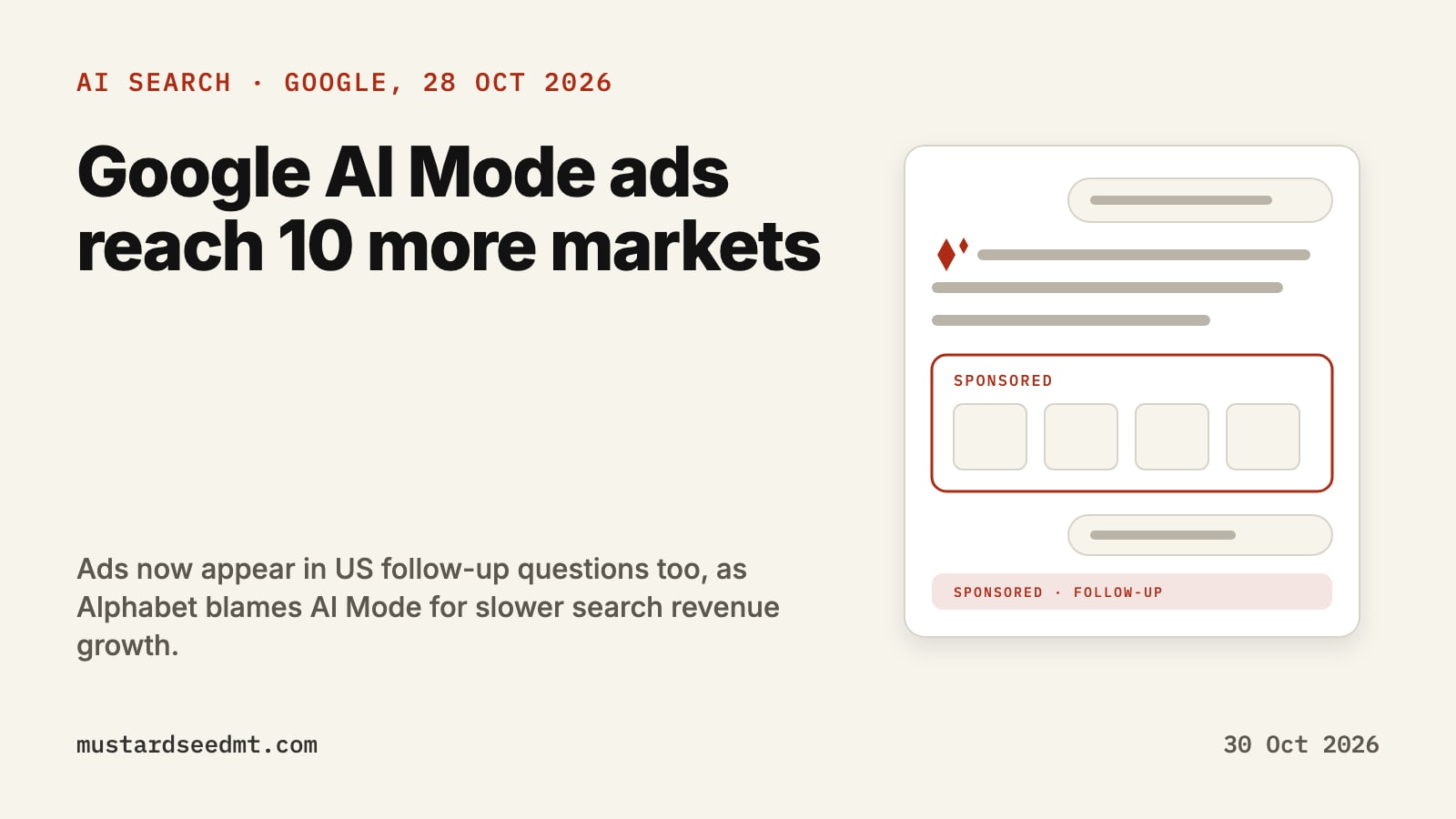
Google AI Mode ads now run in ten more countries, and in the US they can appear in follow-up questions as well as the first answer. Google announced both on 28 October 2026, the same day Alphabet reported that lower monetization in AI Mode had slowed its search revenue growth. For B2B tech companies, more of the research conversation in Google now carries paid placements.
What Google announced on 28 October 2026
In a post on its Ads & Commerce blog on 28 October 2026, Shashi Thakur, VP and GM for Google Search Ads, said ads in AI Mode are now scaling in Australia, Canada, India, Kenya, Malaysia, New Zealand, Nigeria, Pakistan, the Philippines and Singapore. The same post says Google plans to add Brazil, Mexico and the United Kingdom in the fourth quarter of 2026.
The post also launches what Google calls multiturn ads in the US, "to allow ads in follow-up queries in AI Mode". A Google spokesperson told Search Engine Roundtable on 28 October 2026 that these ads "show up on responses to follow-up user queries as users engage in back and forth conversations with AI Mode."
Google says the ads are labelled "Sponsored". According to Thurrott's report of 29 October 2026, Google's support page states that the ads "do not influence the organic responses generated by Google AI."
Why Google is pushing ads into AI Mode now
Alphabet's third quarter 2026 earnings release, dated 28 October 2026, shows Google Search and other revenue of $63.35 billion, up 12% from $56.57 billion a year earlier. The same release says search query growth was the highest it has been in five years.
More people searched, yet revenue growth slowed: The Register put it a little below the 14.5% Google reported for the same quarter of 2025. The Register also reported on 29 October 2026 that on the earnings call Philipp Schindler, Google's chief business officer, put the slowdown down to "lower monetization we were seeing in AI Mode." According to the same report, Alphabet shares fell almost 10% on Wednesday 28 October.
Schindler's case for AI Mode, as The Register quoted him, is that "many of these queries are upper funnel queries" and that "the majority of AI Mode queries are incremental, creating more monetization opportunities over time." Put plainly, Google expects to sell more ads against AI Mode research queries over time.
Google is also testing how ads mix with organic product results
On 29 October 2026 Search Engine Roundtable reported a test in AI Mode shopping results: a line above the product carousel that reads "Sponsored" or "All products". It was spotted by Sachin Patel. A Google spokesperson called it "part of our ongoing experiments with ads in AI Mode" and said shopping ads "can appear alongside organic visual search results within carousels for commercially relevant queries."
In its 28 October post Google says click-through rates are "already similar between sponsored and organic product list items within AI Mode." That is Google's own research, and the post gives no figures behind it.
What this means for B2B tech companies
The examples Google gave this week are about shopping: product list items and product carousels. B2B software and infrastructure buyers rarely buy from a carousel, so the first effect on you is indirect.
The longer-term effect is on research queries. Google's post says AI Mode queries are on average three times longer than traditional searches. Schindler calls them upper funnel. That describes the questions a buyer asks while working out what kind of tool they need, before they have a shortlist: "how do I monitor power in a colocation cage", "backup for Proxmox and Kubernetes in one tool". Multiturn ads mean the follow-up question, often the one that names vendors or asks about price, can now carry a paid placement in the US.
For a hard-to-explain product, the answer text matters more than the ad slot. If the AI Mode answer defines your category in a way that leaves you out, a sponsored unit beside it has to argue against the answer.
What to check and change this month
- Run your ten most important category questions in AI Mode, then ask the two follow-ups a buyer would ask next. Record whether you are named in the answer, which pages are cited, and whether any sponsored unit appears. Repeat monthly.
- If you sell into Canada, Australia, India or Singapore, run the same check from those markets now, since ads are live there per Google's 28 October post. Add the UK when Google switches it on.
- Rewrite the pages that should answer those questions so the first sentence of each section gives a direct answer and names your category in the words buyers use. That is what gets quoted or cited in an AI answer.
- In Google Ads, read your search terms report for long, conversational queries and see what they cost and convert at before you raise bids on them.
- Report AI Mode visibility and paid search side by side. If organic citations drop on queries where sponsored units appear, you will see the trade-off in your own numbers.
Google expects to keep testing new formats, according to its own post, and the label test reported by Search Engine Roundtable is one of them. Recheck your log after each Google announcement.
Where Mustard Seed helps
Mustard Seed Solutions works with companies whose technology is hard to explain: DCIM and IT operations, backup and disaster recovery, cloud and DevOps tooling, AI software and legal tech. We run your category questions through Google AI Mode and the other answer engines, log who gets named and cited, and rewrite the pages that should be answering. If you want to know what AI Mode tells your buyers today, get in touch.