
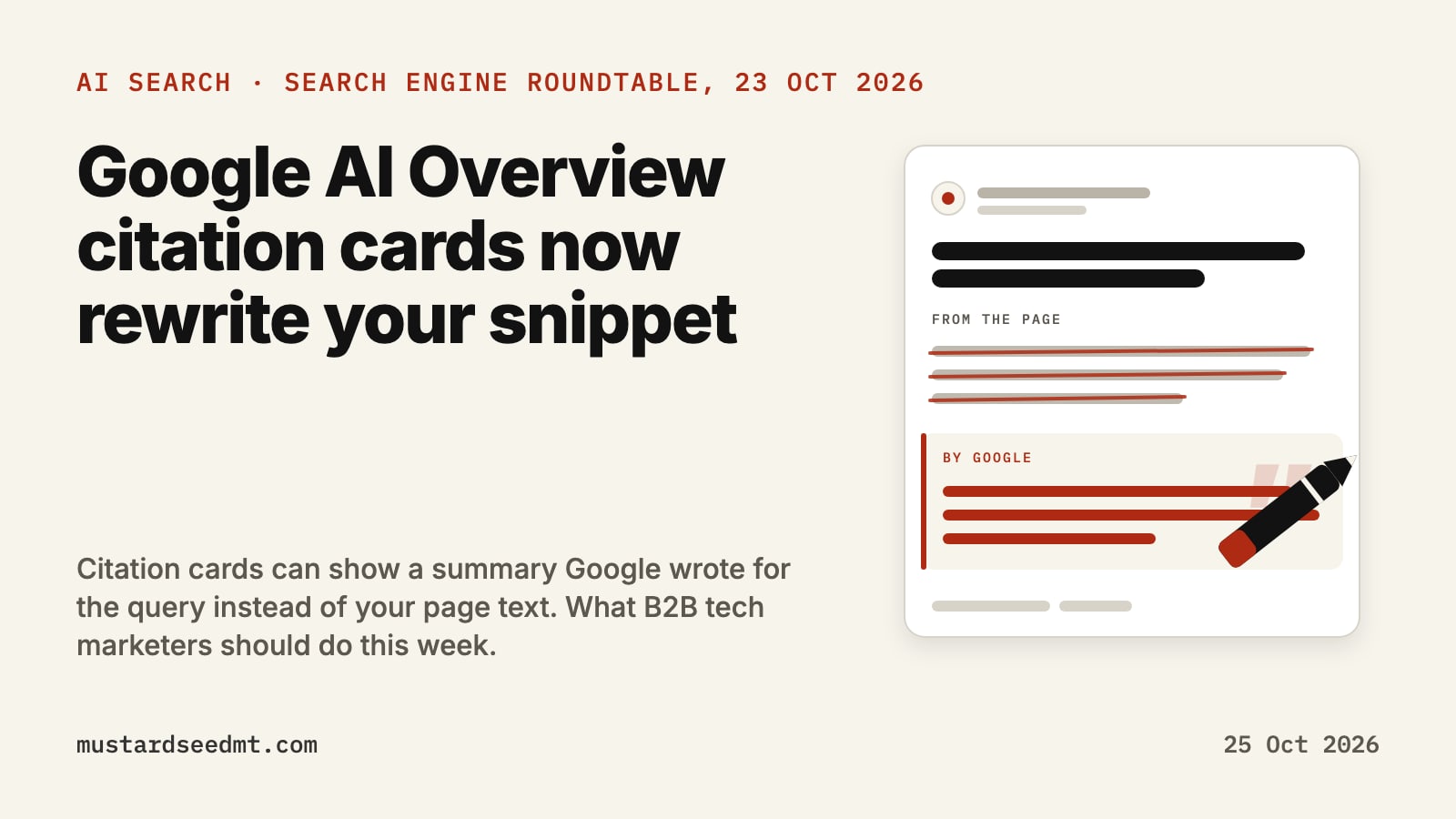
Google AI Overview citation cards can now show a summary written by Google instead of the snippet taken from your page. Brodie Clark spotted the change in a post on X on 21 October 2026, and Barry Schwartz confirmed it on Search Engine Roundtable on 23 October 2026 after reproducing it on some of his own test queries. For B2B tech companies this means the first words a buyer reads about you in Google may not be yours.
What changed in the citation cards
Citation cards are the source boxes beside or below an AI Overview, one per cited page. Until now they showed the page title and a snippet from the page itself. In the cases Clark and Schwartz documented, the card shows text Google generated for that query instead.
Search Engine Roundtable's article carries no statement from Google and does not say whether this is a test or a rollout. Schwartz saw the summaries on some queries and not on others.
What Brodie Clark's example shows
Clark's post, published through his SERP Alert account on X, says the card text "is being summarised based on the information that Google thinks is most relevant to the query". His example was his own homepage: the card used the word "reach", and that word does not appear anywhere on the page.
So the card text was a new sentence written for the query, in words the page never used.
Why the first words a buyer reads may not be yours
For hard-to-explain technology, positioning lives in exact words. A DCIM vendor, a backup vendor and a Kubernetes platform each spend months deciding whether they "monitor", "manage" or "automate". A summary written per query can swap those words for whatever matches the searcher's phrasing.
A snippet is no longer something you control, even on pages with a careful meta description. And any weak or outdated paragraph on the page can be picked up and restated as if it were your main claim.
This sits on top of Google's 15 October links update
On 15 October 2026 Google published "More ways to connect with the web from Search", a post by Hema Budaraju, VP of Product Management. It described "continued and substantial increases" in inline links in AI Mode and AI Overviews, links shown higher in responses more often, image thumbnails on end-of-answer links, a test of a section for official sites "with context about why each link is useful", and clickable creator and publisher names on video results. Google also said the number of people using Preferred Sources has "grown by more than 7x since the start of the year".
So Google is putting more links in front of AI answers and, in the citation cards, deciding how those links are described. Barry Schwartz asked Google on 15 October 2026 to add click data to the AI performance reports in Search Console. Google's reply, as he quoted it on Search Engine Roundtable, was that it will "introduce additional metrics over time".
What Google says you need, and do not need
Google's guide to optimizing for generative AI features on Google Search, last updated 10 July 2026, defines AEO as answer engine optimization and GEO as generative engine optimization, then says: "From Google Search's perspective, optimizing for generative AI search is optimizing for the search experience, and thus still SEO."
The same guide says you "don't need to create new machine readable files, AI text files, markup, or Markdown to appear in Google Search", that an LLMS.txt file "will neither harm nor help" your visibility there, and that "there's no requirement to break your content into tiny pieces for AI to better understand it".
Google's AI features page adds that "there are no additional requirements to appear in AI Overviews or AI Mode", and that clicks and impressions from AI features are reported in the Search Console Performance report "within the 'Web' search type".
If a vendor is selling you llms.txt files, AI-specific markup or paragraph chunking as GEO for B2B tech companies, Google's own documentation says those do nothing in Google Search. Put that budget into the pages themselves.
What to do this week: write paragraphs that survive paraphrase
You cannot stop Google rewriting the card, but you can make the rewrite land close to your own words. A paragraph survives paraphrase when there is only one thing in it to summarise.
- Open each section with the answer in one sentence. Google's guide describes query fan-out as "a set of concurrent, related queries" the model issues to build a response, so each section should answer one of those directly.
- Keep one claim per paragraph. If a paragraph says what the product does, who it is for and what it costs, a summary will keep one of those and drop the rest.
- Name the product, standard or law in full on first mention in each section, so the summary keeps the noun that identifies you rather than "the platform" or "the regulation".
- Keep every number next to the thing it measures and the condition it was measured under; a number alone in a table loses its context.
What to do this week: check, log, measure
- Run your own category queries in AI Mode and in classic Search with AI Overviews from a logged-out browser. Note which pages are cited and what the card says, and take screenshots, because the text changes per query.
- Keep a log: query, date, cited page, card text, and whether the card text matches a sentence on the page. After two weeks you will know which pages Google paraphrases and which it quotes.
- In Search Console, watch the Performance report under the Web search type, where Google says AI Overview and AI Mode clicks land, and the Generative AI performance report where you have it.
- Watch branded query volume. If buyers read Google's description of you and then search your name, branded queries are where that shows.
Where Mustard Seed helps
Mustard Seed Solutions does this work for companies whose technology is hard to explain: DCIM and IT operations, backup and disaster recovery, cloud and DevOps tooling, AI software and legal tech. An AI visibility audit runs your category queries across Google AI Mode, AI Overviews and the other answer engines, logs which pages are cited and how they are described, and lists the paragraphs to rewrite first. If you want a second pair of eyes on how Google currently describes your product, get in touch.