
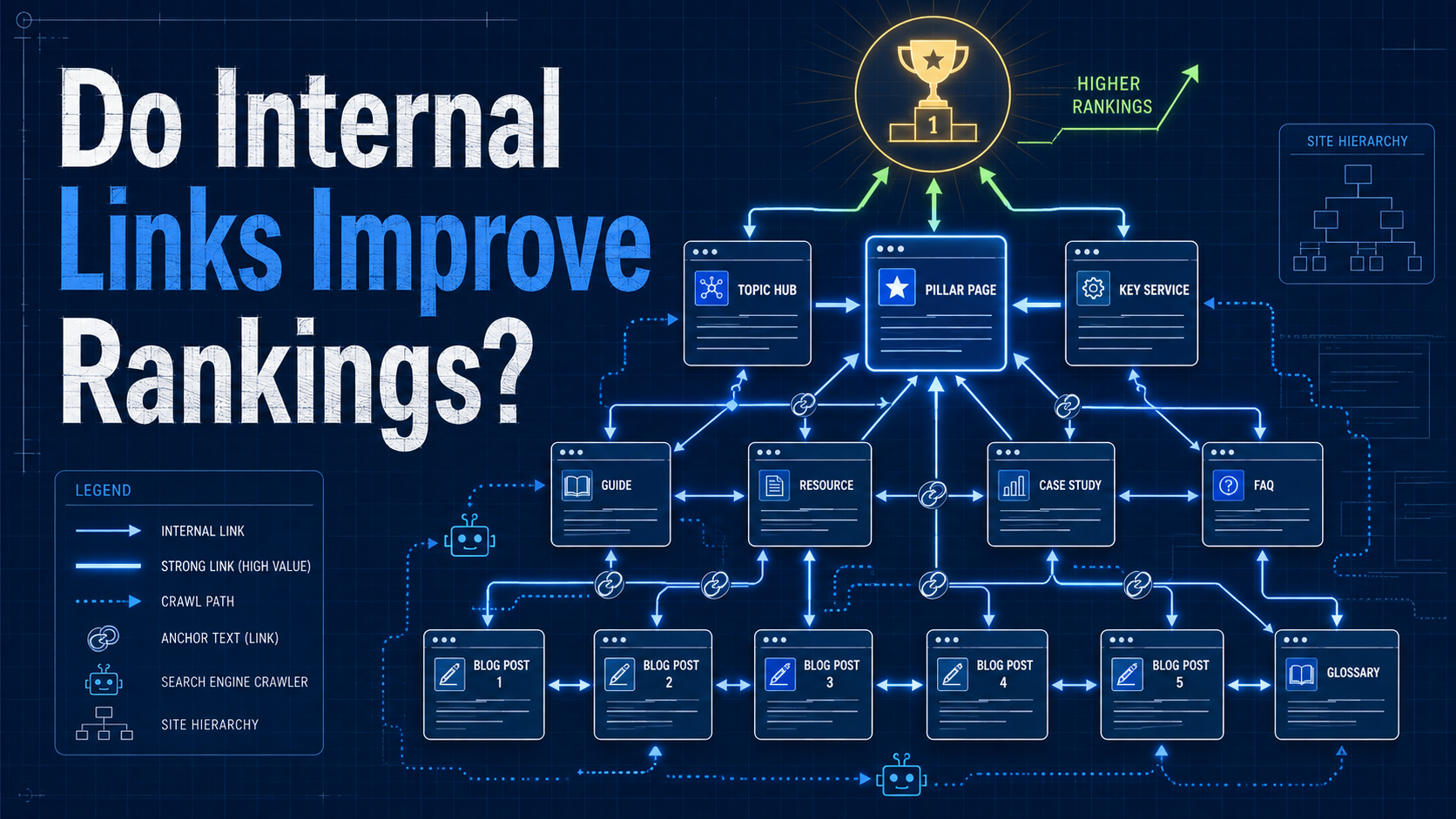
Yes, internal linking can improve SEO by helping Google discover pages, understand relationships between topics, interpret anchor text, and recognize which pages are important within the site. But adding a few keyword links does not automatically move a page up the rankings.
The SEO reaction video behind this series uses an ecommerce example. One claim suggests adding product links inside collection page SEO copy. The reaction argues that the more important question is which page you are trying to rank and how authority should flow through the site.
That is the useful lesson: internal linking is architecture, not decoration.
How Does Google Use Internal Links?
Google says links help it find pages and understand their relevance. Its current link guidance also says every page you care about should have a link from at least one other page on your site.
See Google's link best practices.
Internal links can help with several jobs at once:
- Page discovery
- Crawl paths
- Topic relationships
- Anchor text context
- Site hierarchy
- User navigation
- Distribution of authority through the site
That does not mean Google assigns a simple public score to every internal link. It means links are one of the structural signals that help search engines make sense of a website.
A page with no meaningful internal links can be difficult for both users and crawlers to find.
Why Does Link Direction Matter?
Link direction matters because different pages have different purposes and different levels of importance.
In the video's ecommerce example, the collection page may target a broader commercial query while individual product pages target narrower product names. If the collection page is the page you most want to rank, the internal linking strategy should reinforce that hierarchy instead of treating every URL equally.
A strong ecommerce structure might connect:
- Homepage to major categories
- Major categories to subcategories
- Subcategories to products
- Products back to relevant categories
- Editorial guides to commercial categories
- Related products to one another when useful
The exact direction depends on search intent, user behavior, and which pages need support.
The mistake is following a universal rule such as "always link from collection pages to products" or "never link from collection pages to products." Both can be too simplistic.
Build the structure around the site's real hierarchy.
Does Anchor Text Matter for Internal Links?
Yes, descriptive anchor text helps people and Google understand what the destination page is about.
"Learn more" can be useful when the context is obvious, but a descriptive phrase such as "technical SEO audit" or "local SEO guide" provides more information.
Do not turn every internal link into exact match keyword repetition. That can make the writing awkward and does not improve the user experience.
Good internal anchor text should be:
- Descriptive
- Concise
- Natural in the sentence
- Relevant to the destination
- Varied when different wording makes sense
The goal is clarity.
For example, an article about AI search may naturally link to an AI Visibility Audit when the reader reaches the point where diagnosis becomes useful.
Can Internal Links Rescue a Weak Page?
Sometimes they help, but they cannot fix everything.
A page may struggle because it:
- Targets the wrong intent
- Has thin or outdated content
- Competes with another page on the same site
- Lacks external authority
- Is poorly indexed
- Has technical problems
- Targets a query that is too competitive
- Offers no unique information
Adding internal links to that page may improve discovery or reinforce importance, but it does not solve the underlying issue.
This is why internal linking should be combined with content quality, technical SEO, authority, and clear search intent.
The broader Learning Center is designed around parent topics, sibling resources, and commercial next steps so internal links reflect how the content actually relates.
What Are the Most Common Internal Linking Mistakes?
The biggest mistake is adding links mechanically without thinking about site structure.
Common problems include:
- Orphan pages with no internal links
- Important pages buried several clicks deep
- Hundreds of repetitive footer links
- Generic anchor text everywhere
- Internal links to redirected or broken URLs
- Linking every keyword occurrence
- Sending too much attention toward low value pages
- Failing to link new content from established relevant pages
- Creating content clusters with no clear parent page
- Linking unrelated pages simply to manipulate anchor text
A website can have thousands of internal links and still have poor architecture.
Quality comes from relationships, not volume.
How Should You Audit Internal Links?
Start with the pages that matter commercially and work outward.
Ask:
- Which pages generate leads or revenue?
- Which pages already receive organic impressions?
- Which pages have external backlinks?
- Which pages explain core topics?
- Which important pages are orphaned?
- Which pages compete for the same search intent?
- Where can users naturally move to a deeper or more commercial resource?
Then build a structure that connects broad pages to specific pages and informational pages to relevant commercial destinations.
A useful internal link should improve the reader's path even if search engines did not exist.
That is a strong test because it keeps the SEO architecture aligned with the actual website experience.