
Search engine optimization, commonly known as SEO, is the process of improving a website so that search engines can discover its pages, understand what they are about, and consider them relevant enough to show in search results.
For businesses, the objective is practical. When potential customers search for information, services, or products connected to your company, your website should have a realistic chance of appearing.
Many people make SEO sound mysterious. They describe it as a collection of technical tricks, keyword formulas, content rules, or software tools. These elements may play a role, but they do not explain how SEO works as a complete system.
The short version is this. SEO works by getting a page through four stages, in order. A search engine has to discover the URL, crawl the page, decide to index it, and then rank it against every other indexed page that could answer the same search. A page has to survive all four. Failing any one of them looks identical from the outside: no traffic.
How does SEO work? The four stages in order
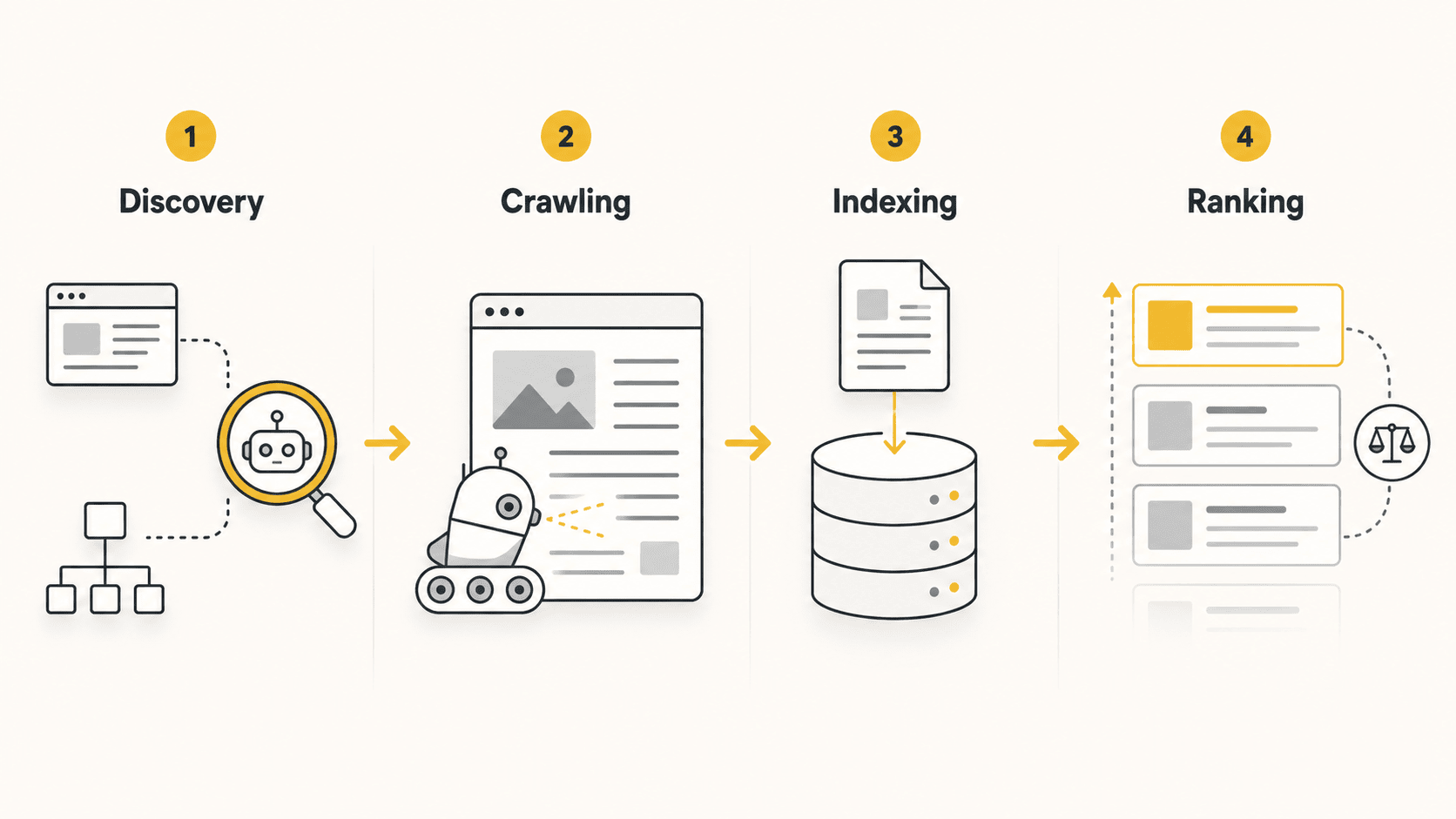
The clearest way to answer how SEO works is to follow a single page through the system.
Discovery means the search engine learns that the URL exists.
Crawling means it fetches the page and processes what is there.
Indexing means it decides the page is worth storing in the database it consults when someone searches.
Ranking means it compares that stored page against everything else that could answer a particular query, and puts the candidates in an order.
The stages run in sequence and each one depends on the one before it. A search engine cannot rank a page it never indexed. It cannot index a page it never crawled. It cannot crawl a URL it never discovered.
This is why “my page is not ranking” is not one problem. It is four possible problems with four different fixes, and the first job in any SEO project is to work out which stage the page is stuck at.
Understanding these stages helps businesses make better decisions and avoid spending money on activities that create little commercial value.
The rest of this article goes through each stage and its common failure, what search engines appear to evaluate once a page reaches the ranking stage, what SEO work actually consists of week to week, how long it realistically takes, and what SEO cannot do.
Stage 1: How search engines discover your pages
A search engine cannot rank a page it does not know exists.
Search engines discover new URLs in several ways. They may find a page through a link from another website, an internal link from an existing page, an XML sitemap, or a previous visit to the domain.
A sitemap can help provide search engines with a list of pages. However, submitting a sitemap does not guarantee that every page will be crawled, indexed, or ranked.
Discovery only means the search engine has found the URL.
This distinction is important. A business can publish hundreds of articles and still receive very little organic traffic. The pages exist, but the search engine may not yet consider them important, distinct, or valuable enough to prioritize.
The common failure at this stage is that nothing points to the page. It has no internal links from the rest of the site, no links from anywhere else, and it is missing from the sitemap. The page is reachable by anyone who already has the URL, and by nobody else.
These orphan pages are usually created by accident. A page is published outside the normal navigation. A landing page is built for a campaign and never linked. A section is removed from the menu but left on the server.
The fix at this stage is unglamorous and cheap. Link to the page from somewhere that already gets crawled, make sure it appears in the sitemap, and check that the URL in the sitemap is the URL you actually want indexed.
Stage 2: How crawling works
After discovering a URL, a search engine may send automated software to retrieve the page. This process is known as crawling.
Modern search crawlers can process HTML, follow links, load many forms of JavaScript, and analyze a page in ways that are more advanced than the simple web spider model described in older SEO guides.
Search engines still have limited resources. They cannot visit every page on the internet at the same frequency.
Large and frequently updated websites may be crawled often because search engines expect them to publish information that users want quickly. Smaller websites may be crawled less frequently, particularly when they are new or have limited external recognition.
Technical accessibility matters at this stage.
A crawler may have difficulty accessing a page if it is blocked, broken, hidden behind a login, redirected incorrectly, or dependent on technology that cannot be processed properly.
The common failures at this stage are mechanical, and they are the ones worth checking first because they are cheap to rule out. A rule in robots.txt disallows the path. The server answers with an error or a chain of redirects instead of the page. The content sits behind a login. The page depends on a script that never finishes, so the crawler sees an empty shell.
The reason to check these first is that they are binary. Either the crawler can retrieve the page or it cannot, and the answer is visible in a server log or in Google Search Console rather than a matter of opinion.
However, technical accessibility is only a basic requirement. A page that can be crawled has not automatically earned the right to rank.
Stage 3: How indexing works
Once a page has been crawled, the search engine decides whether to include it in its searchable index.
The index can be understood as a massive database of documents that may be used to answer search queries.
A page can be crawled without being indexed.
This may happen when the search engine considers the page duplicated, too similar to another page, low priority, or unnecessary for the current index.
For example, a business may create several pages that target nearly identical search terms. Even when each page works technically, the search engine may select only one version and ignore the others.
Indexing problems are therefore not always technical. Sometimes they reveal a strategic issue.
The website may have too many pages with weak differentiation. The topic may have little search demand. The site may not yet have enough authority to support a large volume of content.
The common failure at this stage is a judgement rather than an error. The search engine fetched the page, looked at it, and concluded that the index does not need it. Google Search Console reports this as “Crawled — currently not indexed”, and there is no error message attached because nothing broke.
That is an uncomfortable report to read, because there is nothing to repair. The honest interpretation is that the page did not give the search engine a reason to keep it, and publishing three more pages like it will not change that.
Stage 4: How search engines rank pages
When someone enters a search query, the search engine must decide which indexed pages deserve to appear.
This is the ranking stage.
Search engines use many systems and signals to estimate which results are most useful. These may include the meaning of the query, the topic of the page, links from other websites, location, freshness, usability, language, and the general reputation of the source.
SEO professionals often refer to these elements as ranking factors. The phrase can be misleading because it suggests that each factor works like a simple score.
Search ranking is contextual.
Freshness may be important for current news, software updates, prices, or changing regulations. It may be far less important for a historical definition that has remained stable for many years.
Location may be essential when someone searches for a nearby dentist. It may have little importance when someone searches for a general business concept.
This is why effective SEO cannot be reduced to one checklist.
The common failure at this stage is the least comfortable one. The page is discovered, crawled, indexed, eligible, and simply beaten. Other pages answer the query more completely, come from sources with more recognition, or match the intent behind the search more precisely.
Being outranked is not a fault. It is the normal condition for most pages most of the time, and it is the only one of the four failures that cannot be fixed by a settings change. It is fixed by making the page better than the pages currently above it, or by choosing a query where that is achievable.
SEO stages at a glance
| SEO stage | What the search engine does | Common problem | Typical SEO action |
|---|---|---|---|
| Discovery | Finds the URL | Search engine does not know the page exists | Improve internal links and sitemap coverage |
| Crawling | Retrieves and reads the page | Crawling is blocked or difficult | Fix technical access issues |
| Indexing | Decides whether to store the page | Page is duplicated, weak or unclear | Improve uniqueness, usefulness and site structure |
| Ranking | Compares the page with alternatives | Competitors match the search better | Improve relevance, content, authority and user value |
A simple example of how SEO works
Imagine a B2B cybersecurity company publishes a page explaining ransomware recovery for IT teams.
First, Google discovers the page through the website's internal links and sitemap. Next, it crawls the page and reads its accessible content. Then it decides whether the page is useful and distinct enough to include in the index.
Later, an IT manager searches for a ransomware recovery question. Google compares the indexed page with other relevant pages that could answer the same search. If the page provides a strong answer, demonstrates relevant expertise, works technically, and has enough authority to compete, it has a better chance of ranking.
SEO is the work that improves the company's chances at every step of this process.
What search engines actually evaluate
Nobody outside the search engines has the full list of what they evaluate. The people inside them work on systems and models rather than a single ordered list of factors, and the published documentation describes intentions more often than mechanics.
Anyone who hands you a numbered list of two hundred ranking factors has reconstructed it from patents, leaks, correlation studies, and experience. Some of it is probably right. None of it is authoritative, and that includes this article.
What can be said with reasonable confidence is that the evaluation clusters into a handful of areas.
Relevance is the first. The search engine is trying to work out whether the page addresses the meaning of the query, not just whether it repeats the words in it.
Quality signals are the second. Google publishes guidance describing the kind of content it wants to reward: content that is accurate, specific, written by someone with a reason to know the subject, and produced for readers rather than for search engines. Those are descriptions of intent, not a measurement you can read off a dashboard.
Usability is the third. Does the page load, work on a phone, and let the reader reach the answer without fighting the layout. This tends to matter most as a tiebreaker between pages that are otherwise close.
External recognition is the fourth. Links and mentions from credible, relevant sources are evidence that someone other than the business itself thinks the page or the company is worth pointing at.
Freshness is the fifth, and it is the clearest example of why weighting is contextual. It matters a great deal for news, prices, software versions, and regulations. It matters very little for a definition that has been stable for a decade.
Treat all of these as areas of evaluation rather than switches. Any specific claim about how much weight one of them carries should be treated with suspicion, because the weighting changes by query type, by market, and over time.
The practical consequence is straightforward. Make the page genuinely stronger on each of those axes, and stop looking for the number.
What does SEO include?
SEO is broader than keywords or content publishing. A practical SEO program combines several disciplines that reinforce each other: content and keyword strategy, on page optimization, technical SEO, off page authority, and ongoing measurement.
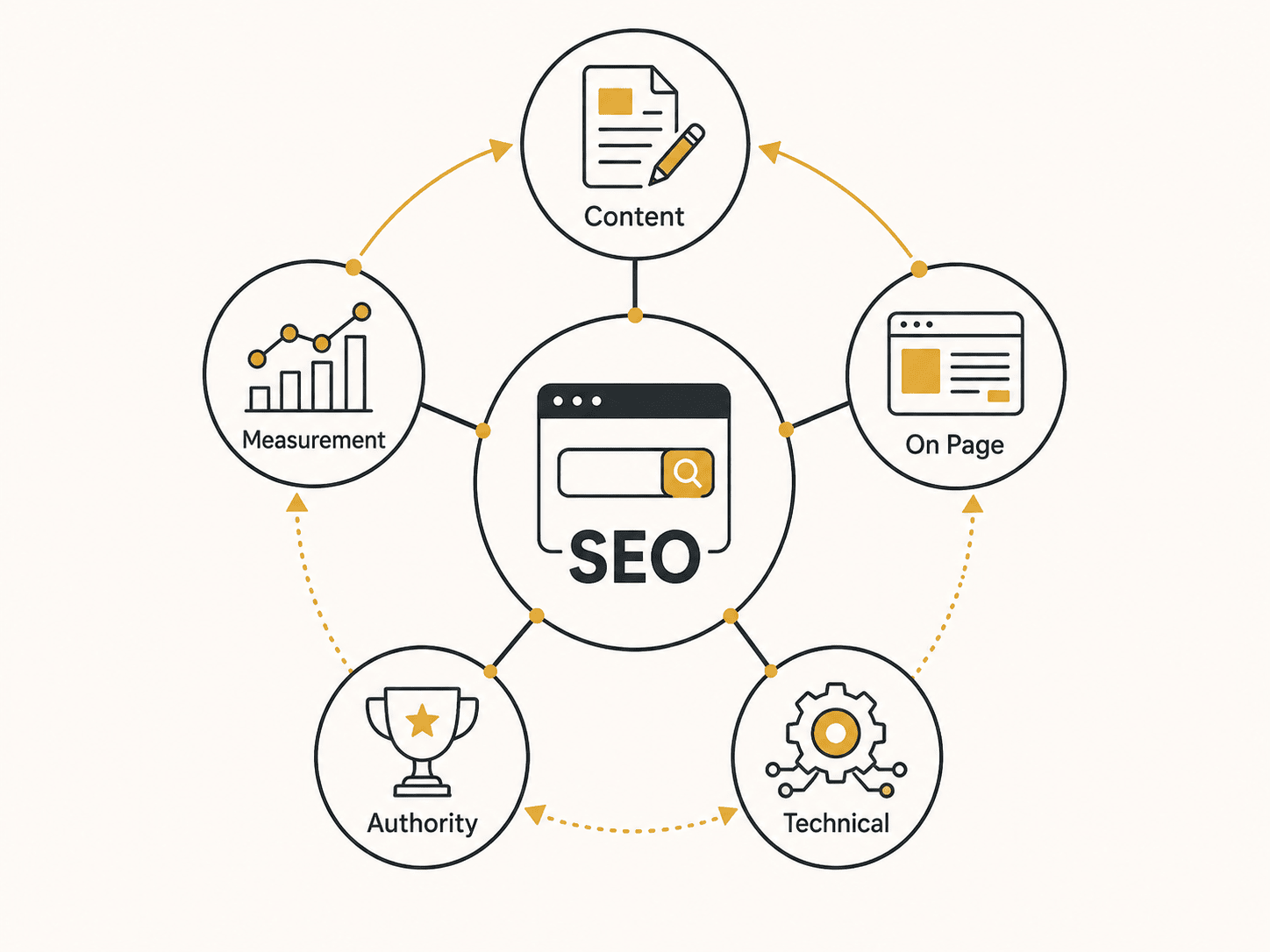
Keyword research identifies the language people use and the intent behind it. On page SEO improves the title, headings, structure, internal links and topic coverage of an individual page. Technical SEO keeps the site accessible and interpretable. Off page work builds the recognition that makes a source credible. Measurement in Google Search Console and analytics then answers the business question: does the organic traffic lead to useful actions?
Why keywords still matter
Keywords connect a page with the language people use when searching.
A keyword helps identify the question, need, or intention that a page should serve.
For example, someone searching for “how SEO works” is probably looking for an explanation. Someone searching for “SEO agency in Warsaw” may be looking for a provider. Someone searching for “SEO pricing” may be comparing costs.
All three searches relate to SEO, but they represent different needs and different stages of the customer journey.
A strong SEO strategy creates pages that match these intentions.
Keyword use does not mean repeating the same phrase again and again. Search engines can understand variations, synonyms, and related concepts.
The priority should be clarity. The page should clearly answer the question behind the search.
The role of content in SEO
Content gives search engines something to evaluate and gives users a reason to visit.
Useful content may explain a subject, answer a question, compare options, solve a problem, or help someone make a decision.
The common advice to “create great content” is too vague to guide a business.
Content must have a clear purpose. It should target a real need, provide a useful answer, and match the expectations of the searcher.
A long and beautifully written article may perform poorly if nobody searches for the topic. A shorter page may perform well if it answers a specific commercial question clearly.
There is no universal word count that guarantees rankings.
Some topics require a detailed guide. Other questions can be answered in a few paragraphs. The right length is the length needed to satisfy the reader without unnecessary repetition.
The role of links and authority
Links remain an important part of SEO.
A link can help a search engine discover a page. It can also act as a form of external recognition.
When trusted and relevant websites reference a business, the search engine receives evidence that the company has earned attention beyond its own claims.
Not every backlink has equal value.
A relevant mention from an industry publication may be more useful than hundreds of links from unrelated websites created only to manipulate rankings.
Authority can grow through real business activity. Public relations, partnerships, research, original data, events, useful resources, and strong customer relationships can all create reasons for other websites to mention a brand.
This is why SEO should not be separated from the wider marketing strategy.
The role of technical SEO
Technical SEO helps search engines access, process, and interpret a website.
It covers areas such as redirects, page status codes, canonical tags, internal links, site speed, mobile usability, navigation, and indexation controls.
Technical SEO is important because serious errors can prevent valuable pages from performing.
However, fixing technical issues does not automatically create demand, reputation, or authority.
A technically perfect website can remain invisible if it targets the wrong searches or has no competitive credibility. A technically imperfect site may still rank strongly when its content and reputation are highly valuable.
The practical goal is technical reliability.
What SEO work actually consists of
Stages and signals explain the theory. The work itself is more ordinary than that, and it falls into three streams that run in parallel rather than in sequence.
Technical work is recurring maintenance. Crawl the site with a tool and look at what the crawler saw. Check server responses. Repair redirect chains and broken internal links. Read robots.txt and confirm it still says what someone intended it to say three years ago. Review canonical tags. Read the indexing report. Check the site on a phone. Watch page speed. Very little of this is a project. Most of it is a habit.
Content work starts before any writing. Find out what people actually search for around the subject, decide which of those questions the business can answer with real credibility, and then write or rewrite the pages that answer them. It also includes the unpopular half of the job: updating pages that have gone stale, merging pages that duplicate each other, removing pages that should never have been published, and adding internal links so related pages point at each other.
Authority work is everything that gives another website a reason to mention you. Public relations, partnerships, original data, genuinely useful free resources, conference talks, customer stories, being available and quotable. It is the slowest stream and the one most often skipped, because it cannot be completed inside the website.
A realistic week in an SEO program looks like a few hours of technical review, some writing or editing, one or two conversations aimed at earning a mention, and a look at what changed in Search Console. It is not dramatic.
The balance between the three streams depends on the site. A new site with fifteen pages rarely has a technical problem worth solving and almost always has a content and authority problem. A large site that has been through three redesigns and two platform migrations usually has the opposite profile.
How long does SEO take to work?
There is no honest single number. There are, however, honest ranges, because parts of the process are mechanical and their timing is observable.
Getting a new page discovered and indexed on an established site usually takes days to a couple of weeks. On a new domain with no external links, it takes longer and is less certain, because the search engine has no history that suggests the site is worth revisiting often.
Movement on specific, low-competition queries often appears within a few weeks to a few months of publishing. These are the queries where a clear, direct answer can win without much external support.
Movement on competitive commercial queries normally takes several months and often longer. Those results are usually held by pages with years of accumulated recognition, and closing that gap depends on authority work rather than on publishing more pages faster.
Technical fixes are the exception to all of this. When a technical problem was the actual constraint, removing it can restore visibility quickly, because the pages were already capable of ranking and were being blocked. When the constraint was not technical, technical work changes nothing, however satisfying it feels.
The more useful question is usually not how long SEO takes but how long it takes to pay for itself, and that depends on the value of a customer rather than on the search engine. A business with a high value per client can justify the investment long before the traffic looks impressive.
As a working expectation for a small business starting from a low base: signs of movement in impressions within one to three months, meaningful clicks within three to six, and commercial results within six to twelve. If someone promises faster than that on competitive terms, ask exactly what they intend to do.
What SEO cannot do
SEO captures demand. It does not create it. If nobody is searching for what a business sells, no amount of optimization will manufacture the searches, and the honest answer in that situation is that the company needs a different channel rather than a better SEO agency.
SEO cannot rescue a weak offer. Traffic arriving on a page that does not convince anyone converts nobody, and the ranking simply makes the problem visible to more people.
SEO cannot guarantee a position. Nobody controls the ranking, including the people selling the service. A guaranteed first position is either an advertisement or a term nobody searches for.
SEO cannot be switched on and off without cost. Rankings decay when pages go stale, competitors improve, and the site stops being maintained. Stopping does not freeze the result in place.
SEO cannot fix a business problem that has nothing to do with search. Pricing, positioning, response times, and service quality all sit outside the search engine and all of them affect whether the traffic turns into anything.
SEO cannot directly control how AI assistants describe a company, although much of the same work influences it. The clarity, accuracy, and external recognition that help a page rank are also what those systems draw on.
How SEO supports business growth
Organic traffic is useful only when it contributes to a business objective.
A company should connect SEO activity with leads, sales, qualified enquiries, customer education, or brand visibility.
Traffic alone can be misleading.
Ten visitors who genuinely need your service may be more valuable than ten thousand visitors who have no connection to your offer.
This is why SEO measurement should include conversion rates, lead quality, search visibility, and revenue contribution.
Rankings are useful indicators. They are not the final business result.
The Mustard Seed SEO visibility chain
A useful way to think about SEO is to connect search visibility with the business outcome that comes after the ranking.
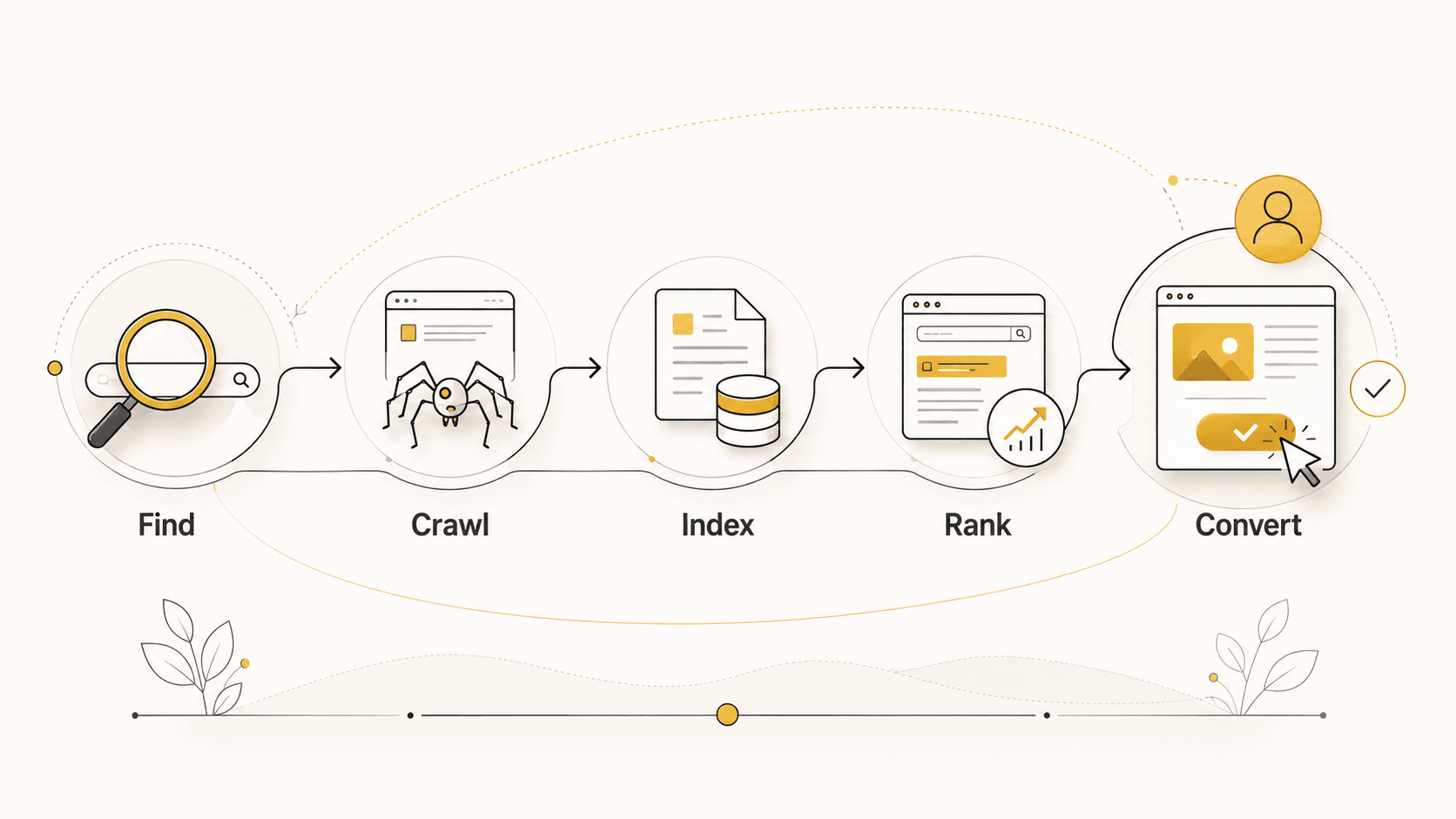
The chain runs Find, Crawl, Index, Rank, Convert. A page must first be discoverable and crawlable, then useful enough to be indexed, competitive enough to rank, and relevant enough to move the right visitor toward a business outcome. A failure at any stage can limit organic growth.
This is also why rankings should not be treated as the final KPI. A page that ranks but attracts the wrong audience, or fails to convert, still has a business problem.
SEO versus paid search
| SEO | Paid search |
|---|---|
| Earns organic visibility | Buys advertising visibility |
| Usually compounds over time | Stops when advertising spend stops |
| Requires content, technical work and authority | Requires campaign setup, targeting, bids and budget |
| Often takes time to build | Can create visibility quickly |
| Best treated as a long term growth asset | Best treated as a controllable acquisition channel |
Many businesses use both. Paid search can create immediate visibility while SEO builds a longer term organic asset.
A practical SEO process
A sensible SEO process begins with the customer.
Identify what potential customers search for, what problems they are trying to solve, and how your company can provide a credible answer.
Create pages around clear search intentions. Make those pages accessible and easy to navigate. Connect related content through internal links. Earn recognition from relevant external sources. Measure whether the resulting traffic produces meaningful action.
SEO is not a one time task. Search behaviour changes, competitors improve, websites grow, and business priorities evolve.
The strongest approach combines content, authority, technical reliability, and commercial understanding.
If you want how SEO works in a single sentence: a search engine has to find your page, fetch it, decide to keep it, and then judge it against the alternatives, and SEO is the work of removing the reason it fails at each of those four points.
That is how SEO actually works.