
When a payment processor freezes your funds, the fastest path back is documentation and escalation, not waiting. Gather proof your business and the flagged transaction are legitimate, push past the email-support loop through your account's phone or chat options, and plan your cash flow assuming the hold could run 120 days or longer.
One small business owner described the moment clearly: a normally quiet account processing a few hundred to a thousand dollars at a time suddenly ran a $3,300 charge because the primary card terminal was down. Stripe flagged it, and the funds were held for "at least 120 days" — with reports elsewhere of that window being extended another 30 days at a time, seemingly without a fixed end. The charge itself wasn't fraudulent. It was simply bigger than the account's normal pattern.
That gap — a real transaction treated as a risk signal purely because of its size — is the core fear behind every one of these stories. It's not that the money is gone. It's that it's stuck, with no clear process and no guaranteed date to get it back, while bills don't pause to wait. A payment processor freeze is one specific, common version of a broader category covered in our guide to platform risk for solopreneurs.
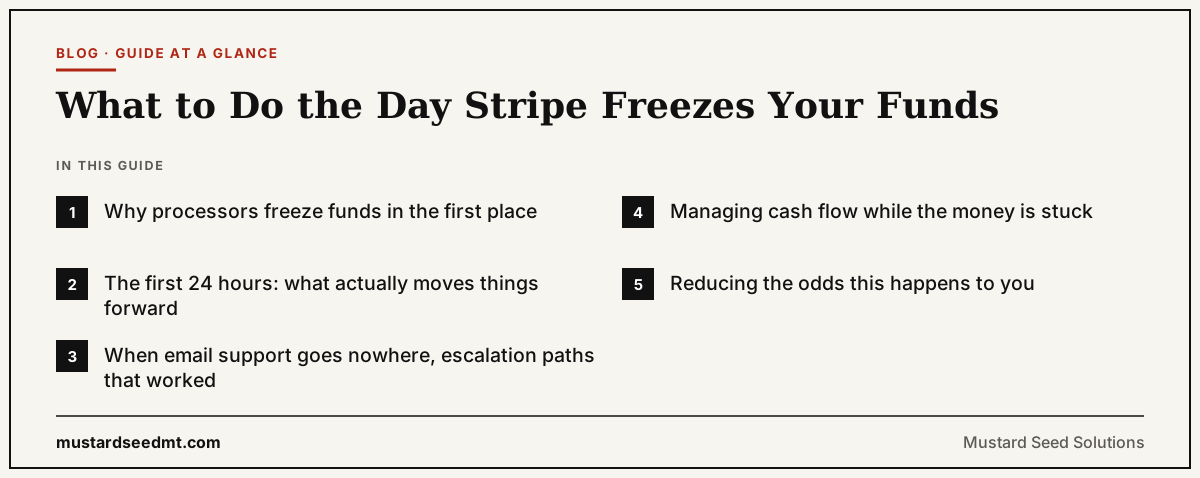
Why processors freeze funds in the first place
Processors like Stripe and PayPal use automated risk models that flag transactions or accounts that deviate from an established pattern: a transaction several times larger than normal, a sudden spike in volume, a chargeback on an account that otherwise ran clean for years, or a business operating outside the category it originally registered under. One account described a seasonal business that does the bulk of its revenue in a five-month stretch each year getting flagged as suspicious the moment sales ramped up — even though the same seasonal pattern had repeated for years.
The frustrating part, described consistently across accounts, is that the process afterward often doesn't resemble a normal dispute process. Multiple people described an email-only support loop with no phone number listed, responses from a different "agent" each time with no memory of the prior conversation, and no ticket number tracking the case at all. One reply to the account above described an eight-year, $30,000-a-month business hit with a similar hold after a single chargeback, with the processor wanting to hold 20% of volume indefinitely — a business owner with years of clean history treated the same as a brand-new, unproven account.
This is the part that's genuinely frightening rather than just inconvenient: it isn't a late payment you're chasing from a slow client, where you at least know who owes you and roughly why. It's your own revenue, already earned, held by a company that in several of these accounts wouldn't confirm a release date, wouldn't put a person on the phone, and reserved the right to extend the hold again. For a solopreneur without a large cash cushion, that uncertainty is often scarier than the dollar amount itself.
The first 24 hours: what actually moves things forward
Based on the accounts that eventually got resolution, the immediate steps worth taking are concrete rather than emotional, even though the situation is genuinely stressful:
- Pull together your business formation documents — articles of organization, EIN letter, a sales tax certificate or certificate of good standing — before support even asks for them.
- Gather proof tied to the specific flagged transaction: signed receipts, delivery confirmation, invoices, and bank statements showing the funds' origin and destination.
- Log into your account directly and look for a callback option inside the help or contact flow — several users found a "have us call you" feature buried there that produced a response in minutes, in contrast to email replies that took weeks.
- Write down every date, every document sent, and every response received. Accounts that eventually resolved a hold consistently had this kind of paper trail when a real human finally engaged.
When email support goes nowhere, escalation paths that worked
A recurring theme across these accounts is that public visibility, not another support ticket, is what finally got a response. One user was advised to post on a technology forum where staff from the company are known to read and occasionally respond directly. Another pointed to filing a complaint with the Consumer Financial Protection Bureau as a formal channel that carries more weight than an email thread. Others suggested reaching out through the company's public social channels, on the theory that a visible complaint becomes an "executive problem" faster than a quiet one.
None of these routes are guaranteed, and some resolutions in these accounts still took weeks even after escalating. But every account describing a resolution involved stepping outside the standard support queue at some point — not simply waiting for the next templated reply.
It's also worth being honest about the accounts that didn't resolve cleanly. One person described paying for experienced legal help to reach the processor's legal team directly, and still waited three weeks for a reply that mostly restated the terms of service. Escalation improves your odds of a faster, more attentive response — it doesn't guarantee the outcome you want, and it doesn't replace planning your cash flow as if the funds might genuinely be gone for the full length of the hold.
Managing cash flow while the money is stuck
While a hold is active, treat the frozen balance as unavailable for planning purposes entirely, rather than money you're "waiting on." One person described losing access to over $50,000 with no warning and said it left the business "dead in the water for days" — the operational disruption, not just the dollar amount, was what did the damage. If you have a backup processor, a bank merchant account, or even a simple invoice-and-wire option for larger clients, activating it immediately keeps revenue moving in parallel while the frozen funds are contested.
Reducing the odds this happens to you
A few patterns from these accounts point to lower-risk habits: keep your stated business category accurate as your business evolves, avoid running one-off transactions well outside your typical size without a heads-up to support first, and don't rely on a single processor as your only way to get paid. One commenter noted that a business processing a one-off charge for a completely different category than what it registered for — the classic example being a phone store suddenly running a large charge tied to something outside phones — is one of the more common, avoidable triggers for a hold, distinct from ordinary size-based flags.
None of this eliminates the risk entirely — several accounts describe holds hitting accounts that had operated cleanly for years with no category or size anomaly at all — but it reduces how catastrophic a single frozen account becomes to your business. The businesses that recovered fastest in these accounts were the ones that already had a second way to get paid before the freeze happened, not the ones that started looking for one after.
A frozen payout is stressful precisely because it feels personal — like the platform has decided something about you rather than about a pattern in the data. Treating it as a process to work methodically, rather than a verdict to react to emotionally, is what separates the accounts that got their money back in weeks from the ones still waiting months later.
Platform risk isn't limited to payment processors — it shows up anywhere a single vendor or platform sits between you and your revenue. For the wider pattern, see The 50 Biggest Solopreneur Challenges.