
Platform Risk: Processors, Reviews, and Dependency
Platform risk is depending on a company you don't control — a payment processor, a review site, or a marketplace — for income you can't replace overnight. This guide covers what actually happens during a Stripe or PayPal freeze, how to respond, how to protect against review-based attacks, and how to diversify so no single platform can shut you down.
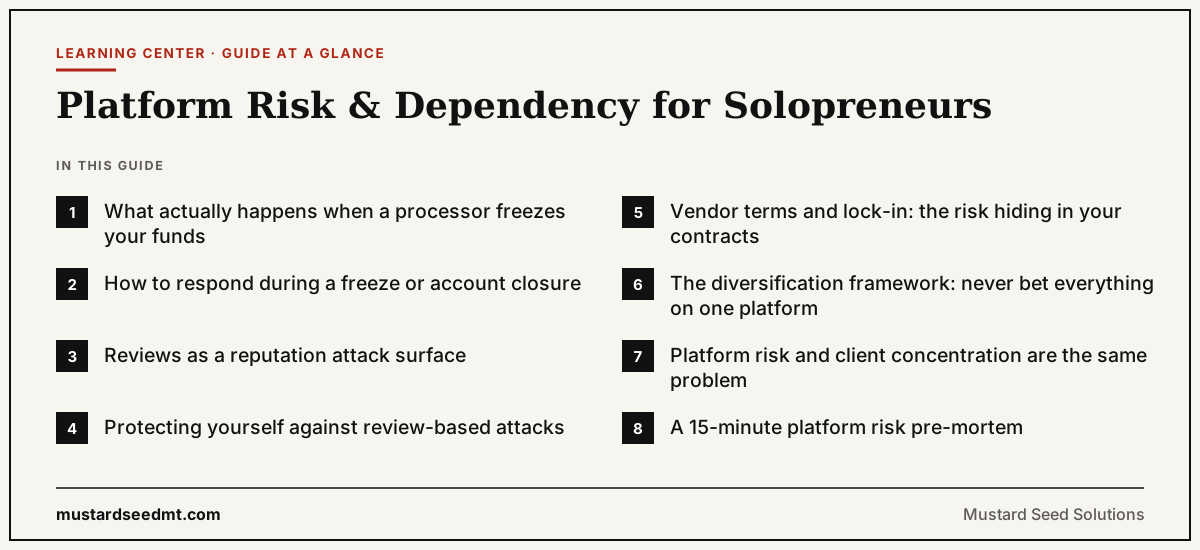
None of this is theoretical. It's drawn from solopreneurs and small business owners describing what actually happened when a processor froze their account, a review disappeared, a single client turned out to be too much of their revenue, or a vendor's fine print quietly worked against them. The pattern repeats often enough — across payments, reviews, marketplaces, and even print suppliers and job boards — that it's worth planning for before it happens to you, not after. Our research into the 50 biggest solopreneur challenges found dependency risk showing up again and again, under different names, in almost every category of solopreneur complaint.
1. What actually happens when a processor freezes your funds
Payment processors can flag a single transaction and hold your money with little explanation. Solopreneurs who have lived through it describe a strikingly consistent pattern, whether the processor is Stripe, PayPal, or Square.
- A large, unusual, or seasonal transaction can trigger an automatic reserve hold — one small merchant had funds held "at least 120 days" after a single $3,300 charge flagged as an outlier, with no clear process offered to resolve it
- Support is frequently email-only, with different named agents giving contradictory answers in the same thread — several affected owners describe the company's phone support as effectively unreachable
- Reserve holds can extend past their original window — some businesses report a hold rolling forward another 30 days at a time, seemingly without limit, on top of the original hold period
- Full account closure can happen with zero warning, even after years of clean processing history — one two-year-old business had its account deactivated mid-Saturday with funds frozen for months, citing only vague "security concerns" and a reference to sections of a terms-of-service document
- The justification given is often generic and unappealable — "our decision to deactivate your account is final," with no specific reason beyond a reference to the general agreement you accepted when you signed up
2. How to respond during a freeze or account closure
There's no guaranteed fix once a hold hits, but solopreneurs who've been through it — more than once, in several cases — describe a few moves that actually help, and a few reflexes that waste time.
- Have a second processor and a separate operating bank account ready before you need them — one business owner's advice after being burned twice: "find a smaller processor" and don't run your banking through the same company that processes your payments
- Document everything up front — signed contracts, ID verification, photos — even though thorough documentation still isn't a guarantee a dispute or freeze gets resolved in your favor; one auto-glass business owner had signed receipts, a matching ID, and security footage of the customer in-shop, and still lost a chargeback dispute
- Escalating outside the standard support queue sometimes works better than tickets do — affected business owners have had traction posting on public forums, reaching support through LinkedIn, or going through channels where company employees are known to actually read and respond
- For US-regulated processors, a complaint to the Consumer Financial Protection Bureau creates a formal, timestamped record, separate from the company's own support process — one commenter noted the company redirects its own complaint volume away from that channel, which is itself a signal of how much it matters
- Never treat a processor's balance as your savings account — a freeze only becomes a bankruptcy risk when it's also where your cash reserve lives; several owners describe realizing this only after the freeze had already happened
3. Reviews as a reputation attack surface
A review platform doesn't have to be malicious for it to become a liability — but sometimes it is. Solopreneurs describe both organic disputes and outright manipulation, sometimes from the same platform in the same week.
- A single unhappy client can leave a public review with far more reach and permanence than the underlying disagreement — one freelance developer got a 1-star review from a client after starting to bill for scope-creep work that had ballooned to roughly $600 in unpaid extras across a series of "quick" favors
- Some review platforms have been described as pulling five-star reviews within a day of a business declining a paid advertising pitch, and later restoring visibility once the business relented — a pattern multiple, unrelated business owners describe independently across different industries
- Purchased or manufactured reviews are common enough that business owners openly debate the tactic in public forums — some frame it as leveling the playing field against fake negative reviews, others point out that templated-sounding reviews are easy for real customers to spot and can backfire on trust
- You generally can't get a sincerely-written negative review removed — your leverage is almost always limited to a public response, not deletion, no matter how unreasonable the review feels
- Aggressive, high-pressure sales calls sometimes accompany the review relationship itself — several owners describe being pressured for 30–45 minutes on a single call, with the reviewer explicitly told repeated cancellation windows that later don't hold
4. Protecting yourself against review-based attacks
You can't prevent every bad review, but you can control how much damage one does — and avoid handing a platform leverage over you in the first place.
- Reply calmly and factually, and write the response for future readers, not the reviewer — a clear, professional account of a scope dispute reads very differently to a prospective client than silence does
- Get scope and pricing in writing before the relationship starts, so a dispute over "extra" work has a paper trail behind it rather than becoming a he-said-she-said review
- Don't build your online reputation on one platform — spread genuine reviews across Google Business Profile, industry-specific directories, and your own site so no single algorithm or sales team controls your visibility
- Treat any unsolicited call demanding payment to "protect" your listing, remove bad reviews, or avoid an audit as a pressure tactic, not a bill you're obligated to pay — hanging up costs you nothing
- Claim your own profiles proactively on the platforms that matter for your business, rather than waiting for a platform's sales team to "help" you claim them — several owners trace their worst experiences back to a cold call that arrived the day after they set up a listing themselves
5. Vendor terms and lock-in: the risk hiding in your contracts
Platform risk isn't only payments and reviews — it's also the fine print of every tool a solo business depends on, from your domain registrar to the print shop that makes your merchandise.
- Read the content-license terms before uploading your logo or designs to a print-on-demand or merchandise vendor — one business owner found a supplier's terms granted a broad, sublicensable right to reuse submitted artwork "in any media... currently available or developed later," a clause customers found only because they checked before ordering
- Domain and hosting providers can raise renewal prices sharply with little notice, add services you never requested, and make cancellation or refunds deliberately hard to reach — one business owner described charges climbing over 50% year-over-year with no warning and unresponsive support
- Job-posting and lead-generation platforms sometimes use a "pay first, terms later" flow — a boosted-visibility fee charged before the real subscription terms are disclosed on the next screen is a pattern business owners have had to dispute through their card issuer rather than get refunded directly
- Equipment financing and "lease-to-own" offers can quote one rate verbally and deliver a materially higher one in the final paperwork, structured as a lease specifically so the lender isn't required to disclose an APR the way a standard loan would be
- None of these is a payment freeze or a bad review, but all of them are the same category of risk: a contract you didn't read closely enough, with a company that has no obligation to warn you before it uses the terms against you
6. The diversification framework: never bet everything on one platform
Payment freezes, review manipulation, and one-sided vendor terms are all faces of the same underlying problem: depending entirely on something you don't control for income, discovery, reputation, or the tools you build on.
- Payments: keep at least one backup processor and a separate bank account for your cash reserve — never let all revenue and all savings pass through the same company
- Discovery: don't let one review site, one marketplace, or one algorithm decide whether new clients can find you — invest in an owned channel (your own site, a direct client list) that no platform can take away
- Clients: the same concentration risk shows up here too — one software agency lost roughly 40% of its annual revenue when its single largest client churned after a public complaint the agency missed, a reminder that over-reliance on any single relationship is the same vulnerability wearing a different hat
- Vendors: before you depend on any tool — a print supplier, a registrar, a job board — skim its terms of service for content-licensing, auto-renewal, and cancellation clauses, the same way you'd check a contract before signing it
- For every core function of your business, ask: "if this disappeared tomorrow, what would I actually do?" — if the honest answer is "I don't know," that's the gap to close first
The uncomfortable truth about platform risk: you usually can't see it until the platform changes its mind. The businesses that recover fastest from a freeze, a review attack, or a lost client aren't the ones who avoided it entirely — they're the ones who already had a second option in place.
Platform risk and client concentration are the same problem
Whether it's a payment processor, a review algorithm, or a single client covering a large share of your revenue, the exposure is identical: something you don't control could change tomorrow, and your business would feel it immediately. Client concentration is the version of platform risk that hides inside your own revenue report, rather than in a company you can point to, which is exactly why it's easy to underestimate — there's no processor notice or review-site email to make it visible. It's worth measuring directly rather than guessing.
How exposed is your revenue to one client? The Client Concentration Calculator shows what share of your income sits with your largest client or platform, so you can see the same dependency risk this guide covers — but in your own numbers.
Client Concentration CalculatorA 15-minute platform risk pre-mortem
Most of the stories above weren't visible as risks until the day they became crises. A short, honest exercise — for each core function of your business, name the single point of failure and your actual backup — surfaces the gaps while they're still cheap to close.
Payments
One processor holds 100% of revenue and your operating cash
Set up (and actually test) a second processor; keep savings in a separate bank account
Discovery
New clients only find you through one review site or marketplace
Build an owned channel — your own site, a direct list — that isn't rented from a platform
Clients
One client accounts for a large share of annual revenue
Track concentration directly and actively grow the next 2–3 accounts
Vendors
A core tool's terms of service were never actually read
Skim licensing, auto-renewal, and cancellation clauses before you depend on it
Frequently Asked Questions
What should I do if Stripe or PayPal freezes my funds?
Start by requesting the specific documentation they need in writing, and keep every response — solopreneurs who've been through it note that different support agents in the same thread sometimes give contradictory instructions, so a written record protects you either way. In parallel, contact your bank about a bridge or line of credit so a hold doesn't become a cash-flow crisis, and consider escalating through public channels or a regulator complaint if support tickets go nowhere. Longer term, keep a second processor set up and ready so a freeze doesn't stop you from getting paid at all.
How long can a payment processor hold my money?
It varies by processor and by why the hold was triggered, but solopreneurs have reported holds of well over 100 days, sometimes extended in additional increments rather than released on a fixed date. There's no universal timeline — which is exactly why having a backup processor matters more than knowing the "typical" hold length.
How do I respond to a fake or unfair negative review?
Respond factually and professionally, and write it for the next reader rather than to win an argument with the reviewer. If the review violates a platform's actual policies (fake account, unrelated business, harassment), report it through the platform's formal dispute process rather than negotiating informally.
Should I ever pay a review site to remove negative reviews?
No. Legitimate review platforms don't sell review removal, and unsolicited calls offering to "fix" your listing for a fee are a recognized pressure pattern, not a real service — business owners describe reviews disappearing and reappearing depending on whether they agreed to pay for advertising.
What is client concentration risk, and how does it relate to platform risk?
Both are the same underlying vulnerability: depending too heavily on one thing you don't fully control — whether that's a payment processor, a review algorithm, or a single client who makes up a large share of revenue. If any one of them changed its mind tomorrow, the diversification question is the same: what's your second option?
How many payment processors should a solopreneur use?
At minimum, one primary and one backup that you've actually set up and tested — not just bookmarked. The value isn't in splitting volume between them day to day; it's in having a working alternative ready the moment your primary processor flags, holds, or closes your account.
Is there a way to fully protect my business from being deplatformed?
Not completely — but you can shrink the blast radius. Own a channel a platform can't take from you (your website, your email list, direct client relationships), keep operating cash separate from any processor balance, and avoid concentrating discovery, payments, or revenue in a single dependency.
How do I know if a vendor's terms of service put my business at risk?
Before you depend on any vendor — a print supplier, a domain registrar, a job board — skim its terms for three things: whether it claims broad rights to reuse content you upload, whether pricing can change or auto-renew without clear notice, and how hard cancellation actually is in practice. None of these show up until you look, and by then some business owners have already paid for the lesson.
Related resources
Reduce your dependency risk
Want a marketing plan that doesn't rely on one platform?
Mustard Seed Solutions helps solopreneurs build owned distribution — a real website, content, and visibility strategy — so no single platform decides whether clients can find you.
Book a consultation