
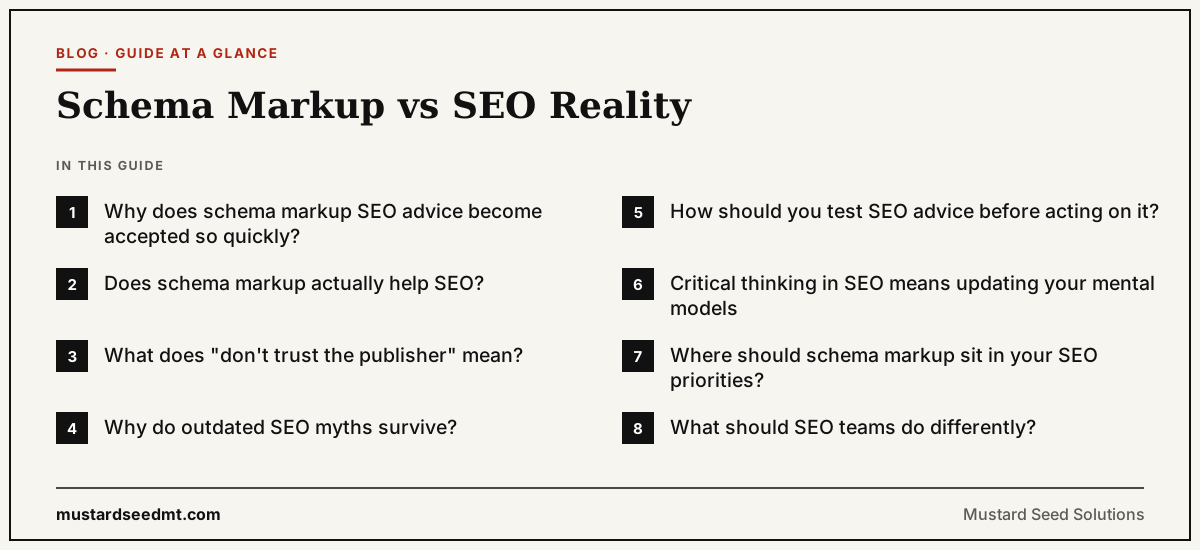
Schema markup SEO advice often jumps from a reasonable statement to a much bigger claim. Structured data can give search engines explicit information about a page and can make pages eligible for certain rich results, but that does not automatically mean adding more schema will improve organic rankings. Google's own documentation describes structured data in terms of page understanding and search appearance, while the episode behind this discussion challenges the widespread habit of treating schema as a ranking strategy.
This distinction matters because SEO has a repetition problem. One person publishes a recommendation, ten people repeat it, an agency turns it into a checklist, and eventually the tactic becomes accepted as something every website "must" do.
Schema is a useful example because it goes beyond structured data and into how marketers decide what to believe.
Why does schema markup SEO advice become accepted so quickly?
SEO advice becomes accepted when repetition is mistaken for evidence. A tactic can sound technically plausible, appear in enough audit templates, and slowly become part of the industry's standard operating procedure without anyone stopping to ask what result it actually changes.
The public summary of David Quaid's argument is deliberately provocative: tribal thinking, outdated myths, conflicting advice, and excessive confidence in technical controls. Schema is used as the example because it exposes how easily SEOs can move from "Google can use this information" to "this will improve rankings." These are two different claims.
This is where critical thinking starts. Before accepting a tactic, define exactly what outcome is being promised.
Does schema markup actually help SEO?
Yes, schema can help with specific search features and machine readable context. Google says structured data provides explicit clues about a page and can make content eligible for richer search experiences. But "helps SEO" is too vague to guide a strategy.
A better set of questions would be:
- Does it improve rankings?
- Does it create eligibility for a useful rich result?
- Does it improve how an entity or page is represented?
- Does it change click behavior?
- Does the target search feature even exist for this content type?
Once you separate those outcomes, the conversation becomes much more useful.
| Question | Weak assumption | Better interpretation |
|---|---|---|
| Why add schema? | More markup means better SEO | Add it for a defined use case |
| Ranking impact | Schema should raise positions | Ranking impact must be demonstrated |
| Search appearance | Rich results are guaranteed | Eligibility does not guarantee display |
| Content quality | Markup can compensate for weak pages | Markup describes what is already there |
| Implementation | Every schema type adds value | Relevance matters more than volume |
The point is not to remove schema from every site. The point is to stop assigning it benefits that have not been demonstrated.
What does "don't trust the publisher" mean?
The episode's public framing uses the idea of Google's "don't trust the publisher" doctrine. The phrase is useful as a mental model: a publisher has an obvious incentive to describe itself, its products, and its content in the most favorable possible way. Picture a business adding structured data that effectively says:
- We are an expert.
- This is the best product.
- This person is authoritative.
- This page deserves visibility.
Why should a search engine accept those claims purely because the publisher placed them in JSON-LD?
That question exposes the weakness in a lot of schema thinking. Publisher supplied markup can provide structured information, but self description and independent validation are different things.
For SEO strategy, that pushes attention toward harder questions about authority, external references, links, reputation, relevance, and whether other signals support what the website says about itself.
Why do outdated SEO myths survive?
They survive because the SEO industry rewards certainty.
"Add this and rankings improve" is easier to sell than "the effect depends on the query, site, competitive environment, search feature, authority, and implementation."
The first version becomes a checklist. The second requires judgment.
There is also a natural tendency for teams to preserve tactics that are easy to measure as completed work. An agency can report that 200 pages received schema markup. A developer can close a ticket. A dashboard can show a green check.
Proving that the work created meaningful business value is harder.
That creates an uncomfortable possibility: some SEO activity survives because it is easy to deliver, not because it deserves priority.
How should you test SEO advice before acting on it?
A better process starts by slowing down before implementation. When someone says a technical change is "good for SEO," ask what the mechanism is supposed to be and what evidence would change your mind.
Use these questions:
- What exact outcome is being claimed? Rankings, indexing, rich results, traffic, conversions, or something else?
- What is the source of the claim? Official documentation, a controlled test, correlation, anecdote, or repetition?
- Could another variable explain the result? Authority, links, content changes, internal linking, or demand may have changed too.
- Does the tactic apply to this site? A valid technique can still be irrelevant to your page type or business.
- What is the opportunity cost? Time spent on low impact technical work cannot also be spent on content, distribution, research, or authority building.
- What result would make us stop? A serious test needs a condition for rejecting the assumption.
This habit is especially important for small businesses. You rarely have unlimited development time, content budget, or patience. Priority matters more than the size of the checklist.
Critical thinking in SEO means updating your mental models
SEO mental models age.
Search systems change. Search features disappear. Documentation changes. A tactic that mattered in one environment may become less important in another. A recommendation that was valid for an ecommerce site may be useless for a consultant with a 30 page website.
The public episode summary explicitly raises the need to update mental models and questions the illusion of technical control. That is the bigger lesson.
A good SEO should be able to say, "I used to believe this, but the evidence no longer supports the same level of confidence."
That is a strength. Refusing to update a belief because it is part of your service package is the real problem.
Where should schema markup sit in your SEO priorities?
Schema should sit where its expected benefit justifies its cost.
When a relevant structured data implementation supports a real search feature or clarifies important page information, it can be sensible work. Google maintains extensive documentation for supported structured data features, which is a stronger starting point than adding markup simply because an audit tool recommends it. A small business should be cautious about polishing increasingly complex markup while fundamental problems remain unresolved.
If the page does not satisfy search intent, the offer is unclear, the site lacks useful content, nobody references the business, and important pages are poorly connected, another schema property may be a distraction.
Technical correctness matters. Priority matters more.
What should SEO teams do differently?
SEO teams should separate implementation from belief.
The person recommending a tactic should be able to explain the expected outcome. The developer should understand why the change matters. The content team should know whether the issue is genuinely technical or whether the page itself needs improvement.
This also makes collaboration easier. Instead of sending development a long list of vaguely justified "SEO requirements," teams can discuss hypotheses, expected impact, effort, and evidence.
That is a healthier way to work because it allows technical teams to challenge SEO assumptions without being treated as blockers.
Schema is the example, not the whole argument
The most useful takeaway from the schema debate is not "schema is useless."
That would simply replace one absolute belief with another.
The stronger takeaway is that SEO advice deserves interrogation. Ask what is known, what is inferred, what is merely repeated, and what the tactic is expected to change for your specific website.
This mindset also matters beyond traditional SEO. As marketers move into AI visibility, GEO, and AEO, new myths are already forming around what AI systems supposedly read, trust, cite, or reward.
The same discipline applies: question the claim before building a strategy around it.