
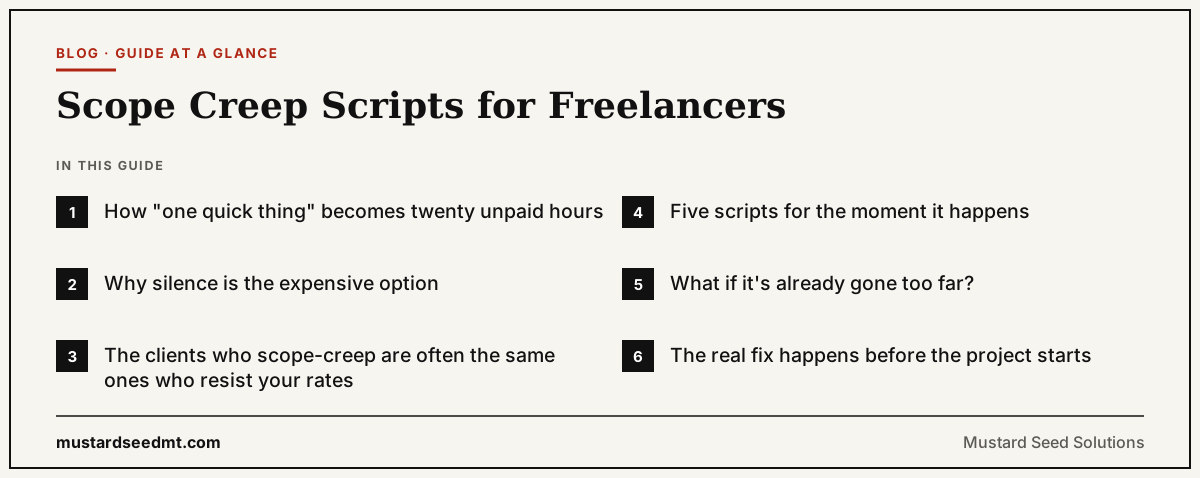
When a client's "quick favor" becomes the fifth unpaid request this month, the fix isn't a lecture on scope — it's a short, specific script that names the extra work, states the cost, and offers a clear choice. The examples below are drawn from real solopreneur stories about goodwill quietly turning into unpaid hours.
Scope creep rarely looks like one dramatic overreach. It looks like a string of small, reasonable-sounding requests — add this button, tweak that color, just one more revision — each easy to say yes to on its own, and easy to lose track of until the unpaid hours add up to real money.
It's common enough that it deserves its own playbook, which is why we cover the broader pattern in our guide to handling difficult clients — the version below focuses specifically on scope and the language that keeps it from getting out of hand.
How "one quick thing" becomes twenty unpaid hours
One web developer's story on r/smallbusiness laid out the pattern almost exactly. A restaurant owner signed a contract for a simple site — a menu, hours, a contact form, around ten pages — for $2,500. The first month went smoothly. Then the "quick questions" started: a reservations button, a downloadable PDF menu, a small header animation. Each one was framed as trivial, so each one got a yes.
By the second month, the developer sat down and added it up: roughly 12 hours of extra work, worth around $600 at their normal rate, given away for free. When they explained — politely, with a relationship discount offered — that future changes would be billed hourly, the client felt blindsided. He accused them of "nickel and diming" him and left a one-star review saying he'd been hit with hidden fees.
The developer's own read on it afterward was telling: the client likely wasn't being malicious. In his mind, he'd hired someone to "do his website," and the website wasn't done until he said it was. The mismatch wasn't dishonesty — it was two different definitions of "done" that were never made explicit.
Why silence is the expensive option
A second story, also from a freelance web developer, showed what happens when the same pattern goes unaddressed for longer. A referral from a trusted anchor client turned into a project with constantly shifting requirements, daily-update demands, and a stream of unpaid revisions. The developer absorbed two months of it rather than raise the issue early, hoping it would settle down.
It didn't, and when the developer finally ended the engagement, the fallout reached the original client too — who felt blindsided rather than informed, and cooled the relationship entirely. Readers who weighed in on the thread converged on the same point: the real mistake wasn't ending a bad-fit project. It was letting the drift go undocumented and unspoken for two months, so that ending it looked sudden from the outside.
The lesson generalizes past referrals. Scope creep is rarely fatal in the moment it happens. It becomes fatal when it accumulates in silence and then surfaces all at once, at which point every party involved feels ambushed by a story they were never told along the way.
The clients who scope-creep are often the same ones who resist your rates
A separate story — a solo marketing operator who raised prices 40% after years of undercharging — offers an indirect but useful data point. After the increase, seven of twenty-two clients left immediately. Those who left were, in the owner's own words, disproportionately "the ones who haggled on everything and sent the most revision requests." Workload dropped by about a third; revenue went up anyway.
Commenters on a related thread about dropping "just to be nice" discounts made the same observation from a different angle: clients who push hardest for a free favor tend to be the same ones who turn out to be the most demanding overall. Scope creep and price resistance aren't two separate problems — they're frequently the same client, showing up in two different forms.
Five scripts for the moment it happens
None of these require confrontation. They just name the boundary out loud, in writing, before the tally gets large enough to feel personal.
1. The first "quick ask" of a project (set the frame early):
"Happy to take a look — quick note so we're on the same page: this one's outside what we scoped, so I'll treat it as a small add-on rather than a revision. I'll confirm the time before I start."
2. The second request in a short window (name the pattern):
"I want to flag something before it becomes a bigger deal later: this is the second request this week that falls outside the original scope. I'm glad to do both — just want us to agree on how they're billed so there's no surprise at the end."
3. The retroactive tally (when you realize hours have already gone unpaid):
"I went back through the requests from the last few weeks and counted about [X] hours outside our original scope. I should have flagged these as they came in — going forward I'll note it in the moment, and for this batch I'd like to bill at [rate], with a one-time discount for the delay in mentioning it."
4. The proactive kickoff line (prevent it before it starts):
"One thing I like to set expectations on up front: the scope covers [X]. Anything outside that — new pages, added features, extra rounds of revision — I'll quote separately before starting, so there's never a surprise on either side."
5. The public reply to a review after holding your line:
"Thanks for the feedback. For anyone reading this: the project was delivered on time and within the agreed scope outlined in our contract. Requests after delivery were treated as additional work and quoted in advance before any billing changed."
Writing these from scratch under pressure is exactly where most solopreneurs lose the thread — which is why we built a scope creep email generator: describe the situation, and it drafts the message for you in a calm, professional tone before the conversation turns into a bad review.
What if it's already gone too far?
Not every scope-creep conversation happens early. Sometimes, like the developer in the restaurant story, you realize the drift only after tallying weeks or months of extra hours. In that situation, the goal isn't to relitigate every past request — it's to draw the line clearly from this point forward while acknowledging what already happened without apologizing for charging fairly.
One approach that shows up in these stories is itemizing the gap the way you would an invoice: list what was in the original scope, list what came after, and put a number on the difference. The developer who lost a client over exactly this said the hardest part wasn't the client's reaction — it was realizing how much he'd given away only after adding it up, at which point raising it felt like changing the rules mid-project rather than simply enforcing the ones already agreed to. Several other freelancers reading that story said the same thing: they hadn't tracked "quick" requests either, and wished they'd started the day the first one arrived.
That's the real value of a documented tally, even a rough one. It turns an emotionally loaded conversation about being "nickel and dimed" into a factual one about hours worked versus hours billed — a distinction that's much harder for a client to argue with, even an unhappy one.
The real fix happens before the project starts
Every story above traces back to the same gap: a scope that was clear enough to sign but never explicit about what happens when a client asks for more. A short clause defining what counts as a revision versus new work — and what extra work costs — removes most of these conversations before they exist.
Short of that, the habit that shows up again and again in these stories is simple: track requests as they happen, and say something the second time, not the fifth. The developer who ended up with a one-star review put it plainly afterward — by the time he realized how much he'd given away, bringing it up felt like changing the rules mid-game. Tracking as you go changes that entirely.