Charging less doesn't win better customers — it wins pickier, slower-paying, more demanding ones. That exact pattern showed up again and again across small business and solopreneur discussions: underpriced work consistently attracted clients who negotiated hardest, needed the most hand-holding, and paid last. Raising prices didn't shrink these businesses. It filtered out the clients causing the most damage.
One post that resonated with hundreds of small business owners argued exactly this: undercutting your own prices doesn't build a bigger customer base, it just changes who shows up, and rarely for the better. Nearly 180 replies piled on with the same story from completely different industries — retail, home services, freelance creative work, consulting. The recurring theme was that customers who negotiate hardest on price are disproportionately the ones who cause the most friction afterward.
None of this is theoretical. Two specific stories from that discussion, and the ones that followed it, spell out exactly what happens when a solopreneur raises prices instead of holding them down to keep clients happy.
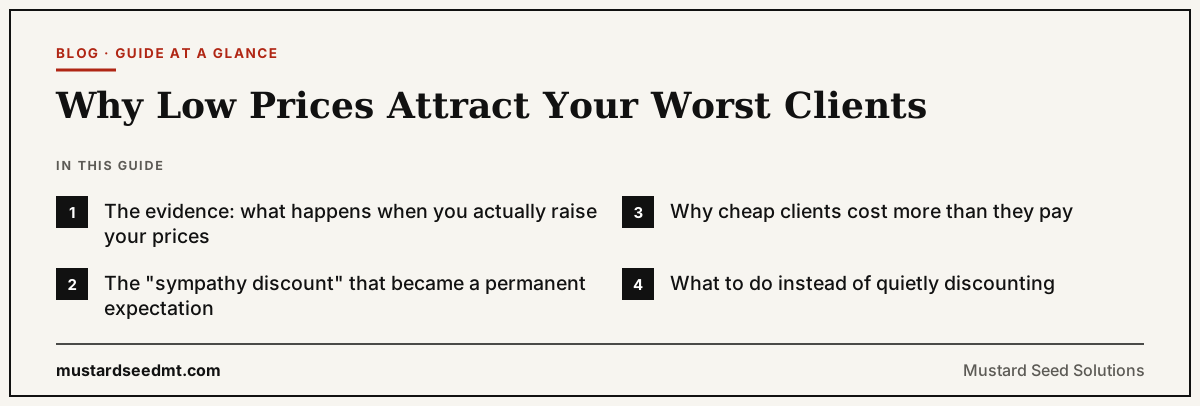
The evidence: what happens when you actually raise your prices
A digital marketing freelancer described three years of charging rates set back when they had zero experience and needed any client they could get. Doing the math properly — actual hours, software costs, taxes, no raise in three years — the effective pay worked out to roughly $14 an hour for skilled work. They gave 22 existing clients three months' notice of a 40% rate increase, braced for the worst, and got this instead: seven clients left immediately, almost all of them the ones who haggled on everything and sent the most revision requests. Two negotiated a smaller increase. Thirteen said, in effect, that they were surprised the rate hadn't gone up sooner.
The result: fewer clients, workload down roughly a third, and monthly revenue up about 12%. The freelancer's own summary was blunt — the clients who complain about price are almost never the ones who value the work, and undercharging doesn't just hurt the bank account, it actively selects for the hardest clients to work with.
The notice email itself became a small case study of its own in the replies. The version that worked best was short and unapologetic: a heads-up on the new rate, a one-line explanation tied to results and market rates, and an explicit, no-hard-feelings offer to recommend someone else if the new number didn't fit the client's budget. Several commenters noted that offering an easy exit, rather than justifying the increase at length, was exactly what made clients feel respected enough to stay — and a couple of the clients who did stay went on to refer new business at the higher rate without being asked.
Other freelancers in the replies described the identical arc under different services. A web designer who'd been charging around $800 for a full site, scared to charge more, described constant revisions and late-night messages about font colors from those clients; after moving to a $1,500 minimum, they lost four or five regular clients and said the difference in client quality was immediate — the remaining clients trusted their recommendations instead of arguing with them. Their own advice to other freelancers: if you're scared of your own prices, they're probably too low.
Curious whether your own rate has the same problem hiding in it? Our pricing guide walks through how to set a number that reflects your real costs, and the freelance rate calculator will run the math for you in a couple of minutes.
The "sympathy discount" that became a permanent expectation
A second story made the same point from a different angle. A performance design studio owner cut a client's fee sharply, from a standard rate down to a flat $250, during a genuine hardship — the client had just received a difficult diagnosis mid-project. Months later, once the client had recovered and was expanding into a much larger project, the studio owner sent a standard quote for the new scope. The client was furious, framed the new price as exploitative given what she'd been through, complained to the client who'd referred her, and both relationships ended.
The replies were almost unanimous, and pointed at a specific fix: when you discount, show the math. Several commenters described writing every discounted invoice as three lines — the standard fee, the discount amount, and the total due — specifically so a temporary favor never quietly turns into a permanent baseline. Multiple people also noted, independent of the discount issue entirely, that the standard rate in that story was itself on the low side for the work described.
Why cheap clients cost more than they pay
Across both threads and the wider discussion, the same handful of complaints repeated: customers who negotiate hardest on price also tend to file the most complaints, demand the fastest turnaround, and disappear when it's time to pay. One reply summarized it as a direct relationship — the harder someone fights the price, the more of your time and patience the relationship ends up consuming, regardless of what they eventually pay. Another commenter went further, listing the pattern out explicitly: cheap customers still expect full quality and full quantity, they pay slower, they're more likely to demand a discount after the work is already delivered, and they're disproportionately the ones who escalate to complaints or disputes.
A marketer working on their own mother's small business described the same lesson from the seller's side: after years of underpricing, they gradually raised prices and only ever saw sales and repeat customers increase, never complaints. Their read on it was simple — most small businesses underprice by default, and customers rarely push back on a fair price the way owners fear they will.
That's not an argument for being expensive for its own sake. It's an argument for pricing at a level that reflects the actual value and actual time involved, because the number itself acts as a filter for who chooses to work with you in the first place.
What to do instead of quietly discounting
A few practical habits came up repeatedly in these threads: state any discount explicitly on the invoice rather than folding it into a lower total. Raise prices in planned stages rather than apologizing for a single number — several commenters specifically warned against one large jump, preferring smaller staged increases every six to nine months so clients can absorb the change without feeling ambushed. Give existing clients real notice — three months, in the example above — and put the reasoning in writing once, clearly, rather than repeating justifications every time someone pushes back. And run the actual numbers before deciding whether a price increase is reasonable, rather than guessing based on what current clients seem willing to pay.
It's worth naming the emotional side of this too, because it showed up as clearly as the financial side. More than one commenter described treating a price haggler with what they only half-jokingly called an "asshole tax" — simply not discounting for the customers who focus purely on cost instead of value, and treating the friction that comes with them as a cost of doing business rather than something to be managed away with a lower number.
If pricing is the single biggest thing you're avoiding right now, it's worth knowing you're not the only one — underpricing and the client problems it causes showed up as one of the most common patterns across the 270 threads we analyzed for our full solopreneur challenges report.