
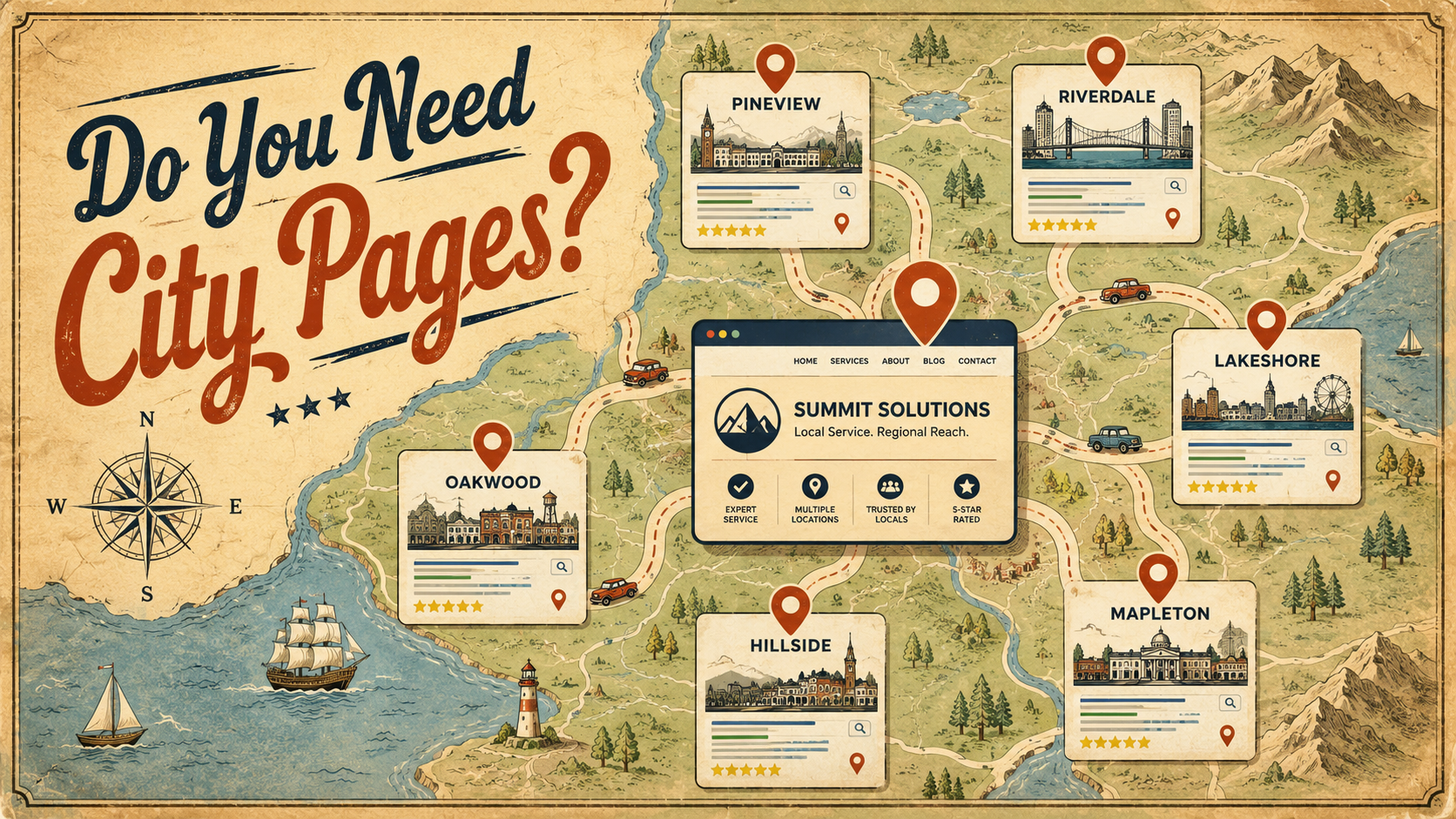
No. You need a separate city or location page when there is meaningful local search intent and you can create a genuinely useful page for that market. Creating dozens of nearly identical pages with only the city name changed can produce thin content, confuse site architecture, and move toward doorway page behavior.
The SEO reaction video behind this series shows a local business using separate pages for different service areas. The underlying idea is sound: if customers search for a service in Palm Springs, Cathedral City, or another distinct location, dedicated pages can give Google and users a clearer answer.
The question is whether each page deserves to exist.
When Do Separate City Pages Help Local SEO?
City pages help when people actually search for your service in different locations and the information needed to make a decision changes by market.
A useful location page can make it easier for search engines to understand that your company serves a specific area. It also gives users a page that speaks directly to the place they searched for instead of forcing one generic page to represent every market.
Separate pages are most justified when:
- The city has distinct search demand
- You genuinely serve customers there
- The service offering differs by location
- You can provide local proof
- You can explain travel or service coverage accurately
- The page answers location specific questions
- The page can support a unique conversion path
A physical branch is not always required for a service area page, but the page must represent a real service relationship.
When Do City Pages Become Thin or Spammy?
The risk increases when a company creates a large set of pages that exist only to capture keyword variations.
Google's current spam policies warn against doorway abuse and keyword stuffing, including pages or blocks of content created primarily to rank for similar queries rather than provide distinct value. See Google's spam policies.
A weak city page often looks like this:
- The same paragraphs on every page
- Only the city name changes
- No local examples or proof
- No unique customer questions
- No useful service area information
- No location specific pricing or constraints
- No reason for a person to choose that page over the main service page
If a visitor could swap one city name for another and nothing meaningful would change, the page probably needs more work.
The objective is not to prove that you know how to create URLs. It is to help a local searcher make a better decision.
What Should a Strong Location Page Include?
A strong location page combines service relevance with local evidence.
That may include:
- A clear explanation of the service in that city
- The areas or neighborhoods actually covered
- Local customer examples where available
- Location specific testimonials
- Relevant project photos
- Local operating constraints
- Response or delivery information
- Frequently asked questions from that market
- Directions or branch information if a physical location exists
- A clear enquiry path
You do not need to force every item onto every page. Use the information that is genuinely useful for that location.
The reaction video also points out that a business can have many location pages but still receive most of its search visibility from branded terms. That is an important reminder: publishing the page does not mean the page is competitive.
The page still needs relevance, authority, internal links, and evidence.
Should Every Location Page Be Linked in the Footer?
Usually, a giant footer containing every city is not the best architecture. It may make every page link to every location whether or not those relationships help the user.
The reaction video recommends a more deliberate structure using internal links and sitemaps rather than placing the complete city list on every page.
A cleaner model can use:
- A main locations or service areas hub
- Regional pages when several nearby cities belong together
- Contextual links from relevant service pages
- Links between genuinely related nearby locations
- Breadcrumbs
- XML sitemaps for discovery
Google says internal links help it discover pages and understand relationships across a site. The links should still make sense to users rather than existing only to push keywords around.
For smaller businesses, the Solo Business Marketing offer can help connect website structure, local visibility, messaging, and conversion without building an unnecessarily complex site.
Do You Need Both Service Pages and City Pages?
Sometimes. They serve different search intents.
A service page answers a category question such as "commercial HVAC maintenance." A location page answers a local version such as "commercial HVAC maintenance in Warsaw" or another specific market.
A strong architecture may therefore include one main service page plus selected local pages where demand and evidence justify them.
Avoid multiplying every service by every city automatically. If you have ten services and twenty locations, creating 200 pages by formula can quickly produce duplication and maintenance problems.
Start with the combinations that matter commercially.
Ask:
- Which services generate the most revenue?
- Which locations generate real demand?
- Which combinations already receive impressions?
- Where do competitors have strong local pages?
- Where can we provide unique proof?
- Which pages would help customers decide?
That creates a more defensible local content system.
How Should You Decide Which City Pages to Create First?
Use business value and search evidence together.
Google Search Console can show whether the website already receives impressions for city and service combinations. Keyword research can identify additional demand. Sales data can show where enquiries actually come from.
A practical prioritization process is:
- Identify your most important services
- Map the cities you genuinely serve
- Check existing search impressions
- Review the local search results
- Look for distinct intent
- Assess whether you have local proof
- Build the strongest pages first
- Measure impressions, rankings, leads, and conversions
- Expand only where the model works
This is more useful than publishing a location page for every name on a map.
The broader Learning Center includes guides on local SEO, website structure, content, and search measurement.