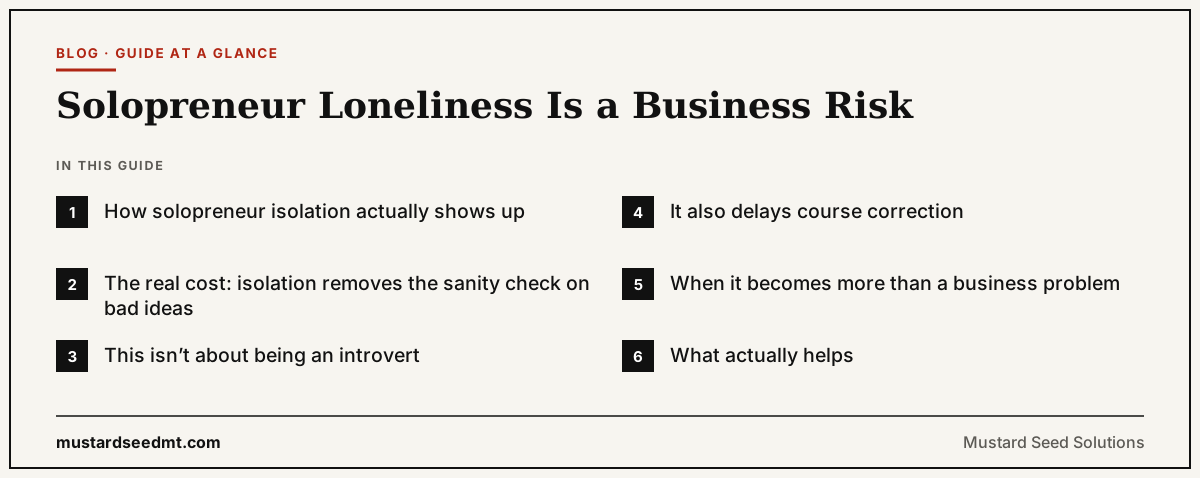
Solopreneur loneliness is a business risk because working alone removes the checks a team normally provides — a co-founder, a colleague pushing back — that catch weak decisions before they get expensive. It shows up less as sadness and more as slower course-correction: problems a second opinion would flag in a week can take months to surface.
That framing matters because “it’s lonely” is easy to file away as an unavoidable cost of working for yourself — something to endure, not something to fix. The evidence from solo founders themselves suggests otherwise. Isolation isn’t just uncomfortable. It has a measurable effect on how well a business gets run, and there’s a fairly specific mechanism behind it.
How solopreneur isolation actually shows up
On r/Solopreneur, one founder described the daily reality of running solo in stark terms: no safety net, nobody else to catch a mistake, no backup — just you, showing up every day and questioning yourself more than you’d ever admit out loud. Another post, warning readers that most people shouldn’t start a business at all, listed loneliness as a defining feature of the work, alongside uncertainty and being tested in ways you can’t prepare for.
It isn’t only a Solopreneur-subreddit phenomenon. Over on r/smallbusiness, a thread thanking the community for being a place to vent described “a mostly lonely world of being a real business owner,” and the reply that got the most agreement was blunt: it’s lonely enough out there for small business owners without also getting crowded out by hype accounts. Another founder, writing about what nobody tells you on the way to six figures, called it a “lonely journey” directly — most friends with regular jobs simply don’t grasp the stress and responsibility that comes with running something alone, and it’s crucial to find people who do.
The real cost: isolation removes the sanity check on bad ideas
A team, even a small one, argues. Someone says “that pricing doesn’t make sense,” or “we already tried that,” or simply asks an obvious question the founder was too close to see. Solo, that friction disappears — which feels efficient right up until it isn’t.
One of the clearest pieces of evidence for this came from a founder who’d run a one-person service business for five years and credited a single unglamorous habit for keeping it alive: a weekly thirty-minute call with someone from a completely unrelated industry — not networking, not selling, just an honest conversation. By their own account, that call caught two expensive mistakes before they snowballed. Commenters on the thread converged on the same explanation for why it worked: the mistakes it caught weren’t tactical, they were about ego or tunnel vision — the kind of blind spot that someone outside your bubble notices immediately and you can’t see at all, because you’re standing inside it.
That’s the mechanism. It isn’t that solo founders are worse decision-makers. It’s that a good decision-making process usually includes a step — “say this out loud to someone who’ll push back” — that solo work quietly deletes by default. Without deliberately rebuilding it, the business runs on one person’s judgment with nothing to catch its errors.
This isn’t about being an introvert
It’s worth separating this from personality preference, because the two get conflated constantly. Plenty of solopreneurs genuinely prefer working alone and have no interest in an office full of people. That’s not the risk described here. The risk is structural: it’s the absence of any regular outside input on the business itself, and it affects people who love solitude just as much as people who’d rather not be alone at all. A founder can be perfectly content on a personal level and still be making decisions with no outside check on them — contentment and isolation-as-a-business-risk are two separate variables, not opposites.
One founder’s community post made this almost accidentally explicit: a recurring “what are you building” thread exists, by its creator’s own description, specifically because solopreneurship can be lonely and it’s easy to forget to network while heads-down on the work. The thread wasn’t framed as a mental-health intervention — it was framed as a practical fix for a structural gap, which is closer to the right way to think about the problem.
It also delays course correction
A related pattern shows up in how long solo founders take to notice a problem that’s already draining the business. One founder posted that they were working sixteen-hour days and still not making progress, with time disappearing into what they called “a black hole of emails” — and the honest answer, from their own account, was that they had no idea where the hours were actually going until they were forced to stop and track it. On a team, a manager or a colleague notices that kind of drift within days. Alone, it can run for months, because there’s no one else watching the pattern from outside.
The same dynamic shows up in what one Reddit commenter called a “build-abandon cycle” — founders who build something, lose momentum once it’s functional, and quietly abandon it without ever testing whether the market wanted it. Several people in that thread pointed to the same root cause: working in a silo insulated from anyone who might push back or criticize the product, which makes it easy to keep building something that feels good rather than confronting whether it actually works.
When it becomes more than a business problem
It would be dishonest to write about solopreneur isolation without acknowledging how serious it can get. One of the most heavily discussed threads in small-business communities was started after a business owner learned that a fellow small-business owner in his town had died by suicide following his business’s failure. The response was not a handful of comments — it was hundreds, from people describing their own darkest periods after losing a business, and the single most upvoted reply was simple: entrepreneurship is hard and lonely, and anyone struggling should be able to reach out. Several commenters specifically credited reaching a friend, a family member, or a therapist with getting them through it.
If any of this is landing closer to home than a business-strategy article should, that’s worth taking seriously on its own terms — not as a productivity problem to optimize away, but as a reason to talk to a real person: a friend, a doctor, a therapist, or a crisis line. Nothing below is a substitute for that.
What actually helps
The fixes that show up repeatedly in these threads are small and unglamorous, which is probably why they work — they’re structural, not aspirational. A recurring call with someone outside the business, chosen specifically because they have no stake in it and will say when something looks wrong. A standing weekly review of the numbers, so drift gets caught early rather than discovered in a scramble. A peer group of other solo founders, used for a reality check rather than a cheerleading section.
Even founders who built real, profitable businesses solo circled back to this after the fact. One who grew a development agency to a quarter-million dollars in revenue within a year admitted the growth had cost more than he’d realized at the time, and described the post announcing it as partly an update, partly a thank-you, and partly a promise to himself to stop building completely in isolation going forward. That’s a useful data point on its own: the fix wasn’t proposed by someone struggling to get started. It was proposed by someone who’d already succeeded by most external measures and still recognized the gap.
None of that requires a co-founder or a team. It requires treating outside perspective as infrastructure — a scheduled, recurring input into the business — rather than something that happens by accident when a friend asks how things are going. For a fuller picture of where this ranks among the problems solo operators actually report, Mustard Seed’s research report on the 50 biggest solopreneur challenges breaks down isolation alongside the operational pressures it tends to compound.