Launching in public feels harder than building because building is a private feedback loop you control — fix a bug, tweak a feature, decide when it’s ready — while launching hands that control to strangers who react on their own schedule. Solopreneurs describe months of confident solo building followed by real hesitation the moment work must be shown publicly.
This is a distinct problem from not knowing how to market. Plenty of solo founders who freeze at the “publish” button can describe their marketing plan in detail — the channels, the content, the outreach. What stops them isn’t the plan. It’s the moment the plan requires being visible.
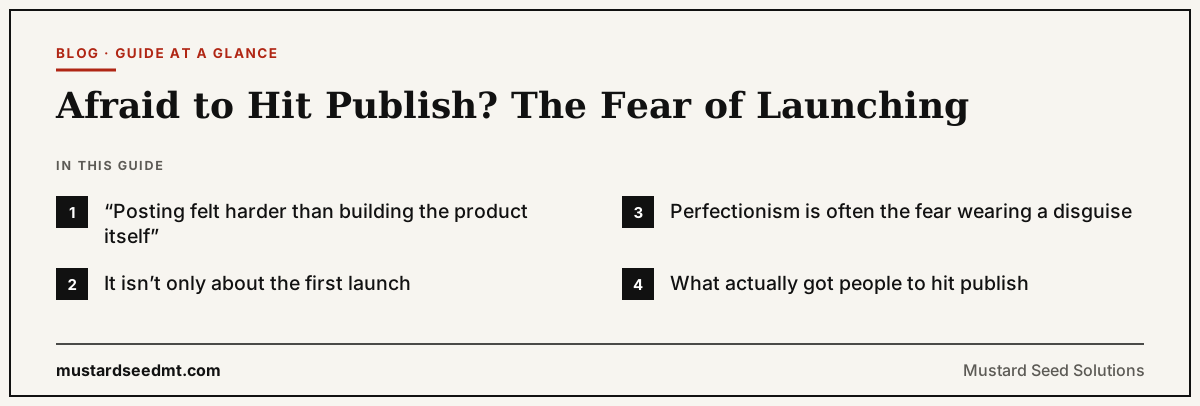
“Posting felt harder than building the product itself”
One founder described spending three months building an AI headshot app entirely solo, then finally posting about it publicly on LinkedIn — and said plainly that the post itself was easy to write, but posting it felt harder than the three months of building. Their diagnosis was specific: building let them keep telling themselves they were getting closer, while nobody was around to tell them when to stop building and put the work in front of real people. Posting meant they could no longer hide inside that loop.
The replies were the real evidence. One founder who’d been sitting on a finished product for four-plus months, already used successfully inside their own agency, admitted that the moment they had to write “hey, I made this thing” and put it out there, they froze — rewriting the launch post roughly six times and inventing reasons to add one more feature before going public. Their explanation matched the original poster’s almost exactly: building is a conversation with yourself where you control the feedback loop; posting puts you in front of people who don’t owe you anything.
Others in the same thread named the fear directly rather than dressing it up. One called it plainly the fear of being judged — while building, a missing feature or a bug is just something you fix; once you launch, a bad reaction is a problem you can’t patch your way out of. Another admitted to “hiding behind my brand,” avoiding even a voice-over demo because of how their own voice sounded on tape.
It isn’t only about the first launch
A separate, widely discussed thread asked why nobody talks about how humiliating early bootstrapping can feel. The original poster described years of solo building that had gone nowhere publicly — a following with no buyers, a product with no revenue — while watching other builders post big numbers. One reply reframed the whole feeling usefully: early-stage building can feel lonely specifically because you’re asking strangers to care about something you’ve poured months into, and that discomfort usually just means the audience or message hasn’t landed yet, not that the work is bad.
A second reply on that same thread named a specific reason the fear of being seen gets worse rather than better over time: the comparison isn’t fair to begin with. It pointed out that most visible “solo founder” success stories quietly leave out years of failed projects, consulting income on the side, savings cushions, a spouse with a stable job, previous exits, or even a small team working quietly in the background. Measuring a first, nervous launch against someone else’s highlight reel — built, invisibly, on advantages that were never mentioned — makes the exposure feel far riskier than it actually is.
A different, longer-running thread described a “build-abandon cycle” — years of building functional products and then losing motivation right at the point they’d need to be marketed. One commenter’s self-diagnosis was unusually direct: a fear of rejection that led them to abandon projects themselves, before anyone else had the chance to reject them, describing it as the same pattern showing up in relationships as well as products. Another reply in the same thread put the mechanism in blunt terms — coding is comfortingly binary, it either works or it doesn’t, and staying inside that loop keeps you insulated from an outside world that might criticize what you’ve made.
Even founders who’d already had real success weren’t immune. One founder recounting a rejected pitch admitted that between the interview and the rejection email, they’d already mentally moved into an imagined future life the acceptance would have bought them — a reminder that the fear isn’t really about the mechanics of publishing, it’s about how much identity gets attached to how the public reacts.
Perfectionism is often the fear wearing a disguise
One recurring pattern makes this fear harder to spot: it rarely announces itself as fear. It shows up dressed as a work ethic — one more feature, one more revision, one more round of polish before anything goes out the door. One founder who’d spent years talking to other solo operators making real money put it in a single line that stuck: perfection is just procrastination with better branding. The delay looks like diligence. What it’s actually doing, in nearly every account described above, is postponing the moment of exposure.
A separate founder, describing a return to building in their forties after years away, framed their whole first goal not as revenue but as overcoming a fear of failure and a habit of overthinking — treating that alone as the real first win, ahead of any launch metric. That’s a useful reframe: for a solo founder stuck at the publish button, getting past the fear itself may be the actual milestone worth tracking, not the launch-day numbers everyone else is comparing themselves against.
What actually got people to hit publish
Almost nobody in these threads described waiting until fear was gone. One founder who’d finally posted after months of delay put it simply: it was less about feeling ready and more about being tired of watching themselves delay the same step over and over. Another described the same tipping point — not confidence, just frustration finally outweighing fear — and added that once you cross that line once, it gets noticeably easier to hit publish again.
A few reframed the stakes rather than waiting for the fear to shrink. One suggested treating a launch as a side project or an exploration rather than a full “coming out” as a founder, lowering the perceived size of the moment. Another reframed silence itself as the real cost: if the product could genuinely help people and never gets published, that’s a failure to the people it was meant to reach — not publishing carries its own risk, even if it doesn’t feel that way in the moment.
None of these reframes remove the discomfort entirely, and none of the founders describing them claimed otherwise. What they share is a refusal to wait for the fear to reach zero before acting. Building offers the illusion of a finish line where everything finally feels ready. Every account above says that line doesn’t exist — the work gets published while the fear is still present, not after it’s gone, and the fear tends to shrink afterward rather than before.
For solopreneurs who recognize this pattern in themselves, it sits alongside a broader set of pressures that make solo marketing harder than it looks from outside. Mustard Seed’s research report on the 50 biggest solopreneur challenges covers where this fits among the reasons solo marketing efforts stall before they start.