
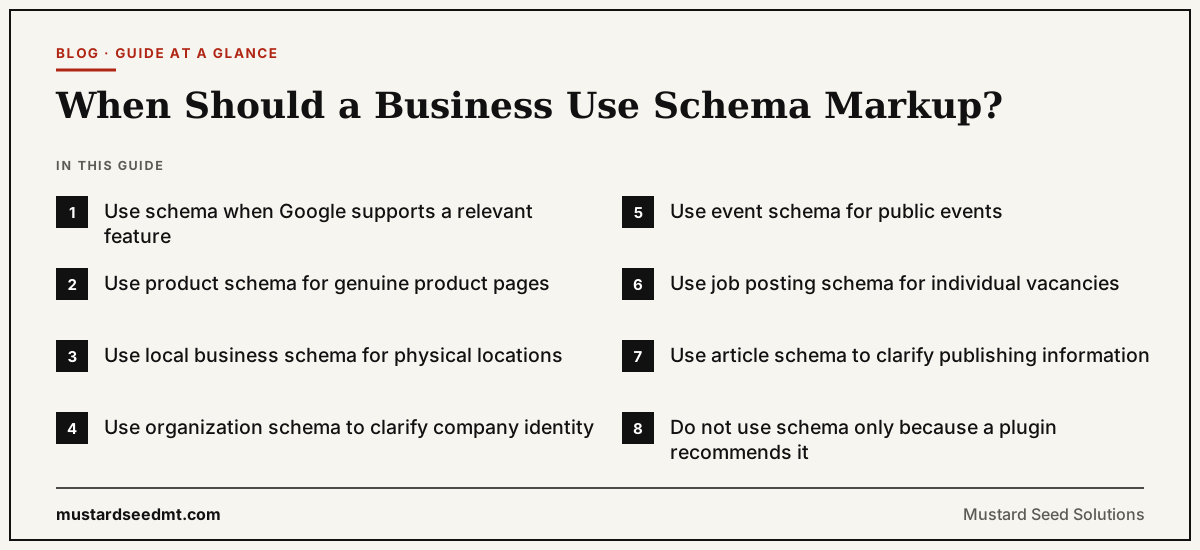
Schema markup can help search engines understand specific information on a webpage.
It can identify a product’s price, an event’s date, a business’s opening hours, a job’s location, or the author of an article. Google may use supported structured data to create enhanced search appearances known as rich results.
This makes schema useful, but it does not mean every business should add every available schema type to every page.
Structured data should solve a clear problem. It should accurately describe visible information and support a search feature that matters to the website’s audience.
The right question is not how much schema a business can add.
The right question is where structured data can make information clearer and improve the search experience.
Use schema when Google supports a relevant feature
A practical starting point is Google’s structured data feature gallery.
The gallery lists the types of markup Google currently supports for enhanced search appearances. Supported examples include products, local businesses, events, job postings, articles, recipes, datasets, organization information, profile pages, and several other content types.
Google may recognize additional schema.org vocabulary without displaying a special search feature for it.
That distinction matters.
A business may add technically valid schema that produces no visible change in Google Search because Google does not use that type for a supported rich result.
Before implementation, determine whether Google documents a feature connected to the page.
When a supported feature exists and the website contains the required information, schema may be worth using.
Use product schema for genuine product pages
Ecommerce businesses are among the clearest candidates for structured data.
Product markup can identify information such as the product name, image, price, currency, condition, availability, brand, rating, and offer details.
When implemented correctly, product information may become eligible for richer appearances across Google Search, Google Images, and other shopping experiences. Google also allows merchants to provide product data through Merchant Center feeds, website structured data, or both.
Product markup should describe a real product visible on the page.
A business should not add prices, ratings, or availability information that users cannot see.
The structured data must remain synchronized with the page. A product shown as available in the markup but unavailable on the website creates an inaccurate experience.
For businesses with changing prices or stock levels, reliable automation may be more important than the initial implementation.
Use local business schema for physical locations
A local business can use LocalBusiness structured data to describe information such as its name, address, telephone number, opening hours, and business type.
Google recommends choosing the most specific applicable subtype, such as Restaurant, Dentist, or DaySpa, rather than using only the broad LocalBusiness category when a more accurate option exists.
This markup is especially relevant for businesses with premises customers can visit.
Each branch or location should be represented accurately. A company with several locations should avoid publishing one combined block that makes it unclear which telephone number, address, and opening hours belong together.
The website information should also agree with the company’s Google Business Profile and other important listings.
Schema helps describe the website. It does not replace the need to maintain an accurate Business Profile for visibility in Google Search and Maps.
Use organization schema to clarify company identity
Organization structured data can help Google understand administrative information about a company.
This may include the legal or public name, logo, website, contact details, and identifiers.
Google recommends adding organization structured data to an appropriate page, commonly the homepage or a page containing company information. For a local company with physical premises, Google recommends using the most specific LocalBusiness subtype alongside relevant organization details.
Organization schema can be particularly useful when a company has a name that may be confused with another organization.
It can also help connect official information consistently.
However, the markup should reflect reality. Adding social profile links, awards, or identifiers does not prove authority. It only clarifies which organization the page represents.
Use event schema for public events
Event structured data can be useful for conferences, concerts, workshops, festivals, webinars, and other genuine events.
It may describe the event name, date, time, location, ticket information, organizer, and attendance format.
The event should have its own page with visible information.
Businesses should not mark ordinary operating hours, sales promotions, or services as events simply to obtain a richer search appearance.
Dates and locations must remain current. Cancelled, postponed, or rescheduled events should be updated promptly.
Google does not guarantee that a valid event page will receive a rich result, even when the markup passes technical testing.
Schema creates eligibility, not guaranteed display.
Use job posting schema for individual vacancies
Organizations recruiting employees can use job posting structured data on individual job pages.
The markup can clarify the position, employer, location, employment type, salary where appropriate, and application information.
The vacancy should be current and genuine.
Expired positions should be removed, redirected appropriately, or clearly marked as closed. The structured data should not continue advertising a role that no longer exists.
A general careers page containing several roles should not necessarily be marked as one job posting.
Each role should have a clear and accessible page when the business wants it treated as a distinct vacancy.
Use article schema to clarify publishing information
Publishers, companies, and professional organizations may use article structured data to identify information such as the headline, author, publication date, modification date, and representative images.
Article schema can support Google’s understanding of publishing details.
It does not make an article authoritative simply because an author and date are included.
The byline should identify the person who genuinely created or reviewed the content. The publication and modification dates should reflect real activity.
Changing a date without meaningfully updating the article does not create useful freshness.
The visible page and the structured data should agree.
Do not use schema only because a plugin recommends it
Many website plugins automatically generate several schema types.
Automation can be convenient, but the generated markup may be incomplete, inaccurate, or inappropriate for the page.
A plugin may mark every page as an article, create conflicting organization records, or insert outdated business information across the website.
Businesses should review what the plugin produces.
The presence of schema code does not mean the implementation is correct.
Use the most specific type that accurately matches the page. Google’s general guidelines require structured data to represent the main visible content and follow the policies for the relevant feature.
Do not use schema to describe hidden information
Structured data should not become a secret layer of promotional claims.
If the markup contains a price, rating, service, address, or event date, users should be able to find the same information on the page.
A business should not add fake reviews, unsupported awards, invented locations, or services that are not actually offered.
Misleading structured data can result in the loss of rich result eligibility and may lead to a manual action related to structured data. Google explains that such an action affects eligibility for rich results rather than normal web ranking.
Prioritize pages with real search value
Schema implementation requires development, testing, and maintenance.
Businesses should begin with pages where richer presentation could matter.
An ecommerce company might prioritize its most important product templates.
A restaurant might prioritize its location and menu related information.
A recruitment website might prioritize active vacancies.
An events company might prioritize current event pages.
A small consultancy may receive limited benefit from adding complicated markup to every service page.
Basic organization and breadcrumb information may be sufficient when Google offers no relevant specialized result for the service.
The potential search feature should justify the work.
Test before applying schema across the website
Google recommends beginning with a limited number of pages.
Add the required properties, validate the code using the Rich Results Test, and use URL Inspection to confirm that Google can access the page. Once the implementation works correctly, it can be expanded to similar pages.
Validation tools can identify syntax errors and missing required properties.
Passing a test does not guarantee that the rich result will appear.
The page must also comply with content policies, remain accessible, and meet the requirements for the specific feature. Google may choose not to show a rich result even when the markup is technically correct.
Keep structured data updated
Schema is not a one time installation.
Prices change. Events move. products go out of stock. Businesses change telephone numbers. Employees leave. Offices close.
When structured data becomes outdated, it can conflict with the page and reduce trust in the information.
Businesses should assign responsibility for maintaining it.
For large websites, structured data should ideally be generated from the same reliable database that supplies the visible page.
Manual markup may be sufficient for a small website with stable information.
The method should match the scale and frequency of change.
Measure the result
Structured data should be connected to a measurable objective.
Search Console can help show whether Google detects valid markup and whether pages receive eligible search appearances.
Businesses can monitor impressions, clicks, click through rates, conversions, and revenue before and after implementation.
Results should be interpreted carefully.
Rankings, titles, prices, seasonality, competitors, and search demand can all change during the same period.
Schema is worthwhile when it improves a relevant search experience or makes important information easier to understand.
Use schema with a clear purpose
Businesses should use schema markup when three conditions are present.
The page contains a real content type that can be described accurately.
Google supports a relevant feature or the markup meaningfully clarifies the organization.
The company can maintain the information over time.
Structured data is useful infrastructure.
It can support rich results and clearer interpretation, but it is not a universal ranking shortcut.
Implement it where it serves users, matches visible content, and supports a genuine search opportunity.