
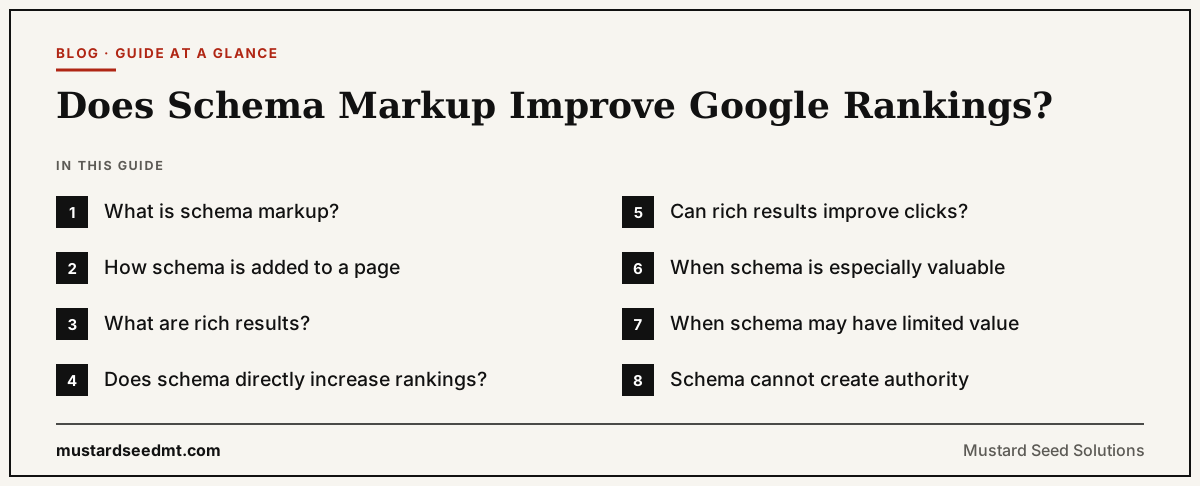
Schema markup is one of the most discussed elements of technical SEO.
Agencies often recommend adding structured data across a website to help Google understand the content.
This recommendation can be useful, but it is frequently presented with an exaggerated promise: adding schema will improve the page’s rankings.
Schema markup does not operate like a guaranteed ranking boost.
Its main purpose is to describe page information in a standardized format and make eligible content available for enhanced search appearances known as rich results.
These enhancements can improve how a listing appears and may influence user interaction.
That is valuable, but it is different from directly making a page more authoritative, relevant, or trustworthy than its competitors.
What is schema markup?
Schema markup is structured information added to a webpage.
It identifies specific elements and explains what they represent.
For example, product structured data can identify a product’s name, price, availability, image, rating, and brand.
Recipe markup can identify ingredients, cooking time, calories, and instructions.
Organization markup can describe a company’s legal name, address, logo, contact details, and identifiers.
Google describes structured data as a standardized format for providing information about a page and classifying its content.
The vocabulary commonly comes from Schema.org, while Google publishes separate documentation explaining which types and properties it uses for specific Search features.
How schema is added to a page
Google supports several structured data formats.
These include JSON-LD, Microdata, and RDFa.
Google generally recommends JSON-LD because it is usually easier to implement and maintain.
JSON-LD is normally placed in a script within the page’s HTML.
The data should describe information that users can also see on the page.
A company should not use structured data to add claims, reviews, prices, or services that are absent from the visible content.
The markup is a machine readable description of the page, not a place to hide additional marketing statements.
What are rich results?
Rich results are enhanced search listings.
Depending on the content type and query, they may include information such as prices, availability, ratings, event dates, images, breadcrumbs, job details, or business information.
Google supports structured data for several types of content, including articles, products, events, local businesses, organizations, job postings, recipes, datasets, profile pages, and discussion forums.
Valid structured data can make a page eligible for these features.
Eligibility does not guarantee display.
Google may decide that a normal text result is more appropriate for a particular user, query, location, or device.
Does schema directly increase rankings?
Google’s structured data documentation focuses on understanding page content and enabling rich search appearances.
It does not present schema as a general method for increasing normal web ranking positions.
Google also explains that a structured data manual action removes eligibility for rich results but does not affect how the page ranks in normal web search.
This distinction is important.
Schema can change how a page is displayed without directly making it more relevant or authoritative.
A page with perfect structured data can still rank poorly if its content does not match the query, the website lacks credibility, or stronger competitors provide better information.
A page without extensive schema can still rank strongly when it is relevant, useful, accessible, and authoritative.
Can rich results improve clicks?
A richer listing may attract more attention.
A product result showing price and availability can help a shopper evaluate the offer before clicking.
A recipe with an image and preparation information may stand out from a plain text listing.
A job result with salary and location details can help applicants identify relevant opportunities.
Google cites case studies in which some publishers observed higher click through or interaction rates after implementing structured data and gaining enhanced search appearances.
These outcomes should not be interpreted as universal guarantees.
Results depend on the market, device, search feature, competing listings, and quality of the implementation.
The commercial value of schema should be measured rather than assumed.
When schema is especially valuable
Schema is most useful when Google supports a relevant search feature for the content.
Ecommerce websites can benefit from product information such as price, availability, reviews, shipping, and returns.
Recruitment websites may use job posting structured data to become eligible for job search experiences.
Event organizers can describe dates, locations, ticket information, and performers.
Recipe publishers can identify ingredients, instructions, preparation time, and nutrition.
Local businesses can provide business details such as opening hours, location, and contact information.
Publishers can use article markup to describe authorship, publication dates, headlines, and images.
In these situations, schema has a clear functional purpose.
When schema may have limited value
Not every page needs extensive structured data.
A standard B2B service page may have no relevant rich result beyond basic organization or breadcrumb information.
A consultancy does not need to mark every paragraph with complicated schema.
A software company should not expect generic service markup to overcome weak content or limited authority.
Implementation also creates maintenance costs.
Prices, availability, dates, reviews, and company information can change.
Outdated structured data may conflict with the visible page and create errors.
Businesses should prioritize schema types connected to a real search feature and a measurable user benefit.
Schema cannot create authority
Structured data is information supplied by the publisher.
A company can label itself as an organization, identify an employee as an author, or describe a product as having certain properties.
These labels help organize information, but they do not independently prove that the claims deserve trust.
Authority usually requires wider evidence.
This can include relevant backlinks, independent mentions, customer reviews, professional recognition, original research, and a record of useful work.
Adding Person schema to an author page does not make that author an expert.
Adding Organization schema does not establish the company as an industry leader.
Schema describes an entity. It does not manufacture reputation.
Schema cannot fix weak content
A page must provide useful visible information.
Structured data cannot compensate for copied descriptions, vague service claims, incorrect facts, or pages created only to capture search traffic.
Google’s guidelines require the markup to represent the main visible content accurately. Misleading, hidden, irrelevant, or fake structured data can make a page ineligible for rich results and may be treated as spam.
The correct sequence is to build a useful page first and add suitable structured data afterward.
Do not begin with the markup and then create weak content merely to support it.
Common schema mistakes
One common mistake is marking up information that users cannot see.
Another is applying the wrong content type, such as treating ordinary business instructions as a recipe or marking a sales page as an article.
Businesses may also add fake aggregate ratings, incomplete product data, incorrect event dates, or outdated prices.
Some plugins generate multiple conflicting schema blocks.
Other websites create organization information with different names, addresses, or identifiers across several pages.
These errors can confuse implementation and prevent rich result eligibility.
How to implement schema properly
Choose a structured data type that Google supports and that accurately matches the page.
Read the documentation for that specific feature.
Include all required properties.
Add recommended properties when they provide useful and accurate information.
Ensure the same details appear visibly on the page.
Validate the markup using Google’s Rich Results Test.
Use URL Inspection to confirm that Google can access the page.
Monitor Search Console for structured data errors and enhancement reports.
Review the markup when the underlying information changes.
How to measure whether schema is worthwhile
Businesses should evaluate structured data like any other investment.
Select pages with enough existing impressions to generate meaningful information.
Record their search performance before implementation.
Add the relevant markup and confirm that Google detects it.
Monitor whether rich result appearances increase.
Compare impressions, click through rates, clicks, conversions, and revenue over an appropriate period.
Google itself recommends before and after testing on suitable pages when measuring structured data performance.
Avoid attributing every change to schema.
Seasonality, ranking changes, competitors, titles, prices, and search demand can also influence performance.
Schema and AI search
Structured data may help systems interpret certain facts about a page, but businesses should avoid claiming that schema guarantees visibility in AI generated answers.
AI search systems can use visible page content, web indexes, external sources, product feeds, business profiles, and other information.
Clear structured information can support understanding, particularly for products, events, organizations, and local businesses.
It does not replace useful content or external credibility.
Schema is a feature tool, not a ranking shortcut
Schema markup has legitimate value.
It can clarify page information, make content eligible for rich results, improve search appearance, and support specialized experiences for products, jobs, events, recipes, and other content.
What it cannot do is turn an uncompetitive page into the best search result simply because the markup is technically valid.
Businesses should implement schema where it supports a clear feature and user need.
They should not treat it as a substitute for relevance, authority, strong content, or customer value.
The right question is not, “How much schema can we add?”
The right question is, “Which structured information will produce a useful search experience for this page?”