
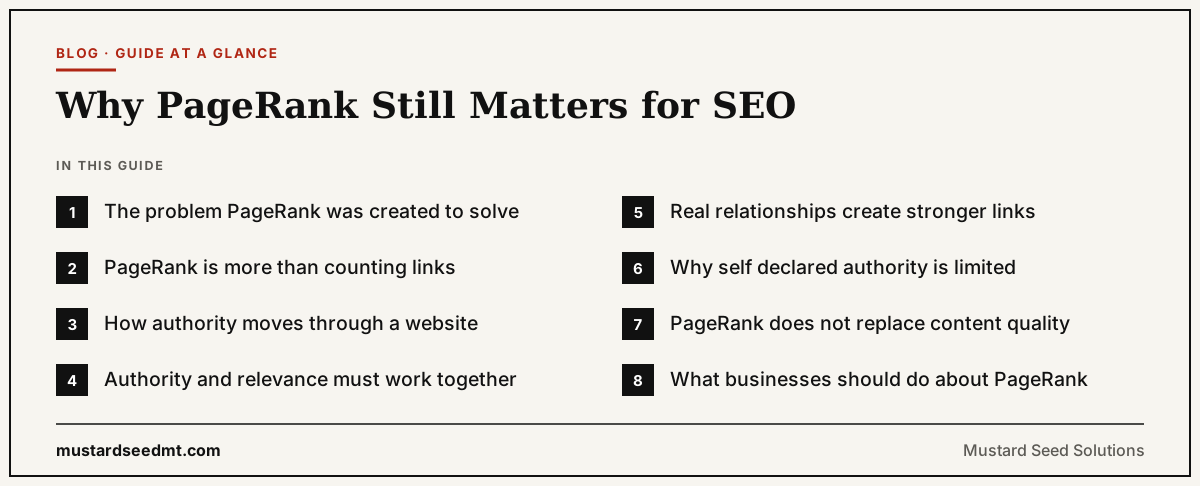
PageRank is one of the most important concepts in the history of search engine optimization.
Developed during Google’s early years, PageRank introduced a scalable method for evaluating web pages through the links connecting them.
The central idea is simple. A link from one page to another can act as a reference. A page that receives links from important and trusted pages may be considered more significant than a page with no external recognition.
Modern Google Search uses far more than the original PageRank formula. Search engines now rely on many systems to understand queries, evaluate relevance, interpret content, detect spam, and select suitable results.
Even with these advances, the logic behind PageRank still matters. Links continue to help search engines discover pages, understand relationships, and estimate authority.
The problem PageRank was created to solve
Early search engines needed a way to decide which pages should appear first.
Matching words was not enough.
A page could repeat a keyword many times without being accurate, useful, or trustworthy. Website owners could manipulate basic search systems by placing popular terms throughout a page.
PageRank introduced a second form of evaluation.
Instead of looking only at what a page said about itself, the system examined how other pages connected to it.
This created a form of third party validation.
Any company can claim to be experienced, trusted, or authoritative. Independent references are more difficult to control.
When a university references a research paper, a respected publication cites a specialist, or an industry association links to a business, those connections provide evidence beyond the publisher’s own marketing claims.
PageRank is more than counting links
One of the most common misunderstandings in SEO is the belief that more backlinks automatically lead to better rankings.
The number of links and the value of links are different things.
A link from a trusted and relevant website may carry more significance than hundreds of links from sites with no genuine audience or topical relationship.
Context matters.
A link from an article that discusses your industry gives search engines a clearer relationship than a random link placed in an unrelated directory.
The quality of the linking page also matters. A page that has earned recognition from other respected sources may pass more authority than a page that has no reputation of its own.
This is one reason large packages of cheap backlinks rarely create a lasting advantage. They may increase the number of links in a report, but they often provide little credible evidence of authority.
How authority moves through a website
PageRank is usually discussed in relation to external backlinks, but internal linking is also important.
When one page on your website links to another, it helps search engines discover the destination. It also shows how the pages are connected.
Internal links can distribute authority throughout the website.
Imagine that your homepage receives links from industry publications, partners, and business directories. If the homepage clearly links to your main service pages, some of that authority can support those pages.
If an important page is buried deeply and receives almost no internal links, search engines may interpret it as less central to the website.
A useful internal linking structure should reflect business priorities.
Important service pages should be easy to reach. Relevant blog articles should link to related services. Supporting guides should connect to each other when the relationship is useful.
This creates a network that helps both users and search engines move through the website.
Authority and relevance must work together
Authority alone does not determine rankings.
A highly authoritative page about accounting software may still be irrelevant to someone searching for local landscaping services.
Search engines must combine authority with relevance.
Relevance includes the meaning of the page, the language used, the search intent, and the relationship between the content and the query.
This is why businesses should avoid chasing links from any website willing to provide one.
A smaller industry publication may be more useful than a larger but unrelated site. The relevant publication confirms that your business participates in the market connected to the search.
The strongest backlinks often combine several qualities. They come from credible sources, appear in relevant context, and exist because the link is genuinely useful to readers.
Real relationships create stronger links
Many businesses treat link building as a separate technical exercise.
They hire someone to send large numbers of outreach emails asking strangers to place links in articles. This approach can occasionally produce results, but it often creates low quality relationships and weak placements.
More sustainable link building usually begins with real business activity.
A company may earn links through partnerships, research, interviews, events, sponsorships, tools, case studies, public relations, or original data.
For example, a software company could publish research based on anonymized customer data. Journalists and industry websites may reference the findings.
A local business could work with complementary service providers and create useful resources for customers. Those businesses may naturally reference each other.
A consultant could appear on podcasts, contribute expert commentary, or publish a detailed industry guide.
These activities create links because there is a genuine reason for the reference.
Why self declared authority is limited
Website owners have complete control over the claims published on their own pages.
They can describe themselves as leading experts, trusted providers, or market authorities.
Those claims may be true, but search engines cannot accept every self description at face value.
External references provide another layer of evidence.
This does not mean that every link is a perfect vote of confidence. Links may be paid, manipulated, outdated, or created automatically.
Search engines therefore evaluate links in context and attempt to identify patterns that indicate manipulation.
The broader principle still matters. Independent recognition usually carries more weight than unsupported self promotion.
PageRank does not replace content quality
Some marketers interpret the importance of PageRank to mean that content does not matter.
That conclusion is too simple.
Links may help a page earn authority, but the page must still be relevant to the search.
A strong backlink profile cannot make an unrelated page the best answer for every query.
Content also affects whether people choose to link to a page in the first place. Useful research, clear explanations, valuable tools, and original resources are more likely to earn references than generic content.
Authority and content support each other.
Good content gives people a reason to link. Relevant links help search engines recognize that the content has earned attention.
What businesses should do about PageRank
Businesses do not need to calculate PageRank directly.
The practical objective is to build a website that earns credible recognition and distributes authority clearly.
Start by making your important pages easy to find. Use internal links to connect relevant content. Avoid creating large numbers of isolated pages that have no relationship to the rest of the site.
Create resources worth referencing. This may include research, original insights, tools, templates, case studies, or detailed guides.
Build relationships with publications, associations, partners, and professionals in your market.
Focus on relevance and credibility instead of raw link quantity.
A smaller number of strong links can be more valuable than a large number of weak ones.
How to evaluate a backlink opportunity
Before pursuing a backlink, ask several practical questions.
Does the website have a real audience?
Is the topic connected to your business?
Would the link make sense to a reader?
Does the page provide useful information?
Is the placement being created because it adds value, or only because someone has been paid to insert it?
These questions are more useful than relying only on a third party authority score.
SEO tools can provide helpful estimates, but their metrics are not Google’s internal PageRank calculations.
PageRank in modern SEO
Search engines have changed significantly, but the web is still built through connections.
Links help define those connections.
They show which pages are referenced, which sources participate in a topic, and which websites have earned recognition from others.
PageRank should not be treated as the only part of SEO. Technical accessibility, search intent, content relevance, user experience, and business credibility all matter.
However, ignoring links and authority leaves out one of the core mechanisms that made modern search possible.
PageRank still matters because search engines need evidence beyond what a website says about itself.
Businesses that earn meaningful recognition, build useful resources, and connect their pages clearly are better positioned to compete in organic search.