
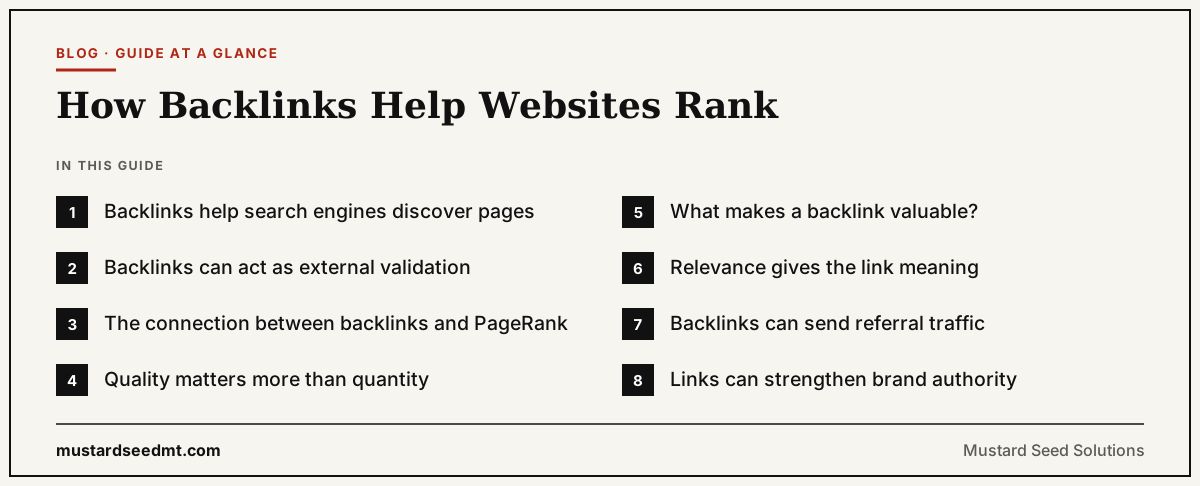
Backlinks are links from one website to another.
They are also called inbound links because they send users and search engines into the receiving website.
Backlinks have played an important role in search engine optimisation since the early development of Google.
The basic idea is that a link can act as a reference. When one website chooses to link to another, it may suggest that the destination contains information worth visiting.
Search engines can analyse these relationships to help understand which pages have earned recognition.
Backlinks are not the only influence on rankings, and not every link has equal value. However, relevant and credible backlinks can still support discovery, authority, and organic visibility.
Backlinks help search engines discover pages
Search engines use links to move between pages.
When a search crawler visits a page, it can follow the links on that page and discover new URLs.
This is one reason backlinks can help a new website or article become visible.
A page with no internal or external links may be difficult to discover. It exists, but few clear paths lead to it.
A backlink from an established website can provide a route for search engines and users.
Discovery does not guarantee indexing or rankings. It simply gives the page an opportunity to be processed.
The destination must still provide relevant and useful information.
Backlinks can act as external validation
Any business can make positive claims about itself.
A company can describe itself as experienced, trusted, innovative, or successful.
Search engines need evidence beyond self promotion.
Backlinks can provide part of that evidence.
When respected publications, professional organisations, research institutions, partners, or industry experts reference a website, they show that the business has received recognition from outside sources.
This does not mean that every backlink is a vote of complete trust.
A link may exist for many reasons. It may reference a source, criticise a claim, recommend a service, provide additional reading, or identify a business.
Search engines examine patterns and context rather than treating all links identically.
The connection between backlinks and PageRank
PageRank is a system associated with Google’s original approach to evaluating the web.
The central concept is that links can pass a form of importance between pages.
A link from a strong page may carry more value than a link from a page with little recognition.
The amount of value may also depend on how many other pages the source links to and how the link fits within the content.
Modern search ranking uses many systems beyond the original PageRank model.
Even so, the idea that links help indicate importance remains central to SEO.
Quality matters more than quantity
A common mistake is measuring link building success only through the number of backlinks acquired.
One relevant and credible link may be more useful than hundreds of low quality links.
Consider two examples.
The first backlink comes from a respected industry publication within an article about your market.
The second comes from an unrelated website that publishes hundreds of paid articles on random subjects.
Both count as links in an SEO report, but they do not provide the same evidence.
The first link has clear relevance and a credible reason to exist.
The second may have been created only to influence rankings.
Businesses should focus on the quality, context, and source of links rather than raw volume.
What makes a backlink valuable?
A valuable backlink usually has several useful characteristics.
The source website has a real audience and a clear purpose.
The source is relevant to the topic or industry.
The linking page contains useful information.
The link appears naturally within the content.
The destination helps the reader understand the subject or take the next step.
The source has earned trust through its own work.
No single characteristic guarantees value. The combination matters.
A small specialist website can provide an excellent backlink when it is respected by the exact audience a business wants to reach.
Relevance gives the link meaning
Search engines use context to understand links.
A backlink to an accounting firm from a financial publication has an obvious relationship.
A backlink from a gardening blog may be more difficult to interpret unless there is a genuine reason for the connection.
This is why relevant links often provide more value than unrelated links.
Relevance can exist at several levels.
The entire website may cover the same industry. The individual page may discuss a related subject. The surrounding paragraph may explain why the destination is being referenced.
A meaningful link helps both the reader and the search engine understand the relationship.
Backlinks can send referral traffic
Backlinks are valuable beyond SEO.
A link from a website with an active and relevant audience can send potential customers directly to a business.
This referral traffic may produce enquiries, sales, partnerships, or brand awareness.
A link that generates qualified visitors can be commercially useful even when its exact ranking effect is impossible to measure.
Businesses should therefore evaluate backlink opportunities from a marketing perspective.
Ask whether the source reaches the right audience and whether the link could introduce the company to people who may care about its services.
Links can strengthen brand authority
Backlinks contribute to a wider pattern of brand recognition.
When a company appears in publications, podcasts, directories, research reports, professional associations, and partner websites, potential customers encounter the brand in different places.
Repeated credible exposure can increase familiarity and trust.
Search engines may also recognise that the brand participates in a real market.
This is one reason public relations and SEO often support each other.
A successful media campaign can produce coverage, brand mentions, links, and referral traffic at the same time.
Internal links also matter
Backlinks bring authority into a website. Internal links help distribute it.
If an article earns strong external links, it can connect to related service pages, product pages, or supporting resources.
This helps users continue their journey and helps search engines understand the website structure.
A page that receives backlinks but does not link to other important pages may create limited value for the wider website.
Internal links should be relevant and useful.
They should not be added randomly only to manipulate authority.
How businesses can earn backlinks
The most sustainable link building begins with creating something worth referencing.
Original research is a strong example. Journalists, bloggers, and industry professionals need reliable data and may link to the source.
Useful tools, calculators, templates, reports, maps, and databases can also attract references.
Businesses can earn links through expert commentary, interviews, podcasts, events, partnerships, case studies, and contributions to professional organisations.
Local businesses can build links through relationships with nearby associations, suppliers, charities, and community publications.
The best opportunities usually come from genuine participation rather than mass outreach.
The limitations of outreach
Email outreach is a common link building method.
A business contacts website owners and asks them to reference a resource.
This can work when the resource is genuinely relevant and the request is specific.
However, many outreach campaigns send generic messages to thousands of websites.
These emails provide little reason for the recipient to care. They often request a link without offering meaningful value.
Effective outreach begins with relevance.
The sender should understand the publication, explain why the resource benefits its readers, and avoid pretending that a transactional request is a personal relationship.
The risks of buying links
Businesses sometimes purchase backlinks to accelerate results.
Paid links can create significant risks when they are designed to manipulate search rankings.
The market contains many websites that sell placements without editorial standards. These sites may publish unrelated content, use artificial traffic, or participate in large link networks.
A purchased link may increase the backlink count shown by a tool while contributing little genuine authority.
It may also disappear when the website closes or changes ownership.
Businesses should avoid treating backlinks as a commodity where the cheapest volume wins.
Do bad backlinks require removal?
Most websites naturally receive some low quality or irrelevant backlinks.
Spam websites may copy content, scrape pages, or create automatic links.
The existence of these links does not always mean the business must take action.
Businesses should focus first on whether they intentionally participated in manipulative link building.
If a company has purchased large numbers of artificial links or joined link schemes, professional review may be necessary.
Fear based backlink audits can waste time by labelling every unfamiliar link as toxic.
The more productive strategy is usually to build stronger and more relevant recognition.
Backlinks support rankings but do not guarantee them
A page with strong backlinks can still fail to rank when it does not match the search intent.
Links cannot turn an irrelevant page into the best answer for every query.
The destination still needs useful content, clear targeting, technical accessibility, and a logical place within the website.
Backlinks work best as part of a wider SEO strategy.
They support authority and discovery. Content provides relevance. Technical SEO provides access. Internal linking provides structure.
A practical backlink strategy
Begin with the business rather than the link count.
Identify the publications, organisations, communities, and partners that influence your market.
Create useful resources that these audiences may genuinely reference.
Build relationships through research, collaboration, commentary, and participation.
Use outreach selectively and honestly.
Measure the quality of referring websites, referral traffic, qualified leads, and improvements in visibility.
Backlinks help websites rank because they connect pages and provide external evidence of importance.
The strongest links are not manufactured only for search engines.
They exist because the destination deserves to be referenced.