
The term “toxic backlinks” has become a major source of anxiety in SEO.
Website owners run backlink audits, see warning labels beside unfamiliar domains, and assume that their Google rankings are in danger.
Some tools classify links as toxic based on patterns such as low authority scores, unusual domain names, limited traffic, high numbers of outbound links, or possible connections to link networks.
These reports can be useful starting points for investigation.
They should not be treated as proof that a website has been penalised or that every flagged link must be removed.
The important distinction is between random low quality backlinks and deliberate link manipulation.
What is a toxic backlink?
“Toxic backlink” is not a precise universal category.
It is usually a label created by an SEO tool to describe a link that matches certain risk patterns.
Different tools use different formulas. The same backlink may be considered dangerous by one platform and ignored by another.
Search engines do not publish the same toxicity scores.
This means the label is an estimate, not a confirmed judgement from Google.
A backlink can look suspicious without causing harm.
Spam websites automatically scrape content, copy pages, create directories, and link to legitimate businesses every day. Website owners often have no control over these links.
Search engines understand that websites cannot control every external reference.
Low quality does not always mean dangerous
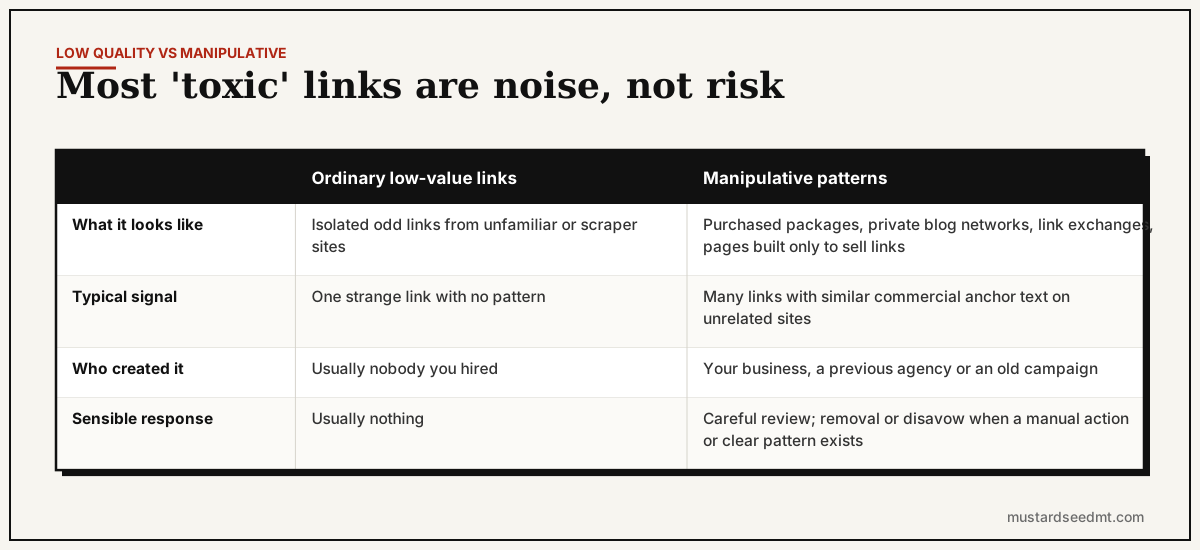
A low quality backlink may simply provide no meaningful value.
It may come from an inactive blog, an automated directory, a scraper, or a website with no relevant audience.
Search engines may ignore such links rather than punish the receiving website.
This is different from a link created as part of a deliberate attempt to manipulate rankings.
The distinction matters.
If every poor link caused a penalty, competitors could damage each other by creating spam links. Search engines have strong reasons to avoid making negative SEO that simple.
Most businesses will naturally accumulate some strange or irrelevant links over time.
Their presence alone is not evidence of a serious problem.
What is link spam?
Link spam generally refers to links created primarily to manipulate search rankings rather than help users.
Examples may include paid placements that hide the commercial relationship, private link networks, automated link creation, large scale link exchanges, and repeated keyword rich links placed across unrelated websites.
The quality of the website does not always determine whether a link is manipulative.
A paid link from a respected publication can still be part of a ranking manipulation scheme when it is sold specifically to transfer authority without appropriate disclosure.
A cheap automated link may be worthless, but it may also be easy for a search engine to ignore.
Intent, pattern, and scale matter.
When backlinks can become a real concern
Backlinks deserve closer attention when the business has actively participated in manipulative link building.
This may include purchasing large backlink packages, using private blog networks, paying for repeated keyword focused placements, joining automated exchange schemes, or hiring a provider that refuses to explain how links are acquired.
A sudden pattern of artificial links can create risk.
The concern becomes stronger when many links share similar anchor text, appear on unrelated websites, or exist within pages created only to sell links.
Historical SEO campaigns can also create problems.
A company may have purchased manipulative links years ago when those tactics were more common. A new marketing team may inherit the link profile without knowing how it was created.
In these cases, a careful review is justified.
What is a manual action?
A manual action occurs when a search engine reviewer determines that a website violates spam policies.
Google Search Console can display manual actions associated with a verified website.
A manual action is different from a drop in rankings.
Rankings change for many reasons, including competition, algorithm updates, lost links, changed search intent, technical problems, and weaker content.
A decline does not automatically prove that toxic backlinks caused the problem.
Before spending time removing links, investigate the wider context.
What is the disavow process?
Google provides a disavow tool that allows website owners to ask Google not to consider particular backlinks when evaluating the site.
This is an advanced tool.
It is not designed as routine maintenance for every website with a few strange links.
Using it without a clear reason can create additional risk because a business may disavow links that were actually helping.
A disavow file should not be created only because an SEO platform displayed a high toxicity percentage.
The decision should be based on evidence of manipulative link activity, a manual action, or a substantial historical pattern that the business cannot remove directly.
Professional review may be appropriate when the situation is complex.
Why backlink tools create fear
SEO platforms need to turn large amounts of data into understandable reports.
Risk labels provide a simple way to prioritise links.
However, a tool cannot fully understand why every link exists.
It may classify a small foreign language website as suspicious even when that site genuinely referenced the company.
It may flag a directory that provides useful local traffic because the directory has a low authority score.
It may consider an old forum link risky even though the discussion is legitimate.
Automated reports lack full business context.
The tool should support judgement, not replace it.
How to conduct a sensible backlink audit
Begin by identifying how the company has historically built links.
Ask previous agencies, employees, and contractors what methods they used.
Review invoices, reports, and outreach records where available.
Then examine patterns rather than isolated links.
Look for large groups of links from unrelated websites, repeated commercial anchor text, paid guest posts, private networks, and pages that exist mainly to publish links.
Separate these from ordinary low value links.
A single strange backlink rarely deserves the same attention as a coordinated campaign involving hundreds of placements.
Focus on activity the company influenced or purchased.
Should you request link removal?
When a manipulative link was intentionally created, contacting the website owner may be appropriate.
Keep records of removal requests, particularly when responding to a manual action.
However, removal outreach can be slow and unreliable.
Some website owners may demand payment. Others may not respond. Some websites may no longer be maintained.
Do not send mass removal requests to every unfamiliar domain.
That process can waste resources and may remove legitimate references.
Prioritise links that are clearly connected to past manipulation.
Can competitors create harmful backlinks?
Competitors can create spam links to another website, but that does not mean the campaign will succeed.
Search engines have spent years developing systems to recognise and neutralise artificial patterns.
A business should not panic every time it notices a sudden group of poor links.
Monitor visibility, manual actions, and the wider backlink profile.
Investigate when there is strong evidence of a coordinated attack or a serious ranking change that cannot be explained by other factors.
Even then, avoid assuming causation without analysis.
Build positive authority instead of chasing every bad link
Time spent reviewing links has an opportunity cost.
A business can spend months contacting obscure websites, updating spreadsheets, and repeatedly running toxicity reports.
That work may produce little commercial value.
In many cases, the stronger response is to earn better links.
Publish original research, develop partnerships, contribute expert commentary, create useful resources, and build relationships with credible organisations.
A growing pattern of legitimate recognition is more valuable than an endless attempt to maintain a perfectly clean backlink profile.
No natural website has complete control over every inbound link.
Questions to ask before taking action
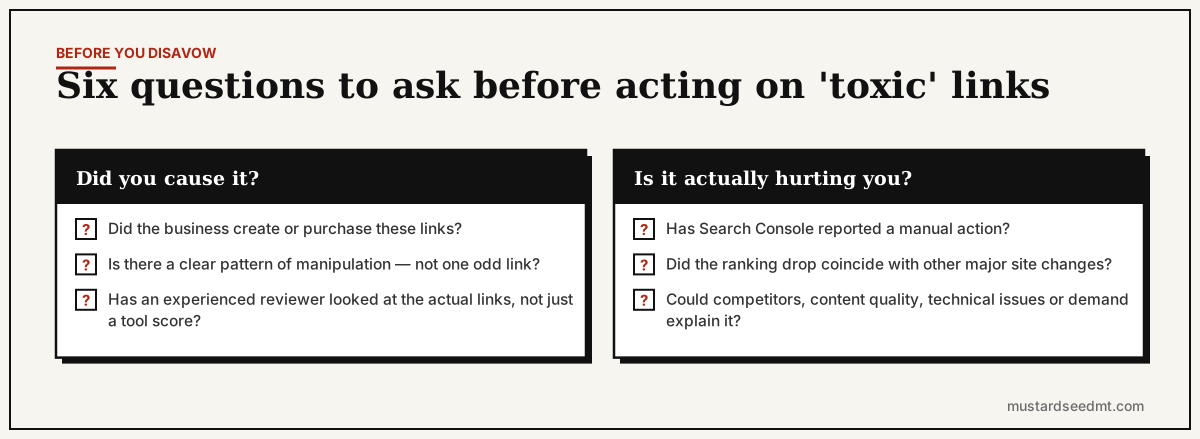
Before removing or disavowing backlinks, ask:
Did the business create or purchase these links?
Is there a clear pattern of manipulation?
Has Google Search Console reported a manual action?
Did the ranking decline begin at the same time as other major website changes?
Could competitors, content quality, technical issues, or changing search demand explain the performance?
Has an experienced reviewer examined the actual links rather than relying only on a tool score?
These questions reduce unnecessary reactions.
Toxic backlinks require context
Some backlinks can create genuine risk, particularly when they form part of an intentional link scheme.
That does not mean every low quality or suspicious looking link is dangerous.
Automated toxicity scores are indicators, not final decisions.
Businesses should understand the difference between ignored links, low value links, and manipulative link spam.
Investigate evidence, review historical practices, and use advanced tools carefully.
Most importantly, focus on building the kind of authority that comes from useful work and credible relationships.
Fear is not a backlink strategy.