
The Promise
Announced in late March 2015 — close enough to April Fools' Day that much of the press initially assumed it was a joke — the Dash Button was a small adhesive plastic device carrying one brand's logo and one function. Stick it near the washing machine, and when the detergent runs low, press it; a pre-configured order goes to Amazon without a phone, a screen, or a search.
The reasoning behind it was sound and specific. Replenishment purchases are the least considered decisions a household makes, they happen at a moment of realisation that is rarely near a computer, and the interval between that moment and the order is exactly where a competitor's shelf gets its chance. The button removed the interval. Buttons cost $4.99, refunded against the first order, and Amazon eventually offered them for several hundred brands.
The Entry
The physical constraint was one button per product. A household that genuinely wanted what the button promised would have needed a wall of them — detergent, coffee, nappies, razor blades, dog food — each committed to a single brand and a single pack size, each requiring a purchase decision and a place to live. The elegance of one press was bought with a proliferation of objects, and that arithmetic worked hardest against the heavy repeat buyers the idea was designed for.
Amazon was also, at the same time, building the thing that made the button redundant. Echo shipped broadly in the same period, and voice reordering answered the same problem with no hardware to buy, no brand lock-in, and from anywhere in the room. Virtual Dash buttons then appeared inside the shopping app at no cost, and the Dash Replenishment Service put automatic reordering inside printers, washing machines, and water filters — and a device that notices it needs a refill is strictly better than one that requires a human to notice and press.
Amazon Dash Buttons: Why It Failed
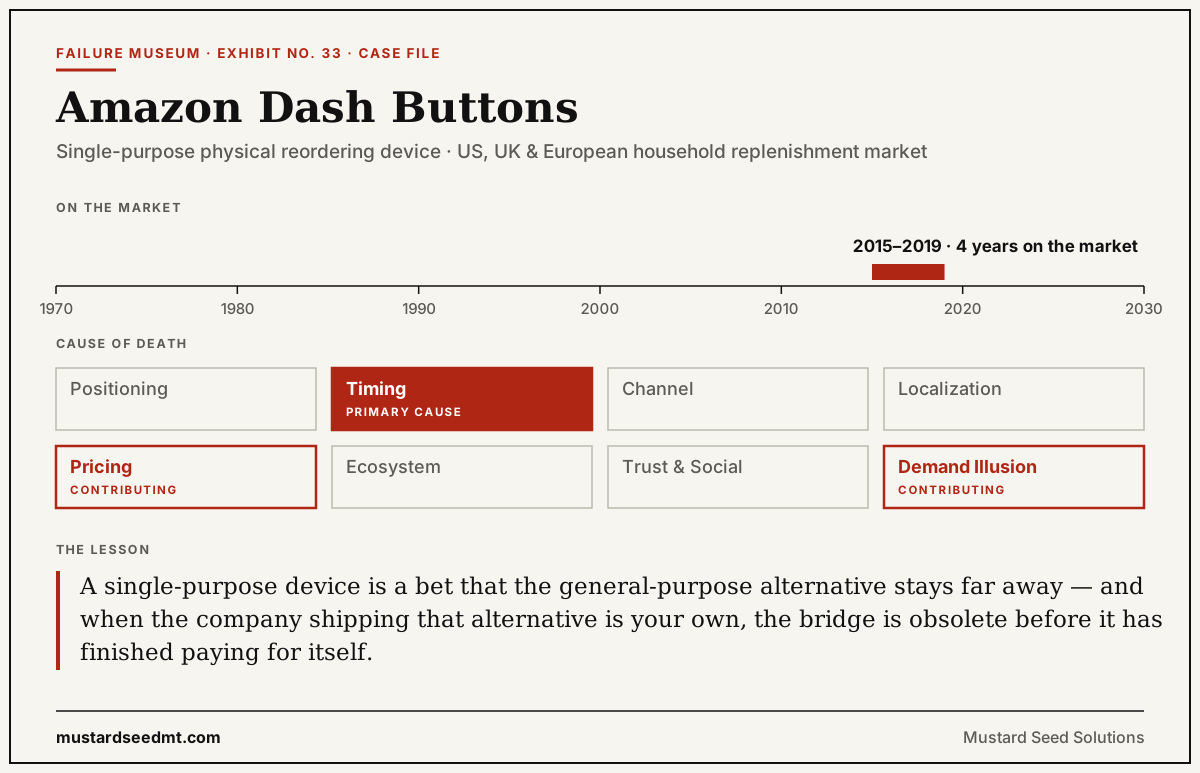
Amazon Dash Buttons were discontinued because a single-purpose physical object per product was a transitional answer to replenishment friction, and the general-purpose alternatives Amazon itself was shipping — voice ordering through Alexa, free virtual buttons, and auto-replenishment built into appliances — made it obsolete within four years. Amazon ended sales in early 2019 citing declining use, and the buttons stopped working on 31 August 2019.
This is a timing failure of an uncommon shape: the product was not early relative to its market so much as early relative to its own company's roadmap. Every advantage the button had — instant, at the point of realisation, no screen — was an advantage over the 2014 alternative of walking to a computer, and none of it survived contact with an always-listening speaker in the same room. The hardware was a bridge across a gap Amazon closed itself, faster than the bridge could pay for its own construction.
A demand illusion sat alongside it. The button generated extraordinary press attention and a genuinely interesting set of usage anecdotes, and the underlying need — frictionless replenishment — was real, which is precisely what made the signal easy to misread. What was never demonstrated was that people wanted this particular artifact, repeatedly, over years. Amazon's stated reason for shutting it down was that usage had slowed, and the tell is that every surviving descendant of the idea removed the physical object rather than iterating on it.
Packaging turned out to matter more than price. A button bound a household to one brand, one size, and one order configuration, and pressing it committed the buyer to a purchase whose price they could not see at the moment of pressing — a mismatch between the unit being bought and the unit of the decision. That is normally a soft commercial problem. In Germany it became a legal one, where a Munich court ruled the button breached consumer protection law and a higher regional court upheld that decision in January 2019, on the grounds that the order it triggered showed neither price nor product detail nor a clear indication that pressing incurred payment.
What Survived
Almost all of it, minus the hardware. Virtual Dash buttons put the same one-tap reorder inside the shopping app for free; Subscribe & Save automated the cadence entirely; Alexa made voice the interface the button had been a physical stand-in for; and the Dash Replenishment Service embedded ordering inside the appliances that consume the supplies — the version of the idea that requires no human to notice anything at all.
The Dash Button also did strategic work that outlived it. It normalised the notion that a purchase could be a single reflex rather than a shopping session, produced usable evidence about which categories households genuinely repeat-buy, and gave hundreds of consumer brands a first cheap experiment in connected direct replenishment — all of which Amazon carried forward into products that did not require gluing anything to a washing machine.
Era: 2010s
Where It Ended Up: Sales ended in early 2019 and the buttons stopped functioning on 31 August 2019; the idea continued as virtual Dash buttons, Subscribe & Save, Alexa reordering, and the Dash Replenishment Service embedded in appliances
The Lesson
"A single-purpose device is a bet that the general-purpose alternative stays far away — and when the company shipping that alternative is your own, the bridge is obsolete before it has finished paying for itself."
Sources
Related Exhibits
Webvan
Grocery delivery for a world that wasn't online yet, built at a scale that assumed it already was.
Microsoft Zune
A genuinely competent music player, arriving to a war the iPod had already won.
Sony Aibo (1st Generation)
A robot companion for a home the market wasn't living in yet.