
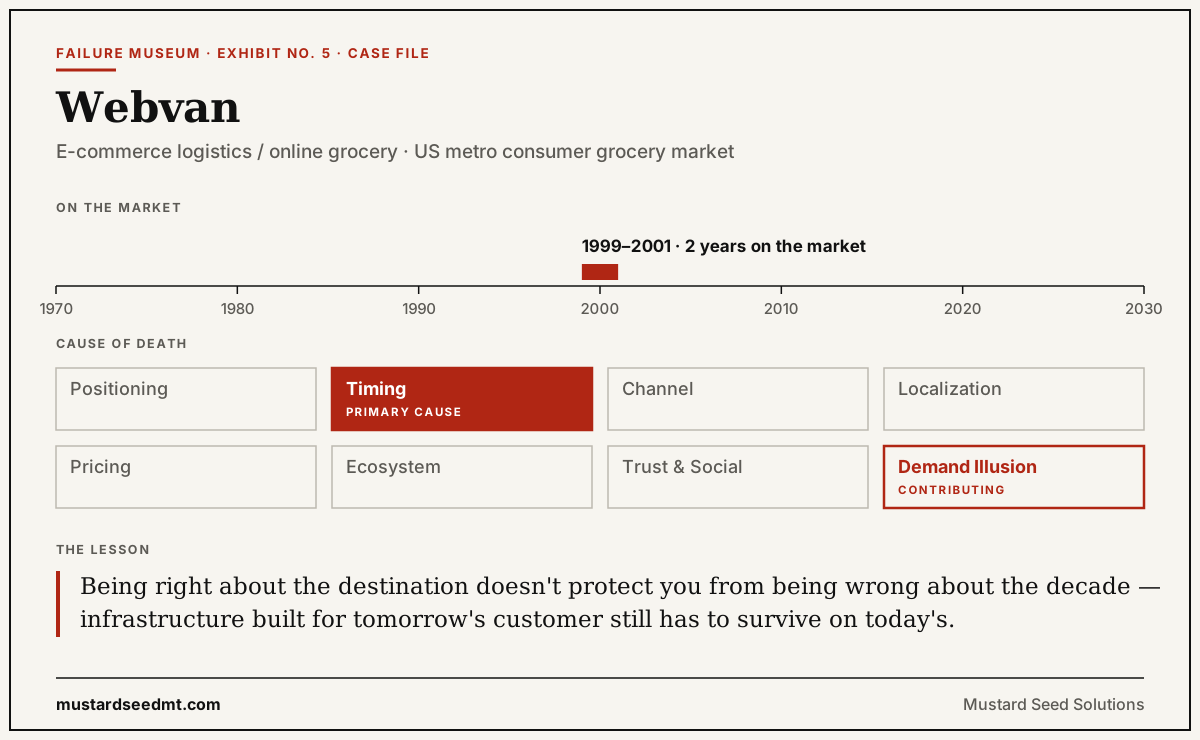
The Promise
Webvan's core idea — order groceries online, receive them same-day via automated, highly efficient regional distribution centers — is essentially the model that online grocery delivery runs on today (Instacart, Amazon Fresh, and dedicated dark-store operators all use variations of it). The underlying insight, that grocery shopping is a repetitive, predictable chore well suited to automation and delivery, was correct.
Webvan raised a then-enormous $375 million IPO in 1999 and built custom, highly automated warehouses (each costing tens of millions of dollars) designed to fulfill orders with minimal human picking, aiming for grocery-store-beating prices through logistics efficiency at scale.
The Entry
Webvan built out infrastructure for a national rollout aggressively and immediately: multiple full-scale automated distribution centers built simultaneously across different US metro areas, each representing tens of millions of dollars in fixed cost, committed before any single market had proven the model could reach profitable order volumes.
This was a deliberate strategic choice — grab the market before competitors could — rather than an accident, but it meant Webvan's fixed costs scaled with its ambition, not with its actual, still-unproven, demand.
Webvan: Why It Failed
Webvan failed because it built national-scale, capital-intensive infrastructure for online grocery delivery in 1999-2000, a full decade before home broadband penetration, e-commerce trust, and delivery-logistics familiarity reached the level required to generate the order volume that infrastructure needed to break even.
The record suggests this was fundamentally a timing failure compounded by a strategic choice to scale before validating: in 1999, a small minority of US households had broadband internet, online payment was still unfamiliar and viewed with suspicion by many consumers, and the habit of trusting a stranger to select your groceries was essentially unformed. Webvan needed a large volume of repeat customers comfortable with all of that simultaneously, in multiple cities at once, to make its automated distribution centers' economics work — and that customer base simply didn't exist yet at the scale required.
Our read is that Webvan's own ambition made the timing problem fatal rather than merely survivable: a company that built ONE distribution center, proved the unit economics in a single market, and expanded only once demand validated the model could have absorbed several more years of slow consumer-behavior change while staying solvent. Instead, Webvan committed to a dozen-plus-city rollout with matching fixed costs before any single market had proven profitable, which meant the company's burn rate was locked to an assumption about adoption speed that turned out to be roughly a decade too optimistic.
Demand illusion compounded timing: early usage and customer satisfaction scores were reportedly strong among the (still small) population who did try the service, which likely reinforced internal confidence that broader demand was close behind — when in fact the early adopters trying Webvan in 1999 were a narrow, internet-forward population unrepresentative of when the mass market would actually be ready.
What Survived
Amazon acquired some of Webvan's assets after its 2001 bankruptcy, and the broader thesis Webvan pioneered — automated fulfillment centers purpose-built for grocery e-commerce — became the literal blueprint for Amazon Fresh, launched in 2007 and expanded significantly in the 2010s, once broadband penetration, e-commerce trust, and delivery-app familiarity had actually caught up to the vision.
The modern online grocery category (Instacart, Amazon Fresh, Getir, and dedicated dark-store operators) is, in aggregate, a multi-billion-dollar validation of Webvan's original thesis — just built roughly fifteen years later, largely with asset-light delivery models (using existing store inventory or smaller local dark stores) rather than Webvan's capital-intensive, purpose-built regional warehouses, spreading the timing risk across a leaner cost base.
Era: 2000s
Where It Ended Up: Filed for bankruptcy in 2001; assets acquired by Amazon, whose eventual AmazonFresh built on similar logistics ideas roughly a decade later
The Lesson
"Being right about the destination doesn't protect you from being wrong about the decade — infrastructure built for tomorrow's customer still has to survive on today's."
Sources
Related Exhibits
Microsoft Zune
A genuinely competent music player, arriving to a war the iPod had already won.
Sony Aibo (1st Generation)
A robot companion for a home the market wasn't living in yet.
Nintendo Virtual Boy
Virtual reality, twenty years early, in one color, bolted to a tabletop tripod.