
The Promise
Aibo, launched in 1999, was a genuinely sophisticated robotic dog capable of learning, expressing simulated emotions, responding to voice commands, and developing what Sony marketed as a distinct personality over time through use — an ambitious, well-engineered attempt at a consumer companion robot nearly two decades before the term 'AI companion' entered common use.
The first units, priced around $2,500, reportedly sold out within Japan in a matter of hours of going on sale, demonstrating real, if narrow, enthusiasm for the concept among early adopters and robotics enthusiasts.
The Entry
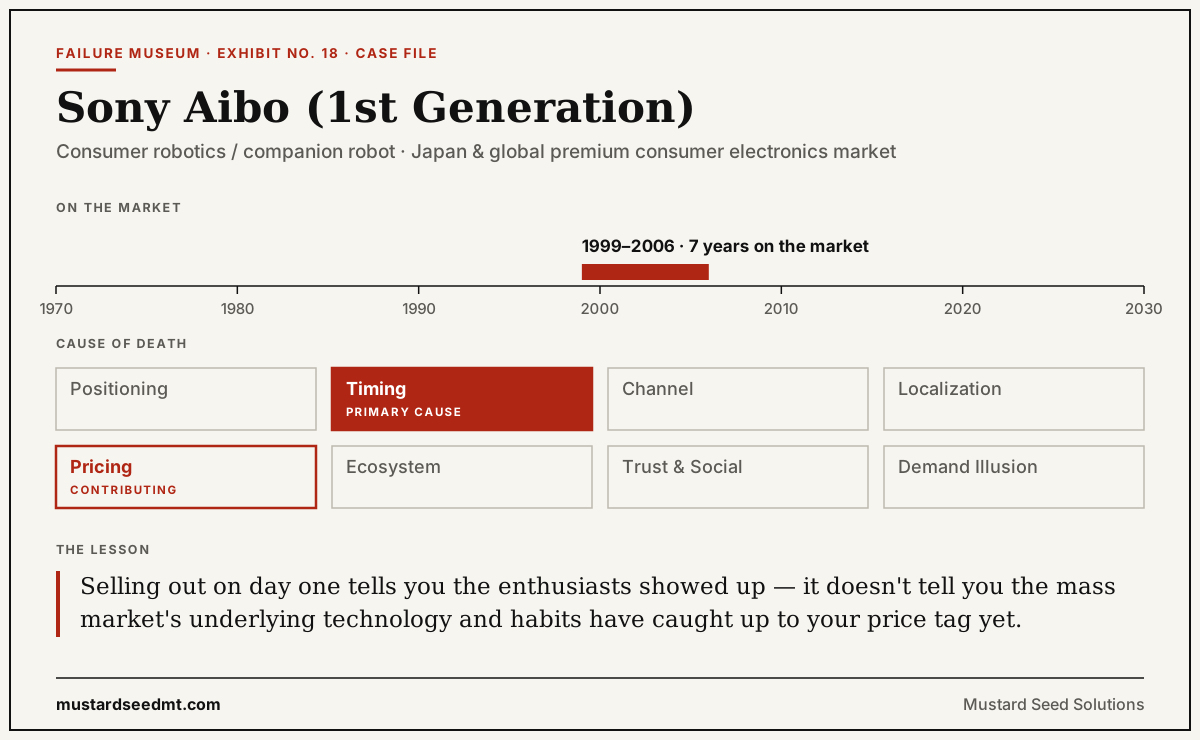
Sony sustained Aibo as a product line for roughly seven years (1999-2006), refining successive generations, but the addressable market remained narrow: a premium-priced (consistently $1,500-$2,500+) robotic companion in an era when home robotics, AI voice interaction, and always-on connected devices were all still unfamiliar, immature categories for ordinary consumers.
The broader technology ecosystem Aibo depended on to feel genuinely capable — natural voice recognition, machine learning sophisticated enough for convincing 'personality' development, affordable sensors and batteries — was, in 1999-2006, meaningfully less mature than the same technologies would be a decade or more later.
Sony Aibo (1st Generation): Why It Failed
The original Aibo line failed commercially at the scale Sony needed because it arrived roughly a decade or more before the underlying technologies it depended on — affordable AI/voice recognition, consumer comfort with connected home robotics, mature battery and sensor technology — were mature and cheap enough to support a genuinely compelling, mass-market companion robot at a price ordinary consumers would pay.
The record suggests the strong initial Japan sell-out reflected real enthusiasm among a narrow, well-resourced early-adopter segment rather than evidence of a broad market ready to buy — a pattern also seen in the museum's Webvan exhibit, where strong early usage among an unrepresentative population masked a much longer runway needed before the mass market was actually ready.
Our read is that the premium price ($1,500-$2,500+ across generations) was less a pure pricing failure and more a direct consequence of the timing problem: building genuinely convincing robotic behavior with 1999-2006-era sensors, processors, and machine learning was expensive, and that cost had to be passed to a consumer base not yet culturally primed to pay a luxury-electronics premium for a robot companion, the way a similar buyer might, a decade or two later, pay a comparable premium for early smart-home or AI-assistant hardware.
Sony's decision to shut down its entire robotics division in 2006, alongside Aibo, suggests an internal read that the category's timing hadn't arrived and further investment in a still-narrow market wasn't justified — a judgment later revisited when Sony relaunched a modernized Aibo in 2018, into a market that had, in the intervening twelve years, become far more comfortable with voice assistants, connected devices, and consumer AI generally.
What Survived
Sony's 2018 Aibo relaunch, using modern cloud-connected AI, cameras, and machine learning far more capable and affordable than what was available in 1999, has been positioned and received noticeably differently — as a mature, if still niche, premium companion product rather than a speculative bet on an unproven category, benefiting directly from the decade-plus of ecosystem and consumer-readiness maturation the original Aibo was missing.
The original Aibo remains culturally referenced as an early, technically serious attempt at consumer companion robotics, and retains an active enthusiast community of owners who continue to maintain and repair original units decades later — a genuine, if small, testament to the emotional connection the design achieved even without commercial mass-market success.
Era: 2000s
Where It Ended Up: Sony discontinued the original Aibo line in 2006 and shut down its entire robotics division shortly after; Sony relaunched a modernized Aibo in 2018 to a market far more accustomed to consumer AI and robotics
The Lesson
"Selling out on day one tells you the enthusiasts showed up — it doesn't tell you the mass market's underlying technology and habits have caught up to your price tag yet."
Sources
Related Exhibits
Webvan
Grocery delivery for a world that wasn't online yet, built at a scale that assumed it already was.
Microsoft Zune
A genuinely competent music player, arriving to a war the iPod had already won.
Nintendo Virtual Boy
Virtual reality, twenty years early, in one color, bolted to a tabletop tripod.