
The Promise
Clubhouse, launched in spring 2020 by Paul Davison and Rohan Seth under Alpha Exploration Co., offered something the internet had genuinely been missing: live, unrecorded, drop-in audio conversation. You opened the app, saw which rooms your network was in, and walked into one — as a listener, or with a hand raised to speak. There were no likes, no comments, no permanence, and none of the performance a finished post demands.
The timing looked inspired. In a year when every conversation had become a scheduled video call and nobody could face another one, Clubhouse offered company without a camera. It grew explosively: roughly two million weekly active users by January 2021, an Elon Musk appearance in February that put the app on every technology front page, invite codes trading on resale markets in China and elsewhere, and a valuation of about four billion dollars by April 2021 — twelve months after launch, on a product still in invite-only beta and still available only on iPhone.
The Entry
The scarcity that made Clubhouse feel valuable was mechanical: invite-only access, an iOS-only app, and a room list assembled from who you followed. It worked exactly as designed for as long as an invitation was hard to get. It also capped the market, and the fix carried its own cost — Android arrived in May 2021 and the waitlist came down that July, at which point the exclusivity that had been half the appeal simply stopped existing. The download curve was already falling by then: roughly 9.6 million downloads in February 2021, 2.7 million in March, and under a million in April.
Meanwhile the feature turned out to be replicable in a quarter. Twitter shipped Spaces, and Facebook, Discord, Spotify, and LinkedIn followed — every one of them attaching live audio to a network the user was already in and an audience they already had. Clubhouse had no technical moat and never claimed one; what it had was a moment, and the incumbents were able to enter that moment while it was still happening.
Clubhouse: Why It Failed
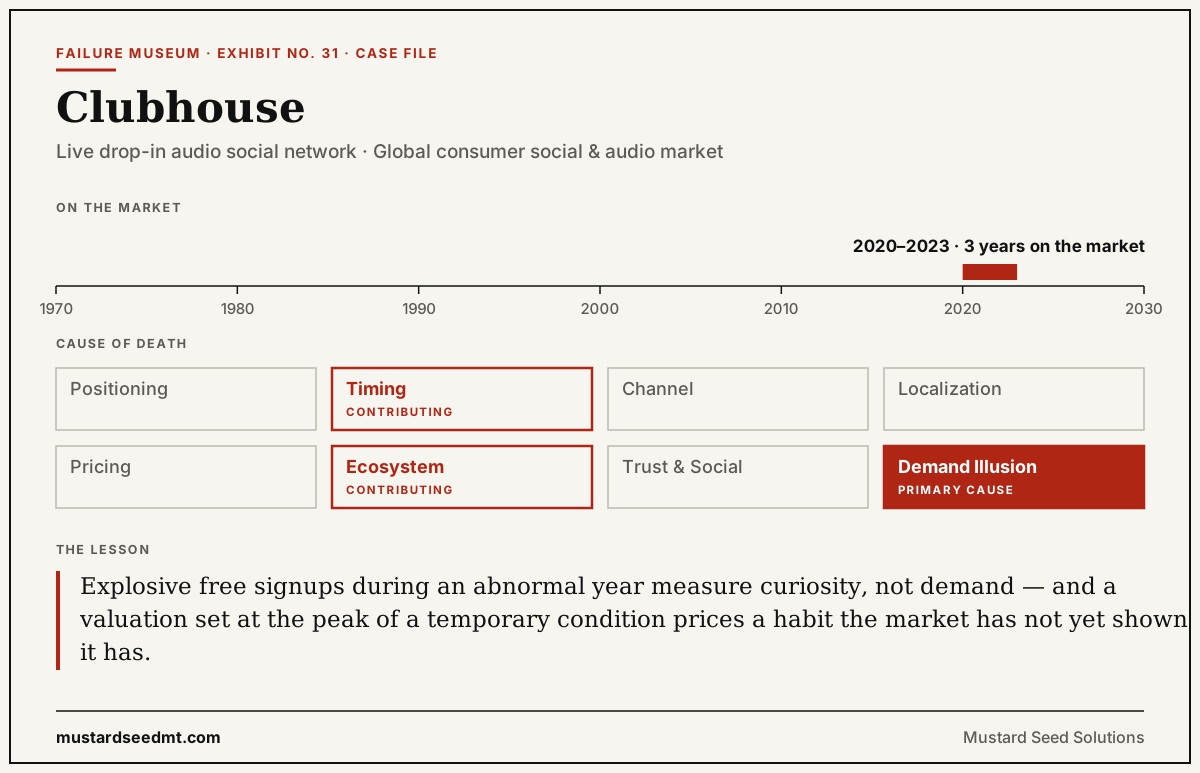
Clubhouse failed because the behaviour its growth was built on — strangers spending unstructured hours listening to live conversation — was a condition of lockdown rather than a durable habit, and the enormous free download numbers of early 2021 measured curiosity rather than demand. When ordinary life resumed and the feature appeared inside networks people already used, there was no retained behaviour underneath the growth to defend.
The diagnostic tell is the shape of the numbers. Downloads, waitlists, and press coverage all peaked spectacularly; retention and any evidence of willingness to pay never followed at comparable scale. That is the classic gap between stated and revealed preference — millions of people demonstrated that they wanted to see what Clubhouse was, and far fewer demonstrated that they wanted to be in it on an ordinary Tuesday. The founders' own explanation for the 2023 layoffs said much the same thing, attributing the decline to the world reopening and to long conversations no longer fitting into people's days.
The timing failure runs in both directions, which is unusual. Clubhouse was early enough that no incumbent had claimed live audio, and that head start was real. But the specific window it grew in was a global anomaly, and a company that raises at four billion dollars twelve months into an anomaly has priced a temporary condition as a permanent one. Then it was late: by the time the product opened to everyone, Twitter Spaces and its imitators had put the feature where users' audiences already lived, and being merely as good was no longer enough to move anybody.
Beneath both sits an ecosystem problem the company was slow to address. A room only exists if a host shows up to run it, and hosting on Clubhouse was unpaid labour performed for an audience the host could not export, message, or take anywhere. At the height of its growth there was no creator monetisation and no way to convert a full room into anything durable, so the people generating the supply had every reason to move to platforms that either paid them or connected the room to a following they owned. When the hosts left, the rooms emptied — and a live-audio network with nothing live in it has no product at all.
What Survived
The format survived everywhere except Clubhouse. Live audio rooms are now an ordinary feature of X, Discord, LinkedIn, and others: Clubhouse proved the interaction was worth building and then watched companies with existing distribution collect the value. That is a common ending for a single-feature product in social software, and it is why the strategic question was never whether live audio was good, but whether it could be owned.
Clubhouse itself did not die; it shrank and changed shape. After halving its staff in April 2023 the company rebuilt the app around small-group voice messaging between friends rather than open rooms of strangers — arguably a more honest reading of what people had actually kept doing on it, at a scale far below the valuation the boom had assigned.
Era: 2020s
Where It Ended Up: Alpha Exploration Co. cut about half its staff in April 2023 and rebuilt Clubhouse as a smaller voice-messaging product for friends; the app still exists, far below its 2021 scale
The Lesson
"Explosive free signups during an abnormal year measure curiosity, not demand — and a valuation set at the peak of a temporary condition prices a habit the market has not yet shown it has."
Sources
Related Exhibits
Quibi
A perfectly engineered answer to a question nobody, especially during a lockdown, was asking.
Juicero
$120 million to discover that hands could squeeze a juice pack just fine, thank you.
Google+
A social network nobody asked to join, built by a company that badly needed one to exist.