
The Promise
Quibi ('quick bites') was built on a specific, well-argued thesis: mobile viewers wanted premium, Hollywood-quality video content designed from the ground up for short, in-between moments — waiting in line, on a commute, between meetings — in episodes under 10 minutes, shot in a format that worked in both portrait and landscape orientation ("Turnstyle" technology, a genuine technical innovation).
Backed by $1.75 billion from major media and tech investors and led by entertainment veteran Jeffrey Katzenberg and former HP/eBay CEO Meg Whitman, Quibi commissioned name-brand talent and directors to make content exclusively for the format, betting that production quality plus mobile-native design would create a category Netflix and YouTube both missed.
The Entry
Quibi launched on April 6, 2020 — three weeks after most of the United States entered COVID-19 lockdown. The entire premise of the product (content for the in-between moments of a commuting, out-in-the-world life) was rendered moot within weeks of launch by a population suddenly confined to their homes, in front of larger screens, with no commute to fill.
The company launched with a nine-figure content budget already spent and a marketing campaign already built around the mobile-moments thesis, and had no real ability to reposition mid-flight — the content, the format, and the pitch were all mobile-first by design.
Quibi: Why It Failed
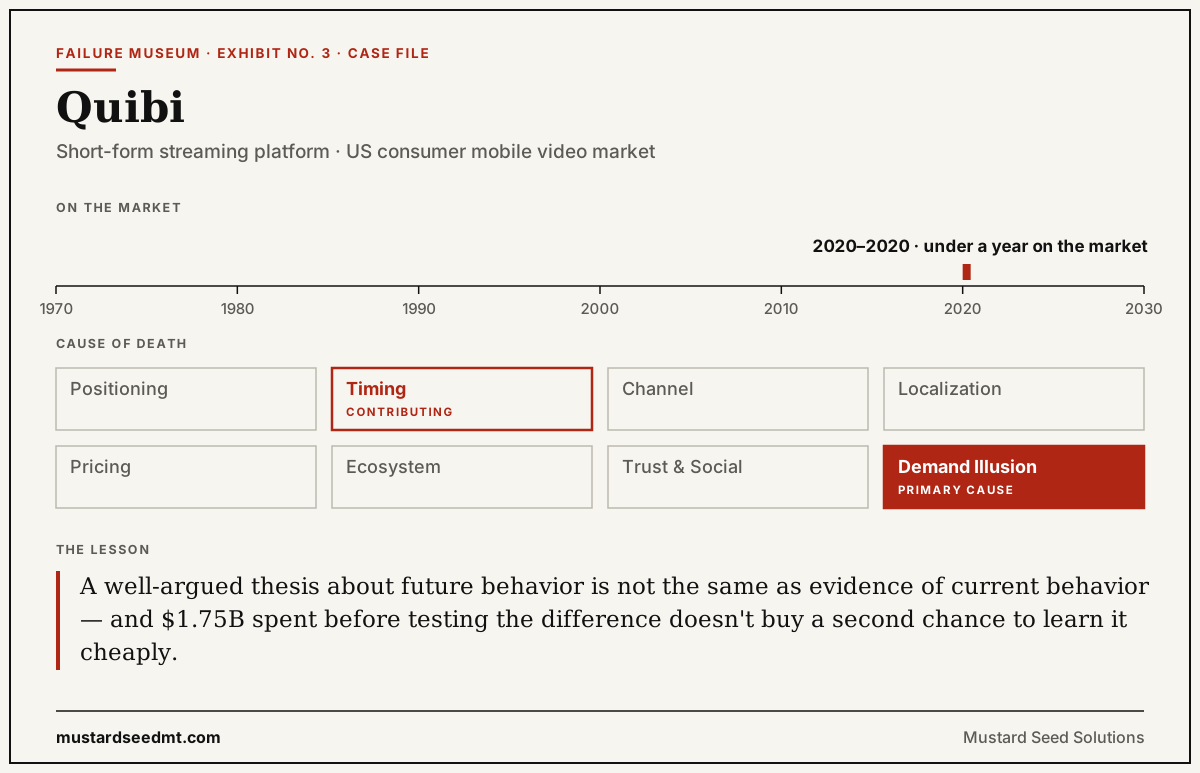
Quibi failed because the specific consumer behavior it was designed around — filling short in-between moments during a mobile, out-in-the-world life — was both an unproven bet even before COVID-19, and was then directly erased by a global lockdown that began three weeks after launch, but the deeper failure the pandemic exposed was that the underlying demand had never been validated with real usage data, only with executive conviction and market research.
The record suggests the pandemic timing was catastrophic bad luck, but our read is that it exposed a demand illusion that would likely have surfaced eventually regardless: Quibi's founders were confident based on industry experience and qualitative belief that a market for premium mobile-only short content existed, but the company never seems to have tested that belief cheaply before committing $1.75B and a full slate of star-studded content to it. The lockdown made the failure fast and total, but the underlying question — would people actually choose 10-minute premium content in a dedicated app over free YouTube or their existing streaming subscriptions — was never really answered with revealed behavior before the bet was placed.
Reinforcing the demand illusion: Quibi restricted its content to its own app with no ability to share clips to social media at launch — a feature added only months in, after widespread criticism — which meant the content had no organic path to discovery outside people already paying for the subscription, cutting off exactly the kind of viral, low-cost validation loop that might have surfaced the demand problem earlier and cheaper.
The premium content budget, ironically, made adaptation impossible: because so much capital was already committed to shooting mobile-vertical, short-form content with A-list talent before a single subscriber signed up, Quibi had no lean, iterative way to test and adjust the format against real usage the way a smaller, faster-moving competitor could have.
What Survived
Roku acquired Quibi's content library for a reported ~$100 million (a fraction of the $1.75B raised) and rebranded much of it as free, ad-supported content on the Roku Channel — the same short-form content, stripped of the subscription paywall and mobile-only format restriction, found a real if modest audience once both of those constraints were removed.
The broader short-form premium video thesis Quibi bet on didn't disappear — it resurfaced inside existing platforms with built-in audiences instead of a standalone app: YouTube Shorts, Instagram Reels, and TikTok all subsequently invested heavily in short-form video, just without a dedicated subscription app or a bet that users would download something new specifically for it.
Era: 2020s
Where It Ended Up: Shut down after 6 months; remaining content library and tech sold to Roku
The Lesson
"A well-argued thesis about future behavior is not the same as evidence of current behavior — and $1.75B spent before testing the difference doesn't buy a second chance to learn it cheaply."
Sources
Related Exhibits
Juicero
$120 million to discover that hands could squeeze a juice pack just fine, thank you.
Google+
A social network nobody asked to join, built by a company that badly needed one to exist.
Clubhouse
Ten million people downloaded the room. Almost nobody came back once the world reopened.