
The Promise
Juicero built a Wi-Fi-connected countertop press that squeezed proprietary, pre-portioned produce packs into cold-pressed juice, with a companion app that scanned a QR code on each pack to verify freshness and sync recipe data — genuinely sophisticated engineering, backed by real investors (Google Ventures, Kleiner Perkins) at a real valuation.
The pitch was premium convenience: cold-pressed juice, a category associated with expensive juice bars, made at home with no cleanup, sold via a $400 (later $700 at launch) machine plus a subscription for proprietary produce packs.
The Entry
Juicero launched its machine in 2016 at $699 (reduced from an initial $699 flagship price point that press coverage widely mocked as expensive for a juicer), paired with a subscription for proprietary juice packs priced comparably to a juice-bar drink.
The company's core technical claim — that the packs required the machine's precise, calibrated pressure to extract juice properly — went untested publicly until journalists at Bloomberg discovered, in April 2017, that the packs could be squeezed by hand, without the machine, in roughly the same time and yielding roughly the same juice.
Juicero: Why It Failed
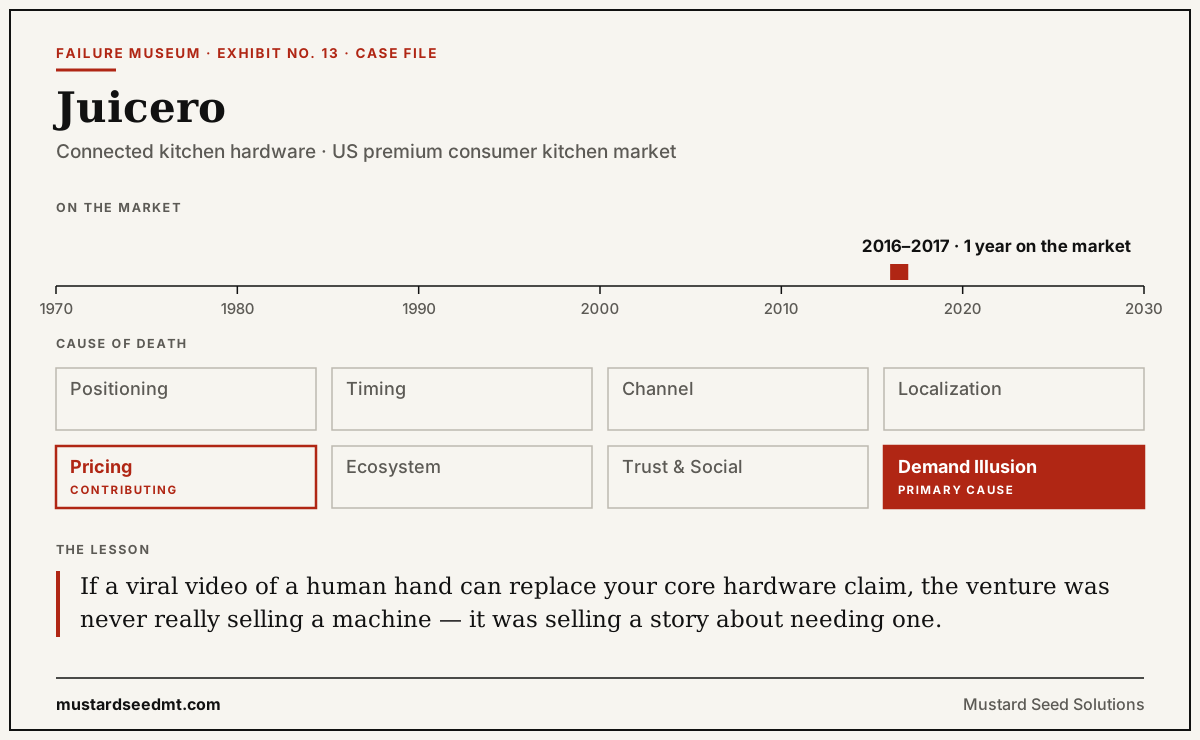
Juicero failed because the core premise justifying its $700 hardware — that a precision machine was necessary to properly extract juice from its proprietary packs — turned out to be false and was publicly demonstrated as false by journalists squeezing the packs by hand, which meant the product's entire reason to exist (rather than simply selling the juice packs directly) evaporated overnight.
The record suggests this is one of the cleanest cases of demand illusion in the collection: significant venture capital and press enthusiasm treated "a smart juicer" as an obviously desirable product category, but nobody had rigorously tested whether the machine itself added value a buyer would pay $700 for, versus simply squeezing a pre-portioned pack by hand — a test that, once performed publicly, took minutes and ended the company's credibility instantly.
Our read is that the demand illusion was compounded by a pricing failure that made the eventual revelation more damaging than it might otherwise have been: at $700 (down from an even higher original announced price), the machine asked a significant premium for convenience that a viral video demonstrated wasn't real — the gap between the price charged and the actual value delivered became the story, in a near-identical dynamic to the Segway exhibit's price-versus-delivered-value gap.
The connected, app-driven QR-code verification system, intended as a value-add (freshness checking, recipe sync), likely reinforced the perception of unnecessary complexity once the core juicing claim collapsed — a smart, connected layer built on top of a premise that didn't need to be that complicated in the first place.
What Survived
Juicero shut down entirely within about five months of the Bloomberg revelation and offered refunds to customers; there was no significant pivot or asset sale, making it one of the more complete failures in the collection rather than one with a partial afterlife.
The company became a widely cited cautionary case study in venture capital and product circles specifically about testing a product's core value proposition (does the hard part actually require the hardware?) before scaling manufacturing and marketing around it — a teaching example referenced in business coverage for years after.
Era: 2010s
Where It Ended Up: Shut down in September 2017, roughly 16 months after its first product shipped
The Lesson
"If a viral video of a human hand can replace your core hardware claim, the venture was never really selling a machine — it was selling a story about needing one."
Sources
Related Exhibits
Quibi
A perfectly engineered answer to a question nobody, especially during a lockdown, was asking.
Google+
A social network nobody asked to join, built by a company that badly needed one to exist.
Clubhouse
Ten million people downloaded the room. Almost nobody came back once the world reopened.