
The Promise
Portal was Facebook's first self-branded consumer hardware: a smart display built around video calling, launched in November 2018 at $199 (with a larger Portal+ at $349), with one genuinely differentiated feature — an AI-driven camera that panned and zoomed automatically to keep people in frame, so a call felt less like posing for a webcam and more like being in the room. Built on Messenger and later WhatsApp, it aimed at the one behavior — calling family — that Facebook's social graph positioned it to own.
This was a serious program, not a side experiment: reviewers consistently rated the calling experience ahead of Amazon's Echo Show and Google's Nest Hub, the pricing was aggressive, and Facebook iterated quickly through a full line — Portal Mini, Portal TV, Portal Go — over the following years. On hardware execution alone, Portal earned a place in the category.
The Entry
The timing could hardly have been worse. Portal launched months after the Cambridge Analytica scandal had made Facebook a global shorthand for data misuse, in a year punctuated by further Facebook privacy and security incidents. The product asked consumers to install a Facebook-branded camera and microphone in the kitchen or living room at precisely the moment public trust in the company was at its lowest. Review after review followed the same arc: praise for the device, followed by hesitation about its maker. A launch-window stumble reinforced the fear — Facebook had to walk back its initial suggestion that Portal usage data wouldn't feed ad targeting, clarifying that some of it could.
Positioning never resolved either. The smart display category had been defined by Amazon and Google as assistant-first devices, and Portal was calling-first with a borrowed assistant (Alexa was built in). Buyers who wanted a smart display defaulted to the Echo ecosystem; buyers who wanted video calls mostly already had them, free, on the phones and tablets they owned. Portal's differentiated feature was real but narrow, and its structural disadvantage was the logo on the box.
Facebook Portal: Why It Failed
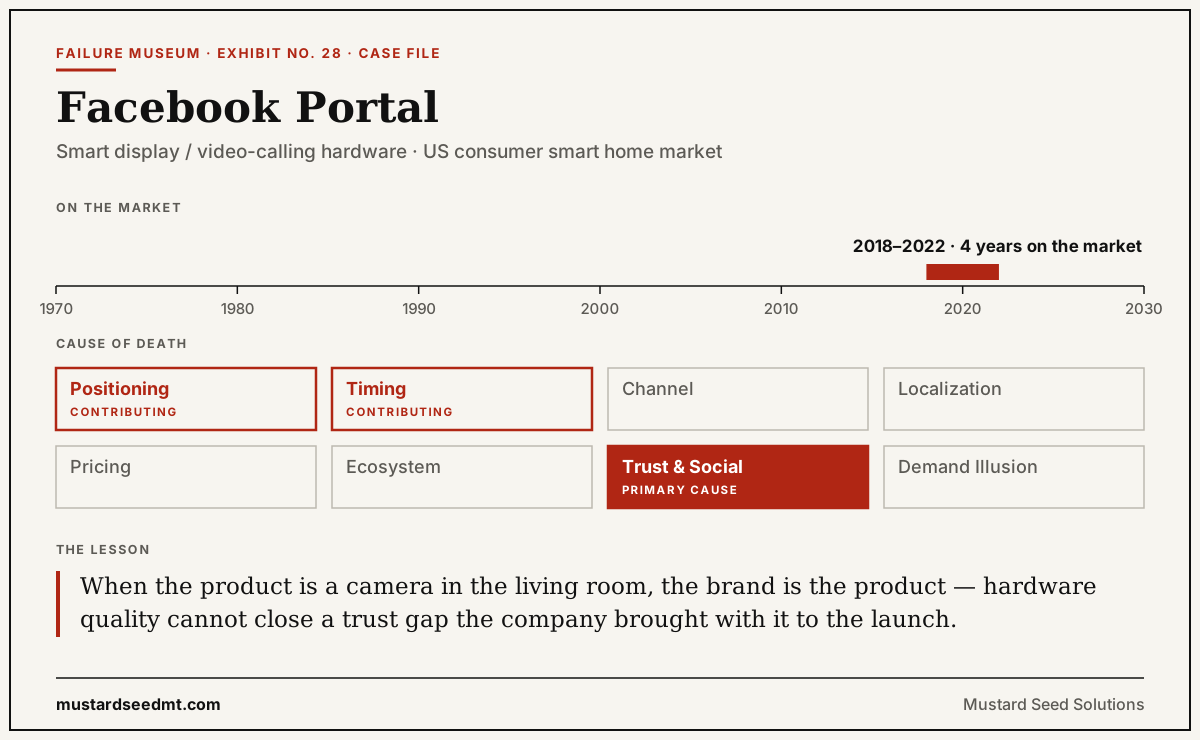
Facebook Portal failed because the product required a level of trust in Facebook — a camera and microphone from the company, aimed at the living room — that the company's own reputation made unavailable, at exactly the post-Cambridge Analytica moment when that gap was widest. The hardware was widely judged excellent; the objection was never to what the device did, but to who was selling it.
Portal is close to the museum's purest recorded case of the trust-and-social diagnostic: the company's existing reputation on privacy was weaker than the trust this specific product required, and no amount of product quality could close a values-level objection. Facebook understood the objection well enough to engineer against it — a physical camera cover shipped in the box, a hardware switch cut the microphone, and the smart-camera processing was described as happening on-device. The record suggests these were real mitigations that answered the letter of the concern but not its source, because the concern was never about the sensor. It was about the vendor.
The timing failure was a choice, not luck: launching a Facebook home camera in the immediate aftermath of the company's worst trust crisis meant entering the market at the moment the brand was least able to carry the product. And the category handed Portal an extraordinary second chance anyway — the 2020 lockdowns produced a once-in-a-generation demand spike for home video calling, and Portal sales genuinely benefited. That even this could not convert into a durable franchise is strong evidence the constraint was never awareness or utility.
Positioning sealed the outcome at the margins: without an assistant, commerce, or content ecosystem of its own, Portal's advantage (better calling) was a feature competitors could approximate over time, while its disadvantage (brand trust) was one Facebook could not patch with firmware. Meta announced in 2022 that it was done with the consumer Portal line — first repositioning it toward business use, then winding it down entirely — and moved its hardware ambitions to categories where the trust equation ran less against it.
What Survived
The interaction Portal led with became table stakes: automatic framing that keeps people in shot during calls is now an expected feature across smart displays, laptops, and tablets — Apple's Center Stage being the most visible descendant of the experience Portal shipped early.
Meta's hardware ambitions survived by relocating to friendlier trust terrain: Quest headsets (an acquired, gaming-first brand worn by choice) and later Ray-Ban smart glasses — categories where Meta could enter as the enabler of a new activity rather than asking to be admitted, as itself, to the family kitchen.
Era: 2010s
Where It Ended Up: Discontinued 2022; Meta wound the Portal line down (after briefly repositioning it for business use) and refocused consumer hardware on Reality Labs — Quest headsets and smart glasses
The Lesson
"When the product is a camera in the living room, the brand is the product — hardware quality cannot close a trust gap the company brought with it to the launch."
Sources
Related Exhibits
Google Glass (Consumer)
The future arrived wearing a camera on its face. The public asked it to leave.
Google Stadia
The tech worked. The trust that Google would keep it running didn't.
Peloton Tread+
The company's answer to a safety regulator was to dispute it. Three weeks later it recalled 125,000 treadmills.