
The Promise
The Tread+ was Peloton's attempt to repeat on a treadmill what it had already done with the stationary bike: take a piece of gym equipment, attach a large screen and a live class, and sell the result as a premium object for the home. At roughly $4,295 it was among the most expensive consumer treadmills available, with a slatted running belt, a high-set deck, and the build quality of commercial equipment.
The commercial logic was strong and the product was well regarded. Peloton had already proven that people would pay gym prices in order not to go to the gym, and the pandemic then delivered the largest demand shock in the history of home fitness. Through 2020 and into early 2021 the constraint on Peloton's business was manufacturing and delivery, not desire.
The Entry
The design that made the Tread+ feel premium also made it dangerous in the room it was sold into. The slatted belt sat high off the floor with a gap beneath the rear roller and no rear guard, while the brand promise placed the machine in a living room or spare bedroom in a family home — a context where children, pets, and objects share the floor with it. Commercial gyms exclude all three by policy; a house cannot.
In March 2021 Peloton disclosed that a child had died in an incident involving a Tread+. In April the US Consumer Product Safety Commission took the unusual step of issuing a unilateral urgent warning after Peloton declined a joint recall, citing dozens of reports of children, pets, and objects being pulled underneath the machine. Peloton publicly called the warning inaccurate and misleading, and told owners the product was safe when used as directed.
Peloton Tread+: Why It Failed
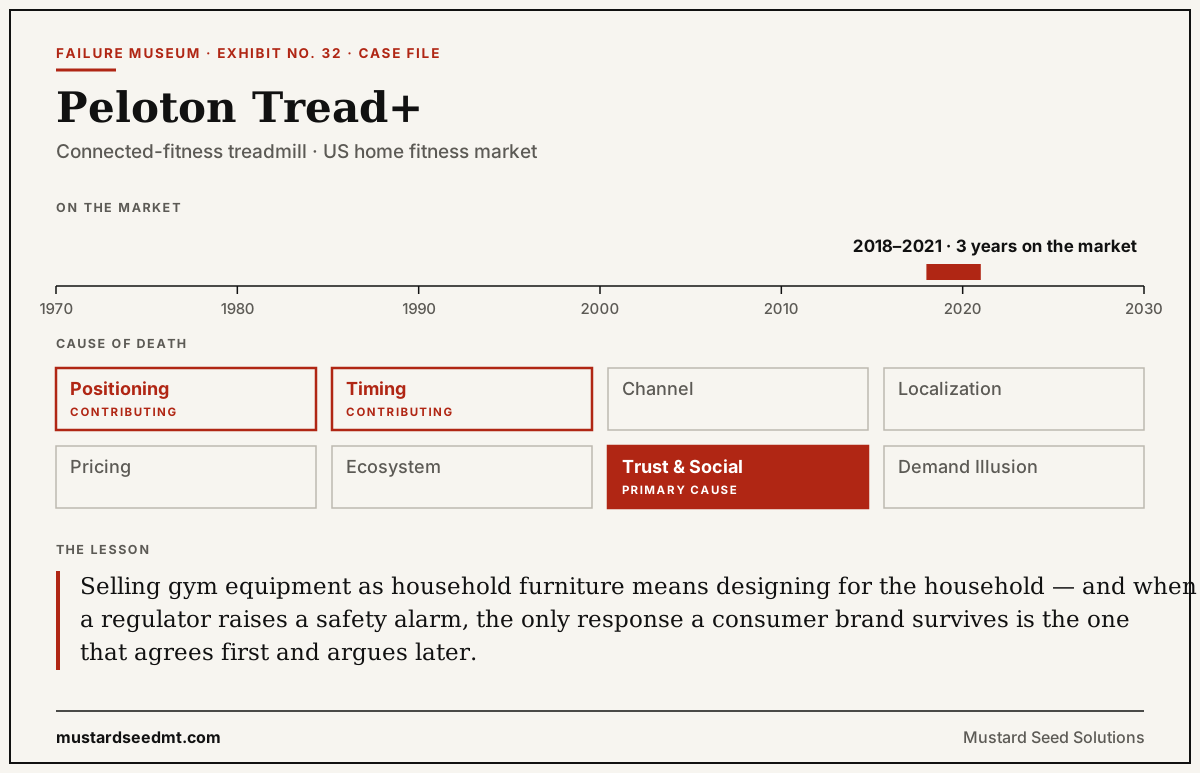
The Tread+ was withdrawn from the market because a product sold for the family home carried a hazard the family home could not be trusted to manage, and because the company's first response to the regulator was to argue rather than act. On 5 May 2021 Peloton recalled roughly 125,000 Tread+ units, and chief executive John Foley stated plainly that the company had made a mistake in its initial response to the CPSC.
The trust failure has two layers, and the second is the one that belongs in a museum of market entry. The first is ordinary product safety: a hazard existed, it was documented, and it was fatal. The second is that Peloton spent three weeks contesting a safety regulator in public — telling owners the machine was safe while the agency was telling them to stop using it around children — which forced customers to choose between two authorities on a question about their own households. There is no version of that argument a consumer brand wins, and the reversal that followed converted a safety problem into a credibility problem that outlasted it.
Positioning made the hazard structural rather than incidental. Peloton's entire proposition was that gym-grade equipment belongs in the home, and the Tread+ was engineered to gym-grade assumptions: adults only, supervised space, nobody unexpected on the floor. Selling a machine as a lifestyle object for the household while designing it for an environment the household does not resemble is the mismatch, and no warning label reconciles the two. The eventual remedy was physical — a rear guard, approved by the CPSC in 2023 — which is itself an admission that the original design had assumed a room the product was never going to be in.
Timing turned an expensive incident into a strategic one. The recall landed at the exact top of the connected-fitness demand curve: gyms were reopening, Peloton's growth assumptions were about to reverse, and the Tread+ — the product meant to carry the company beyond the bike — spent more than two years off the US market. What was lost was not only revenue but the specific window in which a second flagship could have been established, and the product re-entered in late 2023 against a smaller category and a considerably more sceptical buyer.
What Survived
The Tread+ itself survived, with a physical fix: the CPSC approved a rear-guard repair in 2023 and the product returned to sale alongside a cheaper Tread model aimed at the same buyers. Peloton also emerged with a materially different compliance posture, having learned in the most public way available that a safety regulator is not a communications problem.
The category kept going without pause. Connected fitness contracted sharply as gyms reopened, but the underlying proposition — instructor-led classes streamed to equipment at home — is now permanent and competitive, and the specific design question the Tread+ forced into the open, namely what a machine that lives in a family home must assume about that home, is now a routine part of how the category is engineered.
Era: 2020s
Where It Ended Up: Peloton Interactive remains public (Nasdaq: PTON); the Tread+ returned to US sale in late 2023 after the CPSC approved a rear-guard repair, into a connected-fitness market far smaller than the one it left
The Lesson
"Selling gym equipment as household furniture means designing for the household — and when a regulator raises a safety alarm, the only response a consumer brand survives is the one that agrees first and argues later."
Sources
Related Exhibits
Google Glass (Consumer)
The future arrived wearing a camera on its face. The public asked it to leave.
Google Stadia
The tech worked. The trust that Google would keep it running didn't.
Facebook Portal
An excellent video-calling camera from the one company nobody wanted watching the living room.