
The Promise
Daydream, announced in 2016, was Google's plan to make virtual reality a standard feature of Android rather than a separate product category: a platform specification ("Daydream-ready" phones), a $79 fabric-covered headset with a motion controller (Daydream View), and first-party content — YouTube VR, Street View, Play Movies — to seed the library. After the giveaway-scale distribution of Google Cardboard, the theory wrote itself: the phone in your pocket was already the VR headset; Google would supply the standard, OEMs the devices, and developers the apps.
It was a platform play in classic Google style — low-cost hardware to bootstrap an installed base, a spec licensed across manufacturers, and app-store economics waiting to reward developers once the audience arrived.
The Entry
Each leg of the ecosystem underdelivered. Daydream-ready phones remained a modest subset of Android flagships, and Samsung — the one OEM whose flagships mattered most — was already committed to Gear VR with Oculus, splitting mobile VR into two competing platforms neither of which reached critical mass. Developers, asked to build for a small and fragmented installed base, mostly declined. And the users who did buy a View ran into the experience problem Google itself later acknowledged: sealing your phone into a headset cuts you off from everything else the phone does, and usage sagged once the novelty demos were exhausted.
Meanwhile the category moved out from under it. Standalone headsets — Oculus Go, then Quest in 2019 — made phone-based VR the awkward middle: more friction than a standalone, less capability. Google discontinued Daydream in October 2019, shipping the Pixel 4 without support and stating plainly that consumer and developer adoption had fallen short of its hopes.
Google Daydream: Why It Failed
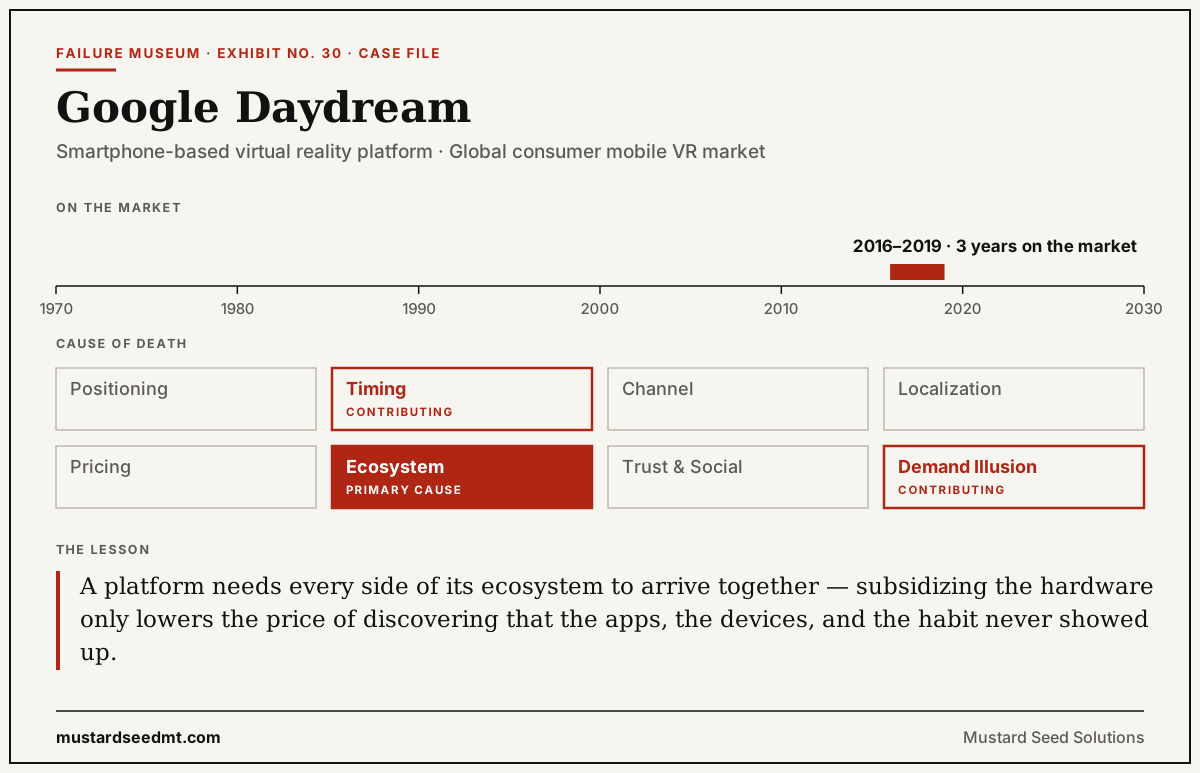
Google Daydream failed because the ecosystem it depended on — phone makers shipping Daydream-ready devices, developers building for them, and users coming back after the novelty — never materialized at the scale a platform needs, while standalone headsets made the phone-in-a-headset architecture obsolete within three years. The $79 price solved the wrong problem: cost was never what kept mobile VR from becoming a habit.
Daydream is a three-sided ecosystem failure, and every side had the same rational objection. OEMs were asked to meet a hardware spec for a use case with no proven pull; developers were asked to invest in an installed base that was both small and split with Gear VR — a competing platform that already held the mobile-VR developer attention Daydream needed to attract; and Google's first-party content, though real, was never a bridge strong enough to carry the platform while the third-party layer stayed thin. The chicken-and-egg trap closed exactly as the taxonomy predicts when no side has a reason to move first.
Beneath the ecosystem problem sat a quiet demand illusion. Cardboard's enormous distribution numbers read internally and externally as validated demand for mobile VR, but Cardboard was a demo — largely given away, used a handful of times, and costless to abandon. That is stated preference wearing the costume of revealed preference. When Daydream attached even a modest price and an expectation of habitual use to the same behavior, the return visits didn't follow; Google's own retirement explanation centered on the observation that locking the phone away from its other jobs was a friction users wouldn't repeatedly pay.
Timing finished it. Phone-based VR turned out to be a transitional architecture, and the transition was faster than a platform flywheel could spin up: by the time Daydream's ecosystem could plausibly have compounded, the standalone generation had redefined what entering VR meant. Daydream was squeezed between Cardboard's free novelty below and Quest's genuine immersion above — a positioning band that simply stopped existing. Google, to its credit and to the pattern of its hardware history, cut quickly rather than subsidizing a stranded architecture.
What Survived
Pieces of the design survived into the category that displaced it: the simple motion controller and approachable, soft-goods industrial design showed up in the standalone generation's thinking, and the Daydream-powered Lenovo Mirage Solo (2018) was itself an early standalone headset — a preview of the architecture Google chose not to follow through on.
Google's immersive computing bet consolidated where its distribution advantage actually worked: augmented reality through ARCore and camera features on the phone itself — the screen-out rather than screens-in direction. The VR demand Daydream chased was ultimately vindicated by exactly the standalone architecture that killed it, which is the failure in one sentence: the market was real, and the phone was the wrong door into it.
Era: 2010s
Where It Ended Up: Platform discontinued October 2019, when the Pixel 4 shipped without Daydream support; Google exited consumer VR hardware and consolidated immersive efforts around AR (ARCore)
The Lesson
"A platform needs every side of its ecosystem to arrive together — subsidizing the hardware only lowers the price of discovering that the apps, the devices, and the habit never showed up."
Sources
Related Exhibits
Better Place
A brilliant answer to EV range anxiety, waiting for car companies who never signed up.
Windows Phone
Genuinely well-designed. Genuinely appless. Guess which one buyers noticed first.
HP TouchPad / webOS
Forty-nine days on shelves. A fire-sale price tag made it a cult classic anyway.