
The Promise
Windows Phone, launched in 2010 and refined significantly with Windows Phone 8 in 2012, was widely praised by reviewers for a genuinely distinctive, clean "Metro" tile-based interface that many considered more elegant and information-dense than iOS's or Android's app-grid approach at the time.
Microsoft committed serious resources to the platform, including a $7.6 billion acquisition of Nokia's devices business in 2014 to secure hardware manufacturing and design talent directly, aiming to build a genuine "third ecosystem" alongside iOS and Android.
The Entry
By the time Windows Phone reached a genuinely competitive product state (Windows Phone 8, 2012), iOS and Android had already established a multi-year head start building the two-sided app-developer ecosystem — millions of consumers already on those platforms, which meant developers naturally built for iOS and Android first and Windows Phone last, if at all.
Microsoft's own app store consistently lagged behind competitors' equivalents by months or years for major apps, and many high-profile apps (certain banking apps, some social platforms, specific games) never arrived on Windows Phone at all, or arrived in stripped-down, poorly maintained versions.
Windows Phone: Why It Failed
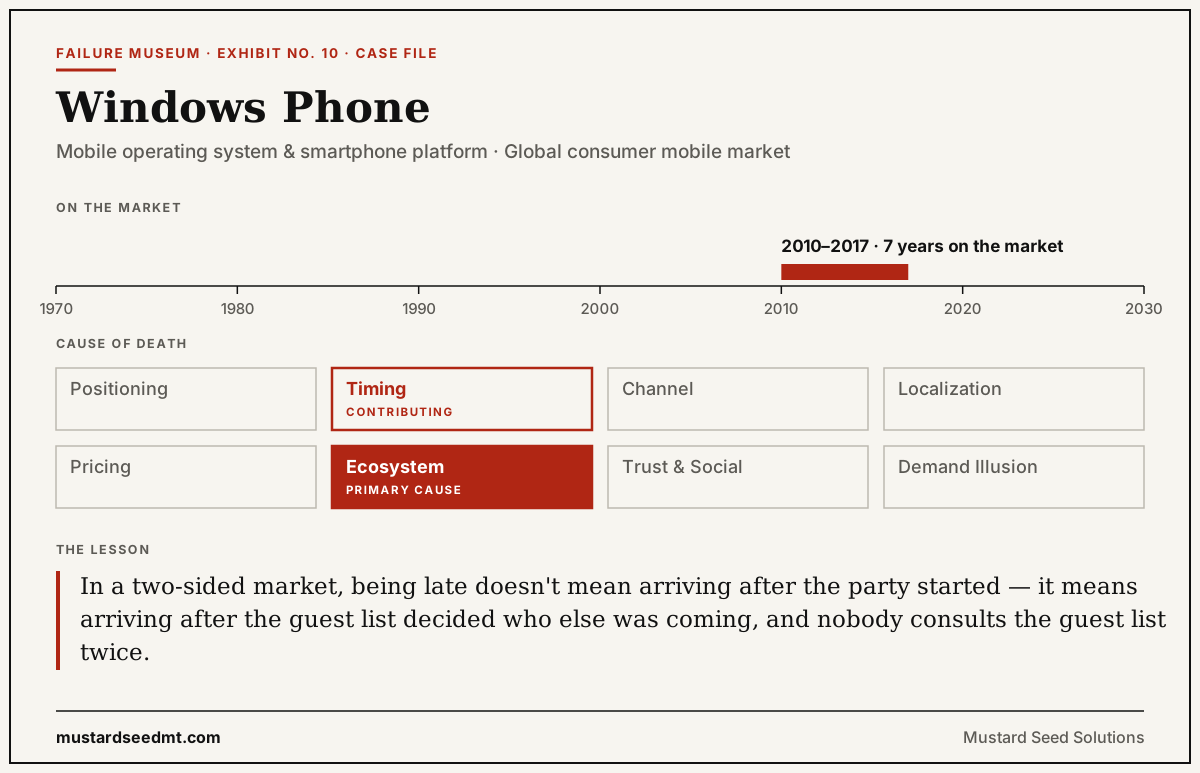
Windows Phone failed because it entered a mobile app ecosystem war years after iOS and Android had already achieved the developer-and-user scale needed to make each other the default choice, and no amount of interface design quality could overcome a smartphone buyer's practical need for the apps — banking, social, niche utilities — that developers simply weren't building for a third, smaller platform.
The record suggests this is the museum's clearest case of an ecosystem failure operating at full strength: developers build for the platforms with the most users, and users choose platforms with the most apps — a self-reinforcing loop that, once iOS and Android achieved critical mass, made any third entrant's product quality nearly irrelevant to the outcome, regardless of interface design.
Our read is that Microsoft understood the ecosystem problem and tried to solve it directly through the Nokia acquisition — controlling hardware to guarantee volume and using that volume to court developers — but the $7.6B bet came several years after the app-gap had already hardened into consumer perception ("Windows Phone doesn't have the apps I need"), a reputation that proved harder to reverse than the underlying app-count gap itself.
The interface quality, ironically, may have made the ecosystem failure more visible rather than less: reviewers and users consistently praised the design while simultaneously reporting they couldn't switch because a specific app they depended on wasn't available — meaning the product's core strength was never in question, only its ecosystem, which no design award could fix.
What Survived
Microsoft wrote off the majority of the Nokia acquisition's value within about a year and formally discontinued Windows Phone development in 2017, but the Metro/tile design language directly influenced Windows 8's and Windows 10's Start Menu redesign and Xbox's dashboard interface, both of which persisted for years afterward.
The clearest strategic lesson Microsoft itself drew — visible in its subsequent moves — was to stop competing for a third mobile OS and instead make its software (Office, Teams, Xbox game streaming) excellent on iOS and Android, the platforms that had already won the ecosystem war, rather than trying to win a fourth round of a battle already decided by developer economics.
Era: 2010s
Where It Ended Up: Discontinued 2017; design language ("Metro"/tile-based UI) influenced later Windows and Xbox interfaces
The Lesson
"In a two-sided market, being late doesn't mean arriving after the party started — it means arriving after the guest list decided who else was coming, and nobody consults the guest list twice."
Sources
Related Exhibits
Better Place
A brilliant answer to EV range anxiety, waiting for car companies who never signed up.
HP TouchPad / webOS
Forty-nine days on shelves. A fire-sale price tag made it a cult classic anyway.
Betamax
Widely considered the better format. Lost anyway — the classic standards war.