
The Promise
Better Place addressed the single biggest objection to early EV adoption directly: instead of waiting 30+ minutes to charge a battery, drivers would pull into a station and swap a depleted battery for a charged one in about the time it takes to fill a tank of gas. The robotic swap stations worked, the batteries worked, and the underlying engineering was proven at pilot scale.
Founded by Shai Agassi in 2007 with roughly $850 million raised, Better Place built its first national networks in Israel and Denmark — small, geographically contained countries chosen deliberately to make full national coverage achievable, rather than trying to blanket a country the size of the US.
The Entry
The entire model depended on one structural requirement: car manufacturers had to build vehicles with standardized, swappable battery packs compatible with Better Place's robotic stations. Better Place itself made no cars — it was, by design, an infrastructure and battery-subscription business that needed automakers to supply the vehicles.
Renault was the only major manufacturer that committed, producing the Fluence Z.E. specifically compatible with Better Place's swap stations. No other global automaker signed on in the volumes required, leaving Better Place with a fully built swap-station network and only one, low-volume compatible car.
Better Place: Why It Failed
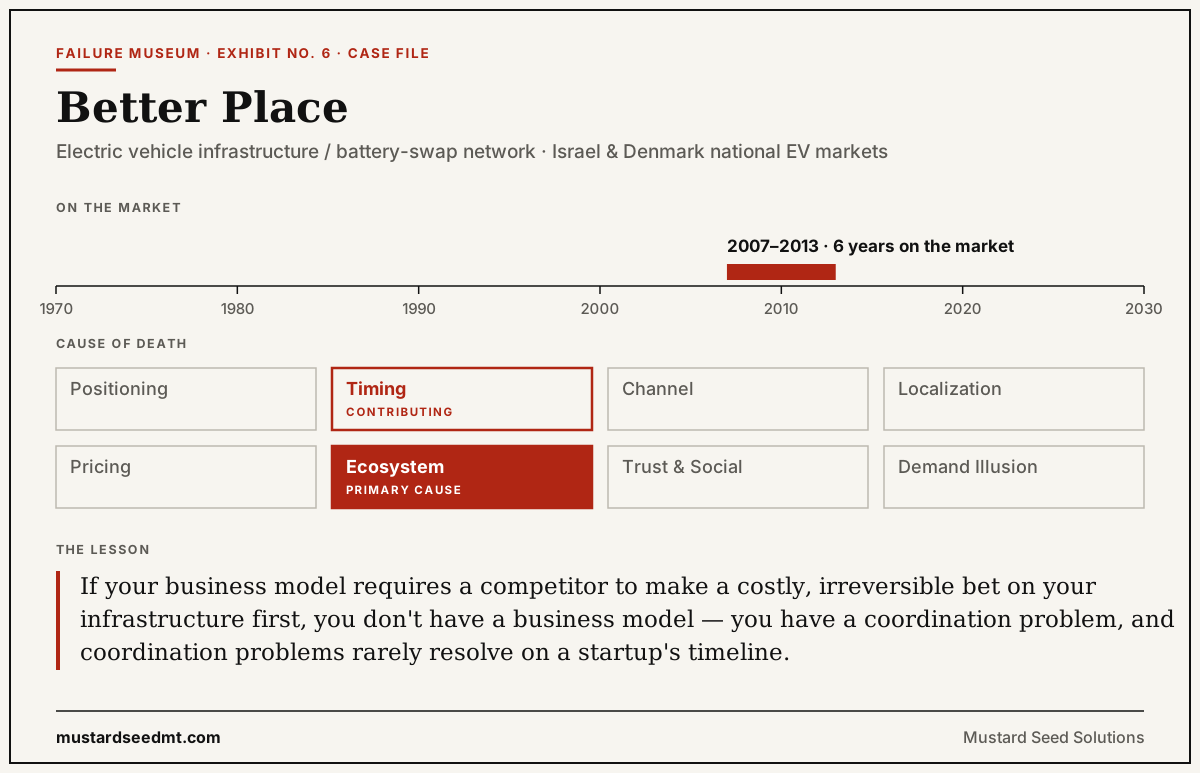
Better Place failed because its entire business model depended on multiple car manufacturers adopting a standardized, swappable battery format, and only one (Renault, in low volume) ever did — leaving a fully built, functioning infrastructure network with too few compatible vehicles to ever reach the subscriber volume the stations needed to break even.
The record suggests this is a textbook ecosystem failure: Better Place correctly solved the consumer-facing problem (range anxiety) but had no leverage to force the actual precondition for its business to work — automaker buy-in — because building a swappable-battery car meant an automaker redesigning its EV around Better Place's specific station format, a large bet on a young startup's infrastructure with no guarantee other automakers would follow and create real scale.
Our read is that the chicken-and-egg problem ran in both directions and neither side could move first: automakers had no reason to commit engineering resources to Better Place's battery-swap standard without proof that a large network of stations and subscribers already existed, and Better Place couldn't build a large network of profitable stations without multiple automakers' cars already using it. Renault's single, modest commitment was not enough volume to break that loop.
The bet on Israel and Denmark as small, contained proving grounds was strategically sound but didn't solve the automaker problem — full national coverage in two small countries was achievable with the capital raised, but it didn't change the calculus for a global automaker deciding whether to redesign a car platform around an infrastructure standard that, everywhere outside those two countries, didn't exist yet.
What Survived
The core insight — that battery swapping, not just faster charging, solves EV range anxiety for high-utilization vehicles — resurfaced roughly a decade later in China, where NIO built a battery-swap network with a fundamentally different structure: NIO makes its own cars, so it controls both sides of the ecosystem problem that killed Better Place, removing the need to convince outside automakers to adopt a shared standard.
NIO's swap network, launched from 2018 onward, has scaled to hundreds of stations across China specifically because the company eliminated the coordination problem Better Place couldn't solve — a direct structural lesson from this exhibit that the museum's LeEco exhibit (localization failure) also touches on from the opposite direction.
Era: 2000s
Where It Ended Up: Filed for bankruptcy in Israel in 2013; battery-swap concept resurfaced in China roughly a decade later
The Lesson
"If your business model requires a competitor to make a costly, irreversible bet on your infrastructure first, you don't have a business model — you have a coordination problem, and coordination problems rarely resolve on a startup's timeline."
Sources
Related Exhibits
Windows Phone
Genuinely well-designed. Genuinely appless. Guess which one buyers noticed first.
HP TouchPad / webOS
Forty-nine days on shelves. A fire-sale price tag made it a cult classic anyway.
Betamax
Widely considered the better format. Lost anyway — the classic standards war.