
The Promise
In 1995, Nintendo — then the most credible name in gaming hardware — shipped a console promising the era's most hyped technological frontier: virtual reality. The Virtual Boy, developed within the R&D group of Game Boy creator Gunpei Yokoi, was a tabletop stereoscopic system — look into the visor and see genuine depth — offered at a mass-market price of $179.95 in the US.
The underlying instinct was right twice over. Immersive 3D really was gaming's future, both in the polygonal revolution arriving that same generation and in the headset VR wave two decades later. And Nintendo's signature strategy — using cheaper, proven component technology in novel ways — had just produced the Game Boy's decade of dominance. The Virtual Boy was that same playbook, pointed at a technology the mid-1990s could not yet build.
The Entry
What shipped could not deliver what the name promised. The display constraints of the era forced a red-only LED image on a black field; there was no head tracking, so "virtual reality" in practice meant standing still, hunched over a visor on a tripod, in monochrome. It was not portable like a Game Boy and not shareable like a living-room console — a solitary, physically awkward device between categories, launched with health guidance about eye strain and against extended use by young children, into Nintendo's otherwise family-shared context.
The launch window sealed it. 1995–96 was precisely the moment the industry pivoted to the PlayStation, the Saturn, and Nintendo's own imminent N64: real-time polygonal 3D, in color, on the television. Against that comparison the Virtual Boy read as a novelty, developers treated it as a doomed platform — fewer than two dozen games were ever released — and Nintendo's own attention and marketing muscle were already committed to the N64. It was discontinued within about a year, one of the shortest-lived consoles Nintendo has ever shipped.
Nintendo Virtual Boy: Why It Failed
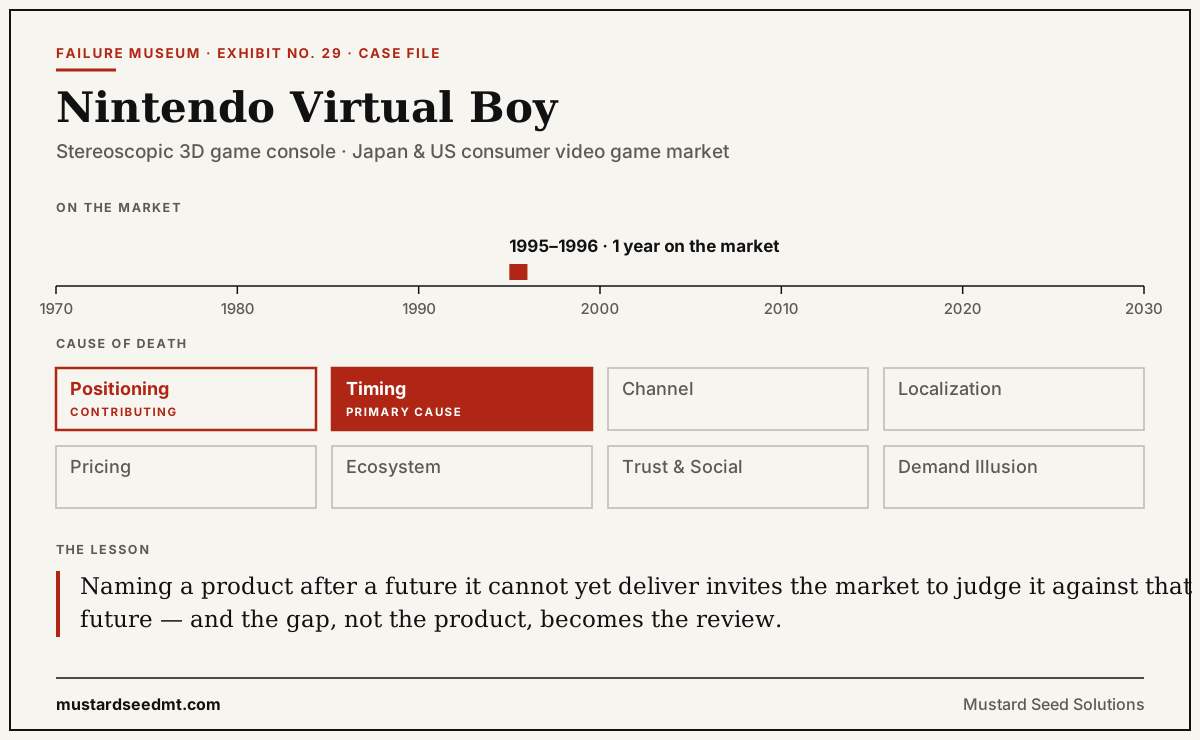
The Virtual Boy failed because it promised virtual reality roughly two decades before consumer technology could deliver it, and shipped what that gap forced: a monochrome, stationary, tabletop approximation that satisfied neither the VR promise nor the ordinary standards of a 1995 game console. The concept was early; the product, judged against its own name, was inevitably a disappointment.
This is the museum's cleanest specimen of "right in concept, wrong in decade." Every compromise that defined the product — the red LED display, the absent head tracking, the tripod posture — traces to an external dependency (display cost, sensor technology, processing power) that simply had not shipped yet, and would not until the smartphone component supply chain of the 2010s made consumer headsets viable. The roadmap assumed a technological context that was twenty years away, and no amount of execution inside Nintendo could summon it earlier.
Positioning turned the timing gap into a public verdict. The name wrote a check the hardware could not cash: reviewers and buyers judged the Virtual Boy as virtual reality — the framing Nintendo itself chose — and found it absurd, rather than judging it as what it more honestly was, a novel stereoscopic game machine. At the same time it sat between Nintendo's own categories, neither handheld nor console, with no natural occasion of use, and its most direct competition for buyer attention was Nintendo's own imminent, far more exciting N64.
The record also suggests an organizational timing failure layered on the technological one: accounts from the period describe a product pushed to market as the company's focus and resources shifted to the N64, shipping before its designers considered it ready. Whatever the internal specifics, the observable result was a launch with a thin game library, limited marketing commitment, and a quiet discontinuation — the pattern of a product its own company had stopped believing in before the market got its first look.
What Survived
Nintendo's appetite for interface bets survived intact and later paid off spectacularly — the DS touchscreen, the Wii's motion controls — and the 3DS delivered glasses-free stereoscopic 3D in 2011, in a real sense the Virtual Boy's promise finally made good by mature display technology. Instructively, even then 3D proved a minor selling point: a postscript on just how far ahead of actual demand the Virtual Boy had been.
The VR thesis itself was vindicated on the Virtual Boy's terms twenty years later, when panels, tracking, and compute finally existed: the Oculus generation built a real consumer VR market on exactly the immersion the 1995 hardware could only gesture at. The Virtual Boy, meanwhile, became a collector's item and the cautionary reference point invoked in nearly every VR launch discussion since.
Era: pre-2000
Where It Ended Up: Discontinued in 1996, within about a year of launch; Nintendo itself was unharmed — the Nintendo 64 shipped the same year — and returned to stereoscopic 3D with the 3DS in 2011
The Lesson
"Naming a product after a future it cannot yet deliver invites the market to judge it against that future — and the gap, not the product, becomes the review."
Sources
Related Exhibits
Webvan
Grocery delivery for a world that wasn't online yet, built at a scale that assumed it already was.
Microsoft Zune
A genuinely competent music player, arriving to a war the iPod had already won.
Sony Aibo (1st Generation)
A robot companion for a home the market wasn't living in yet.