
The Promise
Vine's founding insight was that constraint could be a creative medium: six seconds of video, looping forever, shot on a phone. Twitter believed in the idea strongly enough to acquire the company in October 2012 — before the app had even launched — for a reported $30 million, and when Vine went live in January 2013 it was positioned as the video-native answer to Twitter itself: brevity as the format, the phone as the camera, the loop as the punchline.
Culturally, it delivered beyond any reasonable expectation. Vine minted a first generation of platform-native video stars, invented comedic formats that still structure short video today, and pushed catchphrases and jokes into mainstream culture at a pace no platform its size had managed before. For a stretch of the mid-2010s, the six-second loop was where mobile video culture actually happened.
The Entry
The competitive response arrived almost immediately: Instagram added video within months of Vine's launch, and over the following two years Instagram, Snapchat, and YouTube all offered Vine's creators the same audiences plus something Vine never built — ways to get paid. Twitter ran Vine as a lean standalone app with no meaningful advertising product and no creator monetization tools, treating the content supply as if it were free and self-renewing.
It wasn't. Vine's top creators were running businesses, doing brand deals informally around the platform rather than through it, and as their audiences grew everywhere else, the economics of posting to Vine first stopped making sense for exactly the people who made the app worth opening. In 2015, a group of Vine's most-followed creators reportedly approached the company with a proposal to keep posting in exchange for guaranteed compensation; Vine declined, and the exodus that followed drained the platform of its supply side while its format was being absorbed as a feature everywhere else.
Vine: Why It Failed
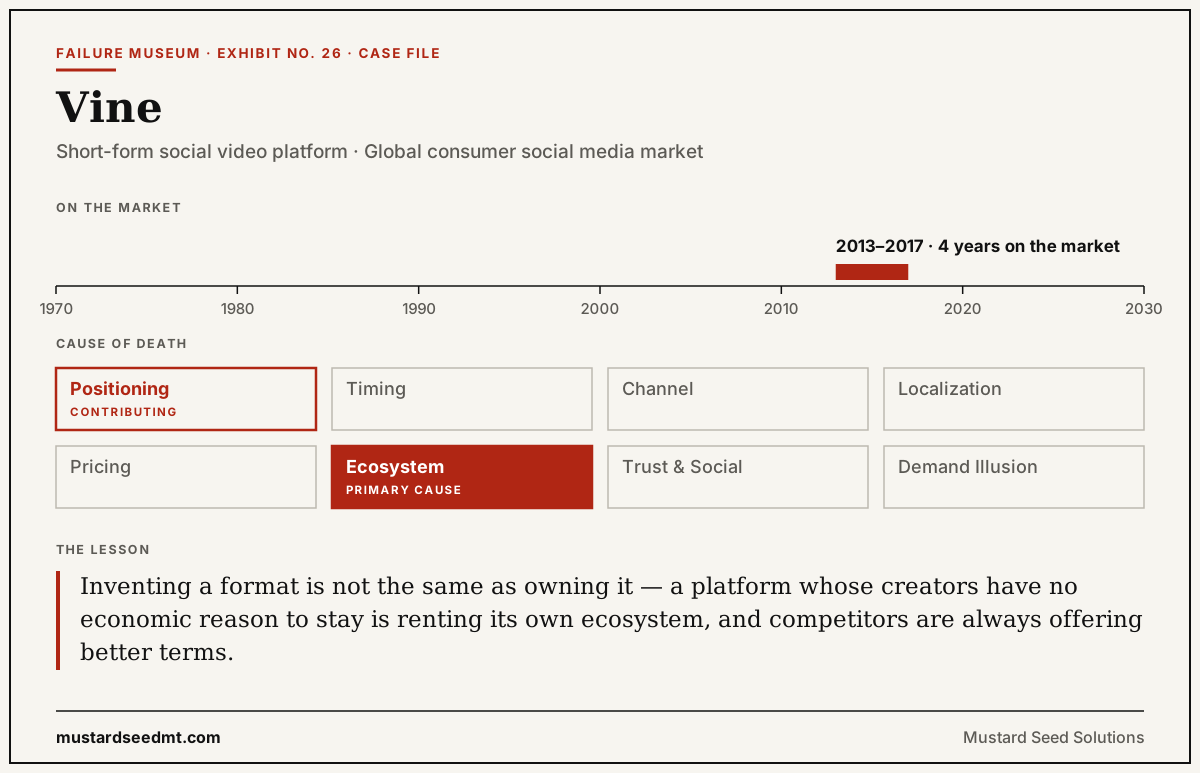
Vine failed because its entire value was produced by a creator ecosystem it never gave an economic reason to stay, while competing platforms with bigger audiences and real monetization absorbed both its stars and its format. Audience demand was never the problem — the missing piece was the business layer that paid the people supplying the content. By late 2016, Twitter, under cost pressure of its own, chose to shut the app down rather than build that layer.
The record makes Vine an unusual ecosystem failure: most platforms die because the third-party layer never shows up, but Vine's showed up spectacularly and then left. The complementary layer a video platform depends on isn't developers — it's creators, and creators behave like any other ecosystem partner: they invest where the return is. Vine solved the cold-start problem, achieved genuine cultural escape velocity, and then watched competitors that already held the advertiser relationships and audience scale offer its own partners better terms it never tried to match.
Twitter's stewardship compounded the structural problem with a positioning one: the company never resolved what Vine was for. It was neither integrated deeply into Twitter's product nor resourced as an independent business with its own revenue line, which meant that when Twitter's own growth stalled and cost-cutting arrived in 2016, Vine was an expense with a fading star roster and no commercial story — the easiest line item to cut. The shutdown announcement came alongside company-wide layoffs, which is about as clear a statement of internal priority as a corporate filing gets.
The counterfactual is unusually well documented, which is why Vine remains a canonical study rather than a footnote: TikTok later took essentially the same format — short, looping, mobile-first video — and built one of the largest consumer products in the world by doing precisely what Vine didn't: algorithmic distribution that manufactured new creators daily instead of concentrating on a fixed star class, and, eventually, funds and tools that paid them. The format was never the failure. The economy around it was.
What Survived
The format survived and conquered: TikTok (built on the remains of Musical.ly), Instagram Reels, and YouTube Shorts industrialized the short looping video Vine invented, and Vine compilation archives still circulate as a genre of their own — cultural proof that the demand side was real all along.
The people survived too. Vine's creator class became the first generation of mobile-native video celebrities, most of whom carried their audiences to YouTube and Instagram and kept building. Co-founder Dom Hofmann later launched Byte, a deliberate spiritual successor, in 2020 — by which point the market position Vine had abandoned was already TikTok's.
Era: 2010s
Where It Ended Up: App discontinued January 2017 (shutdown announced October 2016); the short-loop format Vine pioneered was later proven at global scale by TikTok
The Lesson
"Inventing a format is not the same as owning it — a platform whose creators have no economic reason to stay is renting its own ecosystem, and competitors are always offering better terms."
Sources
Related Exhibits
Better Place
A brilliant answer to EV range anxiety, waiting for car companies who never signed up.
Windows Phone
Genuinely well-designed. Genuinely appless. Guess which one buyers noticed first.
HP TouchPad / webOS
Forty-nine days on shelves. A fire-sale price tag made it a cult classic anyway.