The Promise
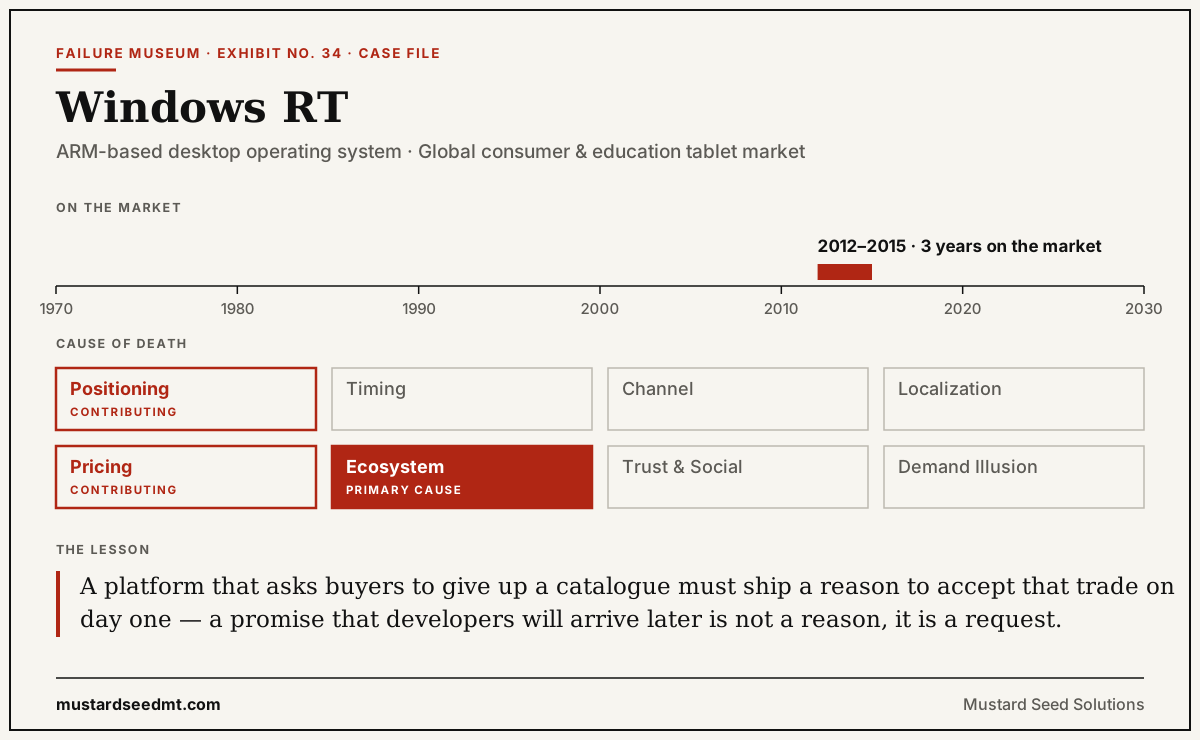
Windows RT, released alongside Windows 8 on 26 October 2012, was Microsoft's answer to the iPad: a version of Windows compiled for ARM processors, which meant tablets that were thin, cool, silent, and lasted a day on a battery — physical properties Intel-based Windows machines could not then deliver. It shipped on Microsoft's own first Surface and on tablets from Asus, Dell, Lenovo, and Samsung.
The strategic reasoning was defensible and the engineering was serious. Tablets were taking the consumer computing market, ARM was the reason they could be built that way, and a company whose franchise is the operating system could not credibly sit out an architecture shift. Windows RT arrived with touch-optimised Office, a familiar desktop, and the Windows name — three assets no other tablet platform could claim.
The Entry
Those three assets were also the trap. Windows RT looked identical to Windows 8, down to a desktop, a taskbar, and File Explorer, but ran only applications from the Windows Store. No existing Windows program — not iTunes, not Photoshop, not a company's internal line-of-business tool, not a printer utility, not the accumulated software estate that is the entire reason anyone buys Windows — could run on it, because ARM cannot execute x86 binaries and RT shipped without emulation.
So the platform's value depended entirely on the Windows Store filling up, and it did not. Developers were asked to port to a new application model, for a new processor architecture, for a device with no installed base, when the same effort spent on iOS or Android reached hundreds of millions of users. Buyers and retail staff, meanwhile, frequently could not tell a Surface RT from a Surface Pro on the shelf. Microsoft took a $900 million charge against unsold Surface RT inventory in July 2013, nine months after launch; the Surface 2 followed and was discontinued in January 2015, and RT device production ended that year.
Windows RT: Why It Failed
Windows RT failed because the only thing that could have justified buying it — a catalogue of applications — never materialised, while the thing buyers assumed they were getting, the ability to run Windows software, was architecturally impossible. Developers had no reason to build for a new store on a new architecture with no users, and without those apps an RT tablet was a device that looked like Windows and did less than an iPad.
The chicken-and-egg trap closed in the textbook way, but RT's version was harsher than most because the counterfactual was sitting on the same shelf. A buyer choosing a tablet in 2012 could pick iOS with hundreds of thousands of tablet applications, or Android, or a Surface Pro that ran everything Windows had ever run. RT asked that buyer to accept the smallest catalogue in the category in exchange for a form factor its own Pro sibling would match within a couple of years as Intel's power consumption fell. Microsoft had no bridge strategy strong enough to hold the gap open: Office on RT was genuinely valuable and genuinely not sufficient.
Positioning turned a hard problem into an unfair one. Calling the product Windows, shipping it with a desktop, and selling it beside real Windows machines set an expectation the architecture could not meet, and the market's verdict was not that RT was limited but that it was misleading. This is the rare positioning failure created by an accurate name — it really was Windows, in every sense except the one customers meant by the word. A different name and a different shell would not have supplied the missing applications, but they would have let the device be judged as a new kind of tablet rather than as a broken PC.
Pricing removed the last argument. The Surface RT launched at $499 for the base model with the keyboard cover sold separately at roughly $100 to $130 — iPad money, and more than iPad money once the keyboard was included, for a device with a fraction of the software. When a product's differentiator is a promise about a future ecosystem, it has to be cheaper than the incumbent for as long as that promise is unproven. RT was priced as though the ecosystem had already arrived.
What Survived
Almost everything except the product. Surface survived and became a successful hardware line by dropping ARM and running full Windows on Intel — the Surface Pro lineage is the direct descendant of the bet, minus the constraint that killed it. The touch-first application model and the store matured inside mainstream Windows, and the work of building Office for ARM was not wasted.
Windows on ARM itself was ultimately vindicated, on the one condition RT could not meet. When Microsoft returned to the architecture later in the decade it shipped x86 emulation, so existing Windows software simply ran and the platform no longer depended on developers arriving first. By the time ARM-based Windows laptops became genuinely competitive on battery life and performance, the ecosystem question had been engineered out of the product rather than left as a request. The idea was right; the sequencing was not.
Era: 2010s
Where It Ended Up: Discontinued; Windows RT device production ended by 2015, and Microsoft returned to ARM years later with a version of Windows that emulated x86 software rather than requiring a new app catalogue
The Lesson
"A platform that asks buyers to give up a catalogue must ship a reason to accept that trade on day one — a promise that developers will arrive later is not a reason, it is a request."
Sources
Related Exhibits
Better Place
A brilliant answer to EV range anxiety, waiting for car companies who never signed up.
Windows Phone
Genuinely well-designed. Genuinely appless. Guess which one buyers noticed first.
HP TouchPad / webOS
Forty-nine days on shelves. A fire-sale price tag made it a cult classic anyway.