
Brand Visibility in AI Search: How to Measure and Improve It
Brand visibility in AI search is whether AI systems know your brand exists, place it in the right category, and describe it the way you would — measured across a fixed set of buyer questions rather than a single spot-check. It is a comparative measure: what matters is not only whether you are named, but how often you are named relative to the competitors buyers already put next to you. This guide sets out the prompt set, the scoring rubric, the three formulas, and what to do about each of the four ways brand visibility typically fails.
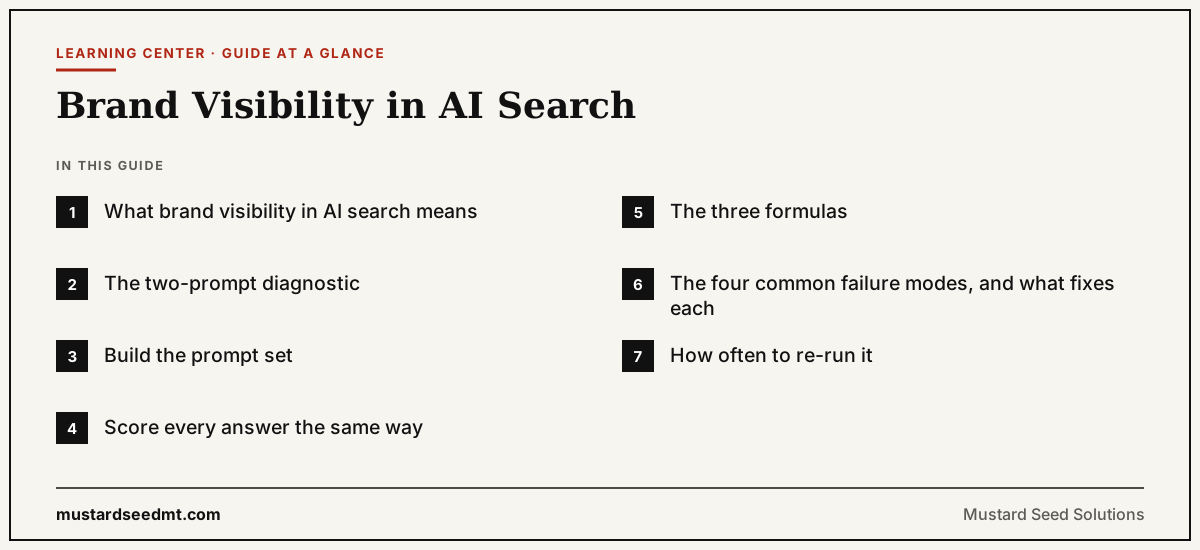
What brand visibility in AI search means
Page-level AI visibility asks whether a specific URL gets cited. Brand-level visibility asks something broader and harder: does the system know who you are, does it place you in the right category, and does it describe you accurately when it does?
The two come apart regularly. A company can have well-optimized pages that get cited for how-to questions and still be absent from every 'best [category]' shortlist, because nothing in the model's sources establishes that the brand belongs in that category at all. Being citable is a content property. Being recommended is a reputation property.
That is why brand-level work resembles PR more than on-page SEO. What moves it is consistent naming and category language wherever the brand appears, presence on the comparison and review sources that keep turning up in your citation logs, and original material that gives other publications a concrete reason to name you.
The two-prompt diagnostic
Before building anything, run two prompts in each engine you care about. They take five minutes and they tell you which of two very different problems you have.
First: 'What is [your brand]?' This tests recognition and accuracy. If the answer is confidently wrong, or confuses you with a similarly named company, you have a disambiguation problem — and no amount of category content will fix it until the basic facts about the brand are consistent across the sources models draw on.
Second: 'What are the best [your category] options?' This tests inclusion. If you are absent here but recognised in the first prompt, the model knows you exist but has no evidence you belong in the consideration set. That is an evidence and third-party coverage problem, not a technical one.
The four possible outcomes each point somewhere different: known and included is a maintenance job; known but excluded is a coverage job; unknown but somehow included is usually a naming collision worth checking; unknown and excluded means starting with the fundamentals — crawl access, a clear description of what you do, and any credible third-party mention at all.
Build the prompt set
A measurement is only comparable to itself, so the prompt set has to be frozen before the first run. Aim for 15–25 prompts, split across three types, and resist the urge to reword them later — changed wording resets the baseline.
- 01
Brand prompts. 'What is [brand]?', 'Is [brand] any good for [use case]?', 'Who is [brand] for?'. These measure recognition, accuracy, and sentiment. Roughly a quarter of the set.
- 02
Category prompts. 'Best [category] for [segment]', 'How do I choose a [category] provider?', '[category] options for [constraint]'. These measure inclusion — whether you make the shortlist when your name is not in the question. This should be the largest group, because it is where buyers who do not yet know you actually are.
- 03
Comparison prompts. '[brand] vs [competitor]', '[competitor A] or [competitor B] for [use case]', 'alternatives to [competitor]'. These measure positioning, and they are the fastest way to discover how AI systems frame your differences — often in language you did not choose.
- 04
Fix the competitor set alongside it. List the 4–8 competitors buyers genuinely compare you against. AI systems describe brands relative to a category, so an aspirational competitor list produces numbers that measure the wrong contest.
Score every answer the same way
The scoring sheet is what separates a measurement from a folder of screenshots. Seven fields, recorded for every prompt in every engine, every month. A spreadsheet is entirely sufficient — the discipline matters far more than the tooling.
Two of these columns do disproportionate work. Description accuracy, scored separately from mention, is what surfaces the brands that are highly visible and consistently misrepresented. And the citation source URL, logged over a few months, quietly builds the single most useful artefact of the whole exercise: a ranked list of the third-party domains AI systems actually trust in your category.
One row per prompt, per engine
| Field | Values | What it tells you |
|---|---|---|
| Mentioned | Yes / No | Was the brand named at all in the answer? |
| Position in answer | First / Middle / Last / Absent | Where a brand falls in a list is a rough proxy for how strongly it is associated with the category. |
| Description accuracy | 0 / 1 / 2 | 0 incorrect, 1 partly correct, 2 accurate. Score what the answer says you do — not whether you liked it. |
| Sentiment | Positive / Neutral / Negative | Most correct mentions are neutral. A negative mention is worth investigating immediately. |
| Cited? | Yes / No | Did the answer link a source for the claim about you, and was it your domain? |
| Citation source | URL | Record the actual URL. The recurring third-party domains here are your outreach target list. |
| Competitors named | List | Every other brand in the answer. This is the raw input for share of AI voice. |
The three formulas
Once the sheet has a month of rows in it, three calculations turn it into a report. All three use plain counts — there is no weighting scheme worth introducing at this stage.
- Mention rate. Brand mentions ÷ eligible prompts × 100. Your headline number. Read it per engine as well as overall — a healthy blended figure often hides one engine where you are invisible.
- Share of AI voice. Your mentions ÷ all tracked mentions across your competitor set × 100. This is the number worth reporting upward, because it moves when competitors move and a raw mention rate does not.
- Description accuracy average. Mean of your 0–2 accuracy scores across all mentions. Below about 1.5 and you have a messaging consistency problem showing up in AI answers, regardless of how good the mention rate looks.
The four common failure modes, and what fixes each
Almost every brand-visibility result sorts into one of four patterns. Diagnosing which one you have matters more than the absolute numbers, because the remedies barely overlap.
- 01
Absent entirely. Low mention rate across all prompt types and all engines. Start with access — confirm ordinary search indexing, and check OAI-SearchBot for ChatGPT search and PerplexityBot for Perplexity. Then check whether any third-party source describes what you do in category language at all. This is the slowest failure to fix and the most common.
- 02
Known but not recommended. Brand prompts return accurate answers; category prompts never include you. The model has facts about you but no evidence you are a credible option. The remedy is third-party coverage: comparison pages, review sources, and editorial mentions on the domains your citation log already shows AI systems trusting.
- 03
Mentioned but described wrongly. Reasonable mention rate, accuracy scores of 0 or 1. Usually caused by inconsistent self-description across your own properties, or by one outdated third-party page carrying more weight than your current site. Fix the inconsistency at source, then look for the specific stale page — the citation column will normally name it.
- 04
Visible in one engine only. Strong in Perplexity, invisible in ChatGPT, or similar. Almost always an access or retrieval difference rather than a content one. Check the platform-specific crawler for the weak engine first, since each system has its own and one robots.txt rule does not cover them all.
How often to re-run it
Monthly is the right cadence for most companies. AI answers vary between runs and retrieval sources update continuously, so a single pass is a snapshot; the trend is the product. Run it on roughly the same date each month and log the results in the same sheet.
Two rules keep the data honest. Do not change the prompt wording — a reworded prompt is a new prompt and breaks comparability. And do not average away the differences between engines: a blended mention rate that looks stable can easily conceal one engine collapsing while another improves, which is exactly the movement worth catching early.
Frequently Asked Questions
What is brand visibility in AI search?
Brand visibility in AI search is whether AI systems know your brand exists, place it in the right category, and describe it accurately when they mention it. Unlike page-level AI visibility, which asks whether a specific URL gets cited, brand visibility is comparative — it measures how often you are named relative to the competitors buyers already compare you against.
How do you measure brand visibility in AI search?
Freeze a set of 15–25 brand, category, and comparison prompts, run them across the engines that matter to you, and score every answer on seven fields: mentioned, position in answer, description accuracy (0–2), sentiment, whether it was cited, the citation source URL, and which competitors were named. Convert those counts into mention rate, share of AI voice, and an average accuracy score, then repeat monthly without changing the prompts.
What is share of AI voice?
Share of AI voice is your brand mentions divided by all tracked mentions across your competitor set, times 100. It is the metric worth reporting upward because it responds to competitive movement: your raw mention rate can hold steady while your share falls, simply because competitors became more visible.
Why does an AI tool describe my brand incorrectly?
Usually one of two causes. Either your own properties describe the business inconsistently, so there is no single clear version for a model to settle on, or one outdated third-party page carries more weight than your current site. The citation column of your scoring sheet normally identifies the specific source responsible.
Do I need a tool to measure brand visibility in AI search?
No. A spreadsheet with seven columns, run by hand once a month, produces every metric in this guide. Dedicated tools are worth considering once the manual loop is established and you know which prompts, engines, and competitors actually matter — automating a measurement you have not yet defined tends to produce dashboards nobody trusts.
How is brand visibility different from AI search visibility?
AI search visibility is the broader topic, covering both page-level citation and brand-level presence. Brand visibility is specifically the brand-level view: recognition, category inclusion, description accuracy, and share of voice, rather than whether any individual page of yours was quoted.
Related Resources
AI Search Visibility
The pillar guide: what it is, the full metric set, and platform-by-platform requirements.
AI Visibility Audit Tool
Score your brand's AEO/GEO readiness across 17 signals.
AI Crawler Access Checker
Check whether OAI-SearchBot, PerplexityBot, and others can reach your site.
AI Crawler Access Study 2026
Original data from 1,000 domains: who blocks AI crawlers, and how much.
How to Get Your Brand Mentioned in AI Search Results
The evidence AI systems need before they name your brand in an answer.
Share of Voice, Defined
The traditional metric that share of AI voice adapts, and how the two differ.
Brand Visibility
See How AI Tools Describe Your Brand
We run the full prompt set across ChatGPT, Gemini, Perplexity, and Google AI Overviews, score every answer, and show you exactly where your brand is absent, misdescribed, or losing share to competitors.
Get a Free AI Visibility Audit