
How to Get Clients as a Solopreneur
Solopreneurs get clients through a small set of channels worked consistently: their existing network, referrals, active participation in relevant communities, direct outreach to a tightly targeted list, and content that answers real buyer questions. Almost none of it comes from posting broadly and hoping the right person notices — it comes from being specific about who you help and asking directly.
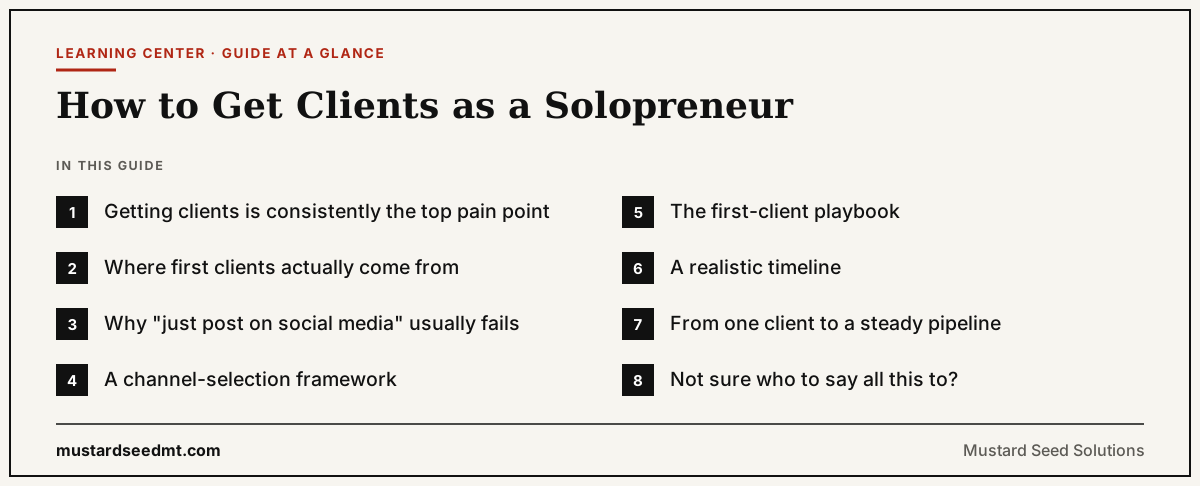
This is the deep, comprehensive version of this question — it's grounded in patterns we found across real solopreneur and small-business discussions, and it covers the full picture: where clients actually come from, why the most common advice ("just post consistently") quietly fails so many solo businesses, a framework for choosing your channels, and a realistic timeline for each one, including what to do once you land the first one. If you're a consultant or freelancer looking for a shorter, narrower take focused specifically on that path, see How to Get Clients as a Consultant or Freelancer — this guide is the broader version behind it.
Getting clients is consistently the top pain point
Across the solopreneur and small-business discussions we reviewed, "how do I actually get clients" comes up more than any other operating problem — more than pricing, more than burnout, more than cash flow. That's not surprising: everything else in a one-person business is at least partly within your control, but a client has to say yes, and no amount of good work fixes a business with nobody to sell to.
What's striking in the real accounts is how rarely the answer is a clever growth hack. One founder who has run a one-person service business for five years credited it to three unglamorous weekly habits: a fixed slot for financial review and chasing overdue invoices, strict intake rules (deposit up front, scope written down before starting), and a short weekly call with someone in a different field — not to sell, just to stay sharp and, as it turned out, to stumble into the occasional introduction. None of that is exciting. It's also closer to what actually works than most advice aimed at solopreneurs.
It also explains why "getting clients" feels harder than it looks from the outside. Every other operating problem in a one-person business — pricing, delivery, cash flow — is at least partly something you control on your own timeline. Client acquisition depends on someone else's yes, on someone else's timing, and often on relationships that take months to build before they pay off. That mismatch between effort and immediate feedback is, on its own, a large part of why this stays the most reported friction point for solopreneurs.
1. Where first clients actually come from
Almost no solopreneur's first client comes from a stranger scrolling past a perfect post. In the accounts we read, first clients came from people who already had some reason to trust the founder — a former colleague, someone met once at a conference, a member of a small community, or a direct, specific ask. The common thread isn't a clever tactic; it's proximity to existing trust.
- Your warm network: past colleagues, former clients, people you've worked alongside
- Referrals from people who already trust you, asked for specifically and clearly
- Small, active communities (Discord, Slack, niche forums) where you show up consistently
- Direct outreach: cold email or DMs aimed at a tightly defined, verified list
- Content that answers a real buyer question — slower, but compounding
2. Why "just post on social media" usually fails
This is the most common trap we found in the research: treating posting as the strategy instead of one channel among several. Volume without a specific ask rarely converts, and the gap between visibility and revenue can be brutal to sit through. Several founders described real follower growth and engagement running alongside a client pipeline that stayed completely flat.
- Views and followers are not the same signal as buying intent
- Generic "helpful" posts get thanks, not conversations
- Posting for months with no ask trains an audience to expect nothing from you
- Content works as a slow-compounding channel, not a fast one
3. A channel-selection framework
You do not need every channel. You need two or three that fit how fast you need revenue and how much of an existing network or audience you're starting with. Treat the mix as a decision you revisit, not one you make once and never touch again.
- Need cash in 2–6 weeks? Start with warm network + referrals + direct outreach
- Have zero audience and zero network? Outreach and communities beat content early on
- Have some audience already? Content and referrals compound faster for you
- Pick one channel to lead, one to support — not five to split attention across
- Revisit the mix every quarter as your situation changes
4. The first-client playbook
A simple, repeatable sequence beats waiting for inspiration. This is close to what worked in the real accounts we found: sharpen the offer, tell the people most likely to say yes, make it effortless to respond, and follow up. None of these steps require an audience, a portfolio site, or paid tools to start.
- Name the exact buyer and the exact problem you solve, in one sentence
- Message your warm network personally — not a broadcast post
- Offer one clear, bounded first engagement, not an open-ended pitch
- Make booking a call the only next step you ask for
- Follow up at least twice; most real conversations start on the second touch
5. A realistic timeline
Different channels pay off on different clocks. Expecting a content post to behave like a warm referral — or a cold email list to behave like an existing relationship — is what causes solopreneurs to give up on channels too early, right before they were about to start working.
- Warm network + referrals: often days to a few weeks for a first conversation
- Direct/cold outreach: typically weeks, and depends heavily on list quality
- Communities: weeks to a couple of months of consistent, non-promotional presence
- Content and SEO: usually 2–6 months before it produces real conversations
6. From one client to a steady pipeline
One client can be luck. A pipeline is something you build on purpose, in small, boring, repeatable moves — the kind that rarely make it into highlight-reel posts but are what actually kept solo businesses alive in the accounts we found. It is unglamorous work, and it is also the difference between one good month and a business.
- Keep a weekly slot for outreach and follow-up, even when you're fully booked
- Ask for a referral or testimonial after every good outcome, not just the big ones
- Turn one completed job into a reason to stay in touch (a short recap, a check-in)
- Track where actual paying clients come from, not just where the traffic comes from
Free tool
Not sure who to say all this to?
Every channel above works better with a sharp, specific answer to "what do you do and who is it for." If your positioning is still vague, referrals stall, cold outreach gets ignored, and content has no clear angle. Our free Positioning Statement Generator helps you turn a fuzzy offer into one clear sentence you can actually use in a DM, an email, or a bio.
Try the Positioning Statement GeneratorA realistic timeline, by channel
A lot of solopreneurs abandon a channel too early because they're judging it against the wrong clock. Referrals and cold outreach can produce a first conversation quickly; content and community-building are slower but compound. Expecting either to behave like the other is what causes the frustration.
Warm network & referrals
Days–weeks
Fastest, but finite — you'll need a second channel once you've asked everyone once
Direct outreach (cold email/DM)
2–6 weeks
Payoff depends entirely on how targeted and verified the list is
Communities
3–8 weeks
Requires real presence before any ask; rushing it reads as spam
Content & SEO
2–6 months
Slowest to start, but the only channel that keeps compounding without more of your time
Why posting alone rarely gets you clients
One account we found described a founder publishing over a hundred pieces of content across a few months — long-form posts, threads, articles, all genuinely useful — and ending up with several hundred new followers, and almost no clients: barely a dozen real conversations came out of it. The shift that changed things wasn't posting more. It was narrowing from teaching a general framework to addressing one specific, costly problem a buyer already knew they had.
A separate discussion on distribution made a similar point from the other direction: solopreneurs tend to swing between two failure modes — posting helpfully with no ask at all, or jumping straight into pitching before any trust exists. Several people in that thread described racking up tens of thousands of views on posts with almost no conversions, or leaving genuinely helpful comments and free work that earned a polite "thanks" and nothing further. The people who broke through described nurturing a relationship with value first, and only then making a specific, low-friction ask.
Content is a channel, not a strategy. It works when it's paired with a specific ask and enough patience for it to compound — not as a replacement for referrals, outreach, or showing up in a community your buyers are already in.
None of this means content is a waste of time — it means it needs a job description. Treat it as the channel that builds trust with people who aren't ready to buy yet, while referrals and outreach do the work of finding people who are ready now. Solopreneurs who paired a slower, compounding channel with a faster, direct one tended to describe far less anxiety about any single post's performance, because no one post was carrying the whole pipeline.
What actually worked in the accounts we reviewed
A few patterns showed up again and again, in businesses ranging from software to home services. A handyman running a door-to-door operation with no ads and no website hit real revenue in two weeks by targeting a specific neighborhood and audience directly. An appliance repair technician started leaving a simple one-page recap after every job — what was done, what to watch for — and saw a meaningful bump in repeat calls, essentially turning one job into an ongoing relationship for the cost of a sheet of paper. A software founder who had lost an agency to bankruptcy rebuilt slowly through small freelance gigs sourced from people who'd seen his earlier posts — proof that even a rough patch of visibility can pay off much later, just not on the timeline anyone wants.
On the outreach side, one founder combined a verified cold-email list with consistent posting and reached meaningful revenue within a few weeks — but a commenter on that same thread pointed out the part that doesn't make it into the highlight reel: plenty of people post or message consistently for four to six months with zero sales before anything lands. Fast results are possible. They are not the baseline, and building a pipeline that survives a slow stretch matters more than any single channel.
General freelance marketplaces came up too, and the verdict was mixed. Several solopreneurs described sourcing work through platforms like Upwork or Fiverr as workable but noisy — a lot of time spent filtering promising-looking leads down to a handful worth pursuing. The people who eventually stepped back from relying on platforms described a common shift: once they had a few solid clients, referrals from those relationships produced fewer, better-fit leads than the open marketplace did, even if it took longer to build up that first handful.
Client acquisition is one of dozens of recurring friction points solopreneurs run into — for the full research behind this guide and 49 other patterns, see The 50 Biggest Solopreneur Challenges.
Frequently Asked Questions
How do I get clients as a solopreneur with no existing audience?
Start with your warm network and direct outreach rather than content — a small, active audience or none at all is exactly when cold posting performs worst. Message past colleagues and contacts with a specific, one-sentence offer, and run a tightly targeted outreach list in parallel. Communities are a strong third channel: joining a handful of relevant Discord or Slack groups and showing up consistently, without pitching, tends to outperform generic public posting for solopreneurs starting from zero.
How do I find my first client?
Most first clients in the real accounts we reviewed came from an existing relationship, not a stranger. Tell your network exactly what you now offer and who it's for, ask for one specific introduction, and make responding effortless — one link to book a call. If your network is thin, a small, verified cold-outreach list or an active founder community is the next-best starting point.
How can I get clients without paying for ads?
Referrals, warm-network outreach, community participation, and helpful content are all ad-free channels solopreneurs use successfully. None of them are free of cost — they cost time and consistency instead of ad spend. Pick two you can sustain weekly rather than trying all four at once.
Why isn't posting on social media getting me clients?
Because visibility and buying intent are different things. In several accounts we reviewed, solopreneurs who published dozens of posts gained followers and views but very few real conversations — the shift came from addressing a specific, costly problem instead of general expertise, and from pairing content with a direct ask rather than hoping the algorithm did the selling.
How long does it take to get clients as a solopreneur?
It depends on the channel, not just effort. Warm-network and referral clients can appear within days to a few weeks. Cold outreach usually takes several weeks and depends on list quality. Community-driven and content-driven clients typically take two to six months to materialize, because both require built-up trust before anyone buys.
Should I pick one marketing channel or several?
Two to three, deliberately chosen, work better than five worked half-heartedly. Pick one channel that matches your urgency (referrals or outreach if you need revenue soon) and one that compounds over time (content or community), and commit to both weekly rather than spreading thin across everything.
How do I turn one client into a steady stream of clients?
Treat it as a system: ask for a referral or testimonial after every good outcome, keep a standing weekly slot for outreach even when you're busy, and stay in touch with past clients instead of only reappearing when work is needed. Solopreneurs who avoided feast-or-famine cycles in the accounts we reviewed tended to do a few unglamorous things every week rather than scrambling only when the pipeline ran dry.
Are freelance platforms like Upwork or Fiverr a good way to get clients?
They can produce work, but several solopreneurs described them as noisy and inconsistent compared to niche communities and referrals — a lot of time spent filtering low-quality leads for a middling hit rate. The people who found platforms most useful treated them as one channel among several, not the whole strategy, and shifted toward direct relationships and referrals as soon as they had a few good clients to draw introductions from.
Related resources
Build a real pipeline
Want help choosing the right channels for your business?
Mustard Seed Solutions helps solopreneurs sharpen their positioning and build a client pipeline from the channels that actually fit their stage — not every channel at once.
Book a consultation