
Marketing for Solopreneurs: Pick Your Channel
The right marketing channel for a solopreneur depends on how fast you need revenue and what you already have: warm network and referrals work fastest; direct outreach and communities suit zero audience; content and SEO compound over months. Most solopreneurs do best picking two channels deliberately, not spreading thin across five.
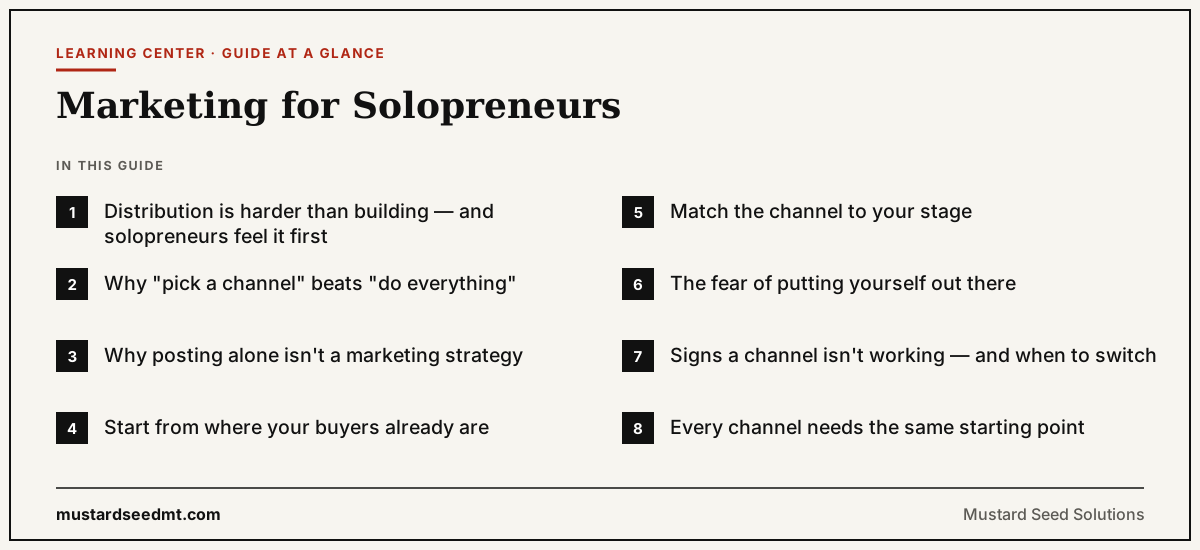
This guide sits one level above the specific tactics — it's the decision framework for choosing which channel deserves your limited hours in the first place. If you've already decided content is your channel, our deeper dive on Content Marketing for Solopreneurs covers execution. If search is your channel, see SEO for Solopreneurs for the practical how-to. This page is for the question that comes before both: which channel should you actually be spending your hours on.
Distribution is harder than building — and solopreneurs feel it first
A recurring theme in the discussions we reviewed: for a one-person business, getting the work in front of the right people is consistently harder than doing the work itself. One thread put it plainly — no matter how good the product or service, if you don't have a way to reach the right people, you're effectively invisible. The mistake most solopreneurs make isn't a bad channel choice. It's swinging between two extremes: posting helpfully with no ask at all, or jumping straight into pitching before any trust has been built.
Several people in that same discussion described the frustrating middle: tens of thousands of views on a post with almost no conversions, or leaving genuinely useful comments and free work that earned a polite "thanks" and nothing further. The founders who broke through described nurturing interest with real value first, then making one specific, low-friction ask — not five asks scattered across five channels.
It's worth sitting with why that middle ground is so common. Being purely helpful with no ask feels safe — nobody can accuse you of selling. Pitching immediately feels efficient — why wait to ask for what you want? Both avoid the genuinely harder work in between: building enough specific, demonstrated trust that an ask doesn't feel like an interruption. That middle step is where most of the actual channel strategy lives, and it looks different on every channel below.
1. Why "pick a channel" beats "do everything"
A one-person business has one person's worth of hours. Every hour spent half-heartedly maintaining a fifth channel is an hour not spent doing the two or three channels well enough to actually convert. Breadth feels productive; depth is what pays.
- Depth on 2–3 channels beats a thin presence on 6
- Every channel has a real time cost, even the 'free' ones
- Switching channels constantly resets your progress on all of them
- Fewer, deeper channels are also easier to actually measure
2. Why posting alone isn't a marketing strategy
In the discussions we reviewed, the single most common marketing mistake for solopreneurs wasn't picking the wrong channel — it was treating "post consistently" as if it were a complete strategy on its own. Posting is an input; clients are an outcome, and the two are connected by far more than volume.
- Visibility (views, followers) and buying intent are different signals
- Posting without a specific ask trains an audience to expect nothing from you
- A narrow, specific problem beats a broad, expert-sounding framework
- Distribution — getting in front of the right people — is a separate skill from creating
3. Start from where your buyers already are
The channel question isn't "what's trending" — it's "where do the people who'd hire me already spend attention, and what are they already doing there." Answer that before you answer which platform to post on.
- B2B service buyers: LinkedIn, niche communities, referral networks, search
- Local or consumer services: local search, reviews, word of mouth, direct outreach
- Technical or builder audiences: founder communities, forums, build-in-public spaces
- If you're not sure, ask five past or almost-clients where they'd look
4. Match the channel to your stage
The right channel changes depending on how fast you need revenue, how much audience or network you already have, and how much of the work you can sustain weekly without burning out. The same channel can be the right call for one solopreneur and the wrong one for another at a different stage.
- Need revenue in weeks: warm network, referrals, direct outreach
- No audience yet: outreach and communities outperform content early on
- Have some audience or reputation: content and SEO start compounding faster
- Have budget but not time: paid can buy speed, but rarely fixes a weak offer
5. The fear of putting yourself out there
Beyond tactics, one theme showed up repeatedly: the discomfort of publicly trying something and having it go quiet. Several founders described the early stretch as genuinely humbling — asking strangers to care about something you've poured months into, then comparing your quiet start to everyone else's highlight reel.
- A slow start is the norm, not a signal you picked the wrong channel
- Most visible 'overnight' stories omit years of earlier, unseen work
- Small, low-stakes tests (one DM, one post, one call) lower the cost of trying
- Compare your week to your own baseline, not to someone else's launch day
6. Signs a channel isn't working — and when to switch
Channels do fail, get noisy, or stop rewarding effort. The skill is telling the difference between "this needs more time" and "this genuinely isn't converting," instead of reflexively hopping to the next trend every time a week goes quiet.
- Give a compounding channel (content, community) a real quarter before judging it
- Track real conversations and clients, not just views or followers
- If a platform's noise-to-signal ratio has visibly worsened, weight it down
- Rising saturation in a channel is a reason to niche down, not necessarily to leave
Free tool
Every channel needs the same starting point
Whichever channel you pick, it only works if people quickly understand what you do and who it's for. A vague offer makes referrals harder to give, outreach easier to ignore, and content harder to angle. Our free Positioning Statement Generator helps you turn a fuzzy description into one clear sentence you can use across every channel below.
Try the Positioning Statement GeneratorWhere paid ads actually fit
Paid ads deserve a specific note because they behave differently from every other channel here: they buy speed, not trust. In one struggling-business turnaround thread we found, commenters pointed out that simply buying a batch of ads had not fixed a membership problem, because the ads were amplifying an offer and message that weren't converting to begin with. Money spent pushing a weak positioning statement in front of more people just gets you a faster, more expensive version of the same result.
That doesn't make paid a bad channel for solopreneurs — it makes it a poor first channel. It works best once your offer and message already convert reasonably well through a free channel like referrals or outreach, at which point ads can accelerate something that's already proven rather than mask something that isn't. If you're considering paid spend before you've had any real, unpaid conversations convert into clients, that's usually a sign to fix the message first.
Channels at a glance
A quick way to compare the main channel categories before committing your limited hours to one or two of them.
| Channel | Speed | Main cost | Best when |
|---|---|---|---|
| Warm network & referrals | Fast | Time only | You have any prior working relationships to draw on |
| Direct outreach | Weeks | Time + list-building | Zero audience, need revenue soon, can define a tight target list |
| Communities | Weeks–months | Time + consistency | Your buyers gather in a specific forum, Discord, or Slack |
| Content & SEO | Months | Time (compounds) | You have some runway and want a channel that keeps working without you |
| Paid ads | Fast, but rented | Cash | Offer and message already convert organically; budget to test properly |
What worked when solopreneurs started from zero
Several accounts we reviewed described starting with genuinely no audience and no list. The pattern that repeated: at zero audience, inbound content doesn't really exist yet, so direct outreach and small, active communities carried the early weight. One founder who crossed a meaningful number of paying customers within months credited joining eight to ten founder communities and becoming known there for sharing real insight — not pitching — as the most underrated channel available to someone starting from nothing.
On general freelance and job platforms, several solopreneurs described the opposite experience: heavy reliance on marketplaces like Upwork or Fiverr felt noisy and inconsistent, while niche communities and referrals — asking one good client who else they know — produced a slower but noticeably higher hit rate over time. Neither approach is universally right; the point is that the channel that works tends to match where trust already exists, not which platform is trending.
Two contrasting accounts made the stage-matching point clearly. A service-based solopreneur with years of relationships behind them leaned almost entirely on warm network and referrals and rarely touched public marketing at all — for them, content or cold outreach would have been wasted effort layered on top of a channel that was already working. A solo SaaS builder starting from literally zero contacts did the opposite: heavy cold outreach and founder communities carried the first months, with content added only once there was enough of an audience for it to have anyone to reach. Same underlying framework, two entirely different right answers.
Why generic marketing advice feels tired to solopreneurs
A quieter theme ran under a lot of the discussions we reviewed: real skepticism toward marketing advice written for a different kind of business. One widely-discussed thread accused a chunk of the marketing world of tweaking colors and engagement metrics without ever answering how to create real demand or make a campaign actually pay for itself — a complaint that lands differently for someone doing all of this alone, with no team to absorb a wasted month.
Platforms wear out too. One long, popular thread described returning to a professional network after time away and finding it unrecognizable — spam, forced positivity, and posts so detached from anything useful that the top replies were mostly jokes at its expense. None of that means the platform is worthless; it means the generic version of "be active there" has stopped working as advice. What held up in the accounts we found was always more specific: a particular community, a particular list, a particular kind of post aimed at a named problem — not a channel treated as a box to check.
There's a useful test hidden in that fatigue: if a piece of marketing advice would work equally well for a ten-person team with a real budget as it would for a solo operator with neither, be suspicious of it. The advice that actually held up across the accounts we reviewed was almost always narrower than what gets repeated as general wisdom — a particular community, a particular list, a particular problem named out loud, not a platform treated as a universal answer for every kind of business.
The solopreneur marketing rule: pick the channel that matches your urgency, pick a second that compounds, and give both a real quarter before switching. Chasing a new channel every few weeks resets progress on all of them.
Putting the framework to work this week
If you take one thing from this guide, make it a decision rather than a feeling: name the one channel you'll lead with this quarter based on how fast you need revenue, name the one you'll build alongside it for the long term, and write down what "working" will look like for each before you start — a number of real conversations, not a number of views. Revisit that decision on a calendar date, not whenever motivation dips or a new platform starts trending. Everything else in this guide is detail in service of that one decision.
Marketing and distribution consistently rank as one of the hardest parts of running a one-person business — for the full research behind that finding, see The 50 Biggest Solopreneur Challenges.
Frequently Asked Questions
What is the best marketing channel for a solopreneur?
There isn't one universal best channel — it depends on how fast you need revenue and what you already have. Warm network and referrals are fastest if you have relationships to draw on. Direct outreach and communities work well from zero audience. Content and SEO compound over months and suit solopreneurs with some runway. Most solopreneurs do best committing to two channels deliberately chosen for their situation, rather than picking whichever channel is easiest to start or most talked about that month.
How do I market myself as a one-person business?
Start by identifying where your specific buyers already spend attention, not what's generally popular. Pick one channel to lead (matched to how urgently you need revenue) and one to support (usually a slower, compounding one like content). Show up consistently in both rather than occasionally across five.
Is social media a good marketing channel for solopreneurs?
It can be, but posting alone rarely converts. In the accounts we reviewed, solopreneurs who published large volumes of generic content saw followers and views grow while client conversations stayed flat — the shift came from narrowing to one specific, costly problem and pairing posts with a direct, specific ask, not from posting more often.
Should I do content marketing or paid ads first?
Content and SEO compound but take months to produce real conversations; paid ads can move faster but tend to expose a weak offer or message quickly and expensively rather than fixing it. Most solopreneurs get more mileage from validating their offer through free channels (referrals, outreach, communities) before spending on ads, then using paid spend to accelerate a message that already converts rather than to rescue one that doesn't.
How many marketing channels should a solopreneur use?
Two to three, worked consistently, outperform five worked occasionally. Every channel has a real time cost, and switching channels frequently resets progress on all of them. Pick channels that match your urgency and where your buyers already are, then give each a real quarter before judging results.
Why does my marketing feel like it's going nowhere?
Often it's a mismatch between the channel's natural timeline and your expectations — judging a content channel after two weeks, or a referral ask after a single vague post. It can also be a signal-vs-noise problem: if you're posting broadly with no specific ask, visibility and paying clients are simply different things.
Is it normal to feel afraid to market myself publicly?
Yes — it's one of the more consistent emotional threads in solopreneur discussions. Founders commonly describe the early stretch of putting themselves out there as genuinely humbling, made worse by comparing a quiet start to other people's highlight-reel launches. Starting with small, low-stakes tests (one message, one post) tends to lower the discomfort faster than waiting to feel ready.
Why does most marketing advice for small businesses feel useless?
A lot of it is written for a different audience: teams with budgets, brand goals, and someone dedicated to distribution. Solopreneurs in the discussions we reviewed were openly skeptical of generic marketing content and self-declared "gurus," and platforms once useful for networking were frequently described as noisy or overrun with low-effort self-promotion. The channels that held up under scrutiny were narrower and more direct: specific communities, specific outreach, specific referrals — not broad platform advice aimed at everyone.
Related resources
Stop spreading thin
Want a marketing plan built around one or two channels?
Mustard Seed Solutions helps solopreneurs pick the channels that fit their stage, sharpen the message, and build a plan they can actually sustain.
Book a consultation