
How to Price Your Services as a Solopreneur
Price your services by starting from your real hourly number, not a rate copied from a competitor or set out of fear. Underpricing is the most common pricing mistake solopreneurs make, and it directly causes feast-or-famine income and quiet scope creep. Raising prices deliberately — even if it costs you some clients — is usually what fixes both.
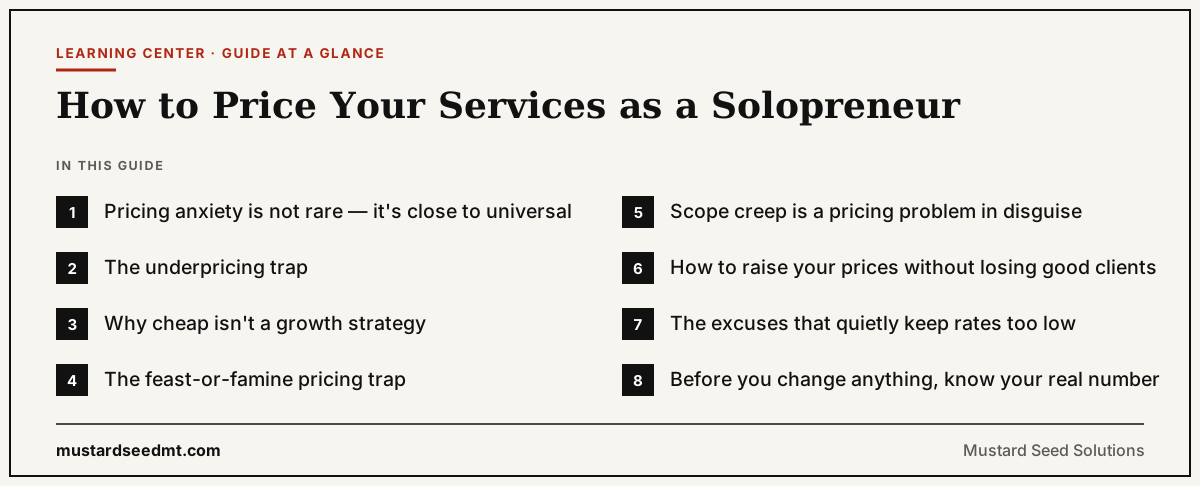
This guide focuses specifically on the psychology and evidence behind underpricing, the feast-or-famine trap it creates, scope creep as a quiet form of underpricing, and how solopreneurs have actually raised their rates without losing their business. For a full breakdown of pricing models (hourly, project, retainer, value-based) and a step-by-step way to set your first number, see our companion piece, How Much to Charge: Pricing Your Services.
Pricing anxiety is not rare — it's close to universal
Across the small-business and solopreneur discussions we reviewed, pricing shows up again and again as a source of quiet, ongoing anxiety — not a one-time decision made and forgotten. Solopreneurs describe caving to discount requests "just to be nice," only to find it left them tired and barely breaking even; one operator described stopping the habit cold and being surprised that almost no one left, while payments got faster and the whole relationship got easier.
The pattern underneath most of these stories is the same: a rate gets set early, under pressure or inexperience, and then never gets revisited because revisiting it feels confrontational. The fix that shows up repeatedly isn't a clever pricing trick — it's simply doing the real math on what you're earning, and treating the result as information rather than as a verdict on your worth.
It's also worth naming what pricing anxiety usually isn't: a sign you're overcharging. In the discussions we reviewed, the fear that a higher price will scare off clients almost never matched what actually happened once someone tested it. The imagined conversation — the client pushing back, getting angry, leaving in a huff — was consistently worse than the real one, which was often a short, calm exchange followed by the client either staying or quietly moving on. Treating your rate as a hypothesis you can test, rather than a fact set in stone the day you started, is what separates solopreneurs who eventually fix underpricing from those who carry it for years.
1. The underpricing trap
Almost every underpricing story we found follows the same arc: a rate set out of inexperience or desperation for any client, kept unchanged for years because raising it feels risky, until the real math finally gets done. By the time it gets done, the gap is usually bigger than expected.
- Rates set at the start rarely get revisited without a deliberate trigger
- "Any client is better than no client" logic quietly caps your income for years
- The gap between your quoted rate and your real hourly earnings is often larger than expected
- Underpricing isn't humility — it's a number nobody stress-tested
2. Why cheap isn't a growth strategy
A lower price does not reliably bring more or better clients. Several accounts we reviewed describe the opposite: discounting attracts the most price-sensitive, highest-friction clients, and trains everyone else to wait for the next deal. It optimizes for volume over fit, which is rarely what a solopreneur actually needs.
- "Charging less won't get you more customers — it will get you worse ones" is a recurring, specific warning
- Discount-seekers were repeatedly described as the hardest clients to satisfy
- Frequent sales or freebies teach buyers to wait rather than to value your work
- A fair, confident price is often reassuring to buyers, not a barrier
3. The feast-or-famine pricing trap
Underpricing and unpredictable income are closely linked: a rate with no margin leaves no cushion for slow months, so any dip in bookings turns straight into a cash crisis. Fixing the price is often what makes fixing the cash flow possible in the first place.
- Self-employed income swings more than a paycheck, by design, not by bad luck
- A cash reserve for lean stretches reduces the panic, not the swings themselves
- Recurring or retainer-based work smooths the swings more than one-off projects
- Pricing with margin built in is what makes a reserve possible in the first place
4. Scope creep is a pricing problem in disguise
A price only holds if the scope behind it holds. Several accounts describe a defined project quietly expanding through small, reasonable-sounding asks until the effective rate collapses — and the client relationship souring only once boundaries finally show up. The price was never wrong; the scope just stopped matching it.
- "Quick, one small ask" repeated weekly is not a quick, one small ask
- Write the scope down before starting, and refer back to it in writing when it shifts
- Charging for extra work after months of quiet scope creep often reads as sudden to the client — flag it earlier instead
- Our free Scope Creep Email Generator drafts the message for exactly this moment
5. How to raise your prices without losing good clients
Raising prices is normal, not aggressive. The clearest real-world account we found: a solo operator raised rates 40% after years of underpricing, lost around a third of clients, and saw revenue rise overall — the clients who left were, in their own words, the ones they were better off without. The math worked in their favor even after the drop-off.
- Apply new rates to new clients first — no old number to defend there
- Give existing clients real notice, tied to your growth and results, not an apology
- A short, plain notice ('starting [date], my rate will be [rate]') outperforms a long justification
- Expect some attrition — it's evidence the old price was too low, not that the new one is too high
6. The excuses that quietly keep rates too low
The reasons solopreneurs give for not raising prices are rarely about the market — they're about fear of a specific, imagined conversation. In the accounts we found, the actual fallout from raising rates was consistently smaller and more manageable than the anxiety leading up to it.
- "My clients can't afford more" is usually a guess, not something tested
- The clients most likely to push back on a fair increase are often the ones costing you the most already
- A polite, confident notice is rarely met with the reaction people brace for
- Every solopreneur who raised rates in the accounts we reviewed wished they had done it sooner, not later
Free tools — two different lenses
Before you change anything, know your real number
Underpricing is hard to see from the quoted rate alone — it shows up in the math behind it. These two calculators answer two different questions that both matter:
Freelance Rate Calculator
The forward-looking lens: what should you charge, starting from the income you want and your realistic billable hours?
Set a target rateTrue Hourly Rate Calculator
The backward-looking lens: what are you actually earning per hour today, once unbillable time, expenses, and taxes are backed out?
Check your real rateRun both. The gap between them is usually the clearest, least emotional argument you'll find for raising your prices.
When scope creep quietly erases your price
One account we found captures this trap well: a solo web developer agreed a fixed price for a defined project — a straightforward multi-page site, contract signed, everything by the book. The first month went smoothly. Then the "quick questions" started: a reservations button here, a small menu tweak there, each one framed as a thirty-minute favor. None of it looked like a big deal in isolation. Together, it quietly ate the margin the original price was supposed to cover.
When the developer finally started charging for the extra work, the client reacted as if the policy had appeared out of nowhere — and left a one-star review over it. The lesson other solopreneurs drew from that thread wasn't "never do free extras." It was that scope needs to be named the moment it changes, in writing, while it's still small — not months later, once resentment has already built up on one side and entitlement on the other. A five-minute message the first time a "quick ask" appears is far cheaper than the conversation that happens after twenty of them.
Feast-or-famine income is a pricing symptom, not just a cash-flow one
One thread we found opened with a plain observation: nobody really prepares you for how unpredictable income feels once you leave a regular paycheck behind. The reply that followed named the pattern directly — feast or famine — and pointed at two practical levers: a cash reserve for the lean stretches, and recurring or retainer work to reduce how sharp the swings are in the first place.
What's easy to miss is how much of that swing traces back to price. A rate with real margin built in makes a reserve possible to build in the first place; a rate that only just covers costs leaves nothing to set aside, so every slow month becomes an emergency instead of an expected part of the rhythm. Raising an underpriced rate does not eliminate feast-or-famine income on its own, but it is very often the precondition for every other fix — the reserve, the retainer, the breathing room — actually working.
What a fair price actually protects
It's worth naming what's really at stake in an underpriced rate, beyond the immediate income gap. A price with no margin leaves no room for the unbillable parts of running a business — admin, invoicing, marketing, the slow months, the client who takes twice as long as quoted. All of that still happens whether or not the price accounts for it; underpricing just means you absorb it silently, usually as unpaid overtime or accumulated resentment toward clients who did nothing wrong.
A fair price is what makes the rest of a sustainable business possible: a reserve for lean months, time for the marketing that brings the next client, and the margin to walk away from a bad-fit engagement instead of needing every single one. None of the other pricing advice in this guide works for long on top of a rate that was never viable in the first place.
Don't compete on being the cheapest. In the accounts we reviewed, low prices consistently attracted the most demanding, price-sensitive clients — not more of the good ones. A fair, confident price is what signals your work is worth paying for.
None of this is an argument for pricing yourself out of your market — it's an argument for pricing yourself out of the bottom of it. There's a wide range between "cheapest option" and "unreasonably expensive," and almost every underpricing story in the accounts we reviewed started well below that range, not somewhere reasonably in the middle of it.
A simple way to act on this today
You don't need to overhaul your pricing this week to make progress. Run the two calculators above and just look at the gap between them — that's your real number. Pick one client relationship where scope has quietly grown and name it in writing, even briefly. And if you've been sitting on a rate increase, pick a date for new clients to start at the new number; you can decide separately, and later, how and when to bring existing clients along. Small, concrete moves like these tend to matter more than getting the "perfect" pricing model on paper.
Pricing anxiety and underpricing are among the most common patterns we found in solopreneur research — for the full list of 50 recurring challenges, see The 50 Biggest Solopreneur Challenges.
Frequently Asked Questions
How do I price my services as a solopreneur?
Start by finding your real number: the income you need, divided by your realistic billable hours, gives you a floor you should never price under. From there, check what others with similar experience charge, and price toward the value of the outcome rather than just the hours. Underpricing at the start is common, but it should be treated as a starting estimate to correct as you gain proof and experience, not a permanent identity you're stuck defending.
How do I know if I'm undercharging?
A clear sign is discovering your real hourly rate is far below what you'd accept as an employee once you account for unbillable hours, software, taxes, and time spent on admin and marketing. In one account we reviewed, a solo operator worked out they were effectively earning about the same as an entry-level hourly job — for work that required real expertise — once all of that was factored in properly.
Will lowering my price get me more clients?
Usually not in a way that helps. Several accounts describe charging less attracting more price-sensitive, higher-friction clients rather than more good-fit ones, and training buyers to expect discounts going forward. A fair, confident price tends to filter for better clients, not fewer of them.
What is feast-or-famine income and how do I avoid it?
It's the unpredictable income swing common to self-employment — steady work one month, a drought the next. Underpriced work makes it worse because there's no margin to build a reserve from. A cash buffer for lean months and a mix of recurring or retainer work alongside project work both reduce the swing, though pricing with real margin is usually what makes either possible.
How do I raise my prices without losing clients?
Apply the new rate to new clients first, since there's no old number to defend there. For existing clients, give clear notice tied to your growth and the results you've delivered, using a short, plain message rather than a long justification or apology. Expect to lose some clients — in the clearest real account we found, losing about a third of clients after a 40% increase still resulted in higher overall revenue.
How do I handle scope creep without damaging the relationship?
Write the scope down before starting, and treat any 'quick addition' as a real scope change worth naming in writing at the time it happens — not months later. Waiting to enforce scope until you're already resentful is what turns a normal business conversation into a confrontation. A short, professional message about the added work as it happens is far easier for a client to accept than a surprise line item later, and it protects the relationship precisely because it's raised early instead of all at once.
Should I charge hourly or a flat rate?
Both are workable, but hourly pricing caps your income and can invite disputes over scope, while flat or value-based pricing rewards your efficiency and gives the client a clear number. Many solopreneurs start hourly out of necessity and move to project or value-based pricing as their confidence and proof grow.
What if I raise my prices and clients leave?
In the accounts we reviewed, this is treated as an expected, even healthy, part of raising rates — not a failure. One solo operator who raised prices 40% after years of underpricing lost about a third of clients and still saw revenue increase, describing the clients who left as the ones they were better off without. Losing a few clients to a fair increase is very different from losing your business to an unfair one.
Related resources
Price with confidence
Not sure your prices reflect what you're actually worth?
Mustard Seed Solutions helps solopreneurs clarify their offer and pricing so they can charge what the work is worth and explain it with confidence.
Book a consultation