
Professional Services Marketing: A Practical Guide for B2B Firms
Professional services marketing is how consulting, legal, accounting, IT and advisory firms turn expertise into enquiries. Buyers are purchasing judgement they cannot inspect in advance, so most of the work is making that judgement visible before the first call: published thinking, named case studies, referrals, and being findable when a buyer searches for the problem you solve.
Professional services marketing helps firms build trust, explain expertise, attract qualified buyers, and turn reputation into business opportunities. For consulting firms, accounting firms, legal services firms, agencies, IT service providers, advisory firms, and other B2B professional services companies, marketing is different from product marketing.
The buyer is not only evaluating a service. They are evaluating expertise, credibility, judgment, trust, and risk. This is why professional services marketing should not rely only on referrals or occasional social media posts. It should connect positioning, SEO, AI Search visibility, LinkedIn, content, PR, paid media, email nurture, referrals, events, and sales conversations into one clear growth system.
What Is Professional Services Marketing?
Professional services marketing is the process of promoting expertise-based services to business buyers. It helps potential clients understand what problems the firm solves, who it serves, what expertise it brings, how it approaches the work, and why it is credible.
Why Professional Services Marketing Is Different
Professional services are built on trust. A buyer may not be able to evaluate service quality before buying. They must judge the firm based on reputation, expertise, content, referrals, proof, conversations, and perceived fit.
What buyers are really evaluating
Professional Services Marketing vs Product Marketing
Product Marketing
Feature and adoption focus
- Features, benefits, and pricing
- Product demos and free trials
- Onboarding and activation metrics
- Comparison and alternative pages
- Product adoption and expansion
Professional Services Marketing
Expertise and trust focus
- Thought leadership and education
- Methodology and process explanation
- Case studies and client outcomes
- Referral support and PR
- Consultative CTAs and soft offers
Business Services Marketing vs Professional Services Marketing
Business services marketing is the promotion of any service a company sells to other companies, from consulting and accounting to staffing, logistics, payroll processing, facilities management and IT support. Professional services marketing is a subset of it. It covers services where the client buys expert judgement, usually delivered by qualified or credentialed people.
The two overlap in channels: both use search, LinkedIn, email and referrals. They differ in what the buyer needs to believe. Operational business services are bought on reliability, coverage, speed and price, so their marketing shows service levels and capacity. Professional services are bought on expertise and trust, so their marketing shows thinking, proof and the people doing the work.
| Aspect | Operational business services | Professional services |
|---|---|---|
| Examples | Staffing, logistics, payroll, facilities, managed IT support | Consulting, legal, accounting, advisory, engineering |
| What the buyer evaluates | Reliability, coverage, response times, price | Expertise, judgement, fit, reputation |
| Main proof | Service levels, client lists, capacity | Case studies, published thinking, named experts |
| Typical first step | Quote or pricing request | Consultation, diagnostic or workshop |
Effective Marketing Strategies for Professional Services Firms
The most effective marketing strategies for professional services firms make expertise visible before the first meeting: a narrow specialism, published answers to real client questions, a page per service, visible experts, case studies, a referral system, a low-risk first offer, regular email and clear descriptions that search engines and AI assistants can repeat. Each one is listed below with a first step.
- 1
Specialise by industry and problem
What it is: Pick the client types and problems you want to be known for, and say so on every page.
Why it works: Buyers of expertise want to lower their risk, and a firm that has solved their exact problem before looks like the safer choice.
First step: Write one sentence: who you help, with what problem, and the result. Test it on three recent clients.
- 2
Publish answers to the questions clients actually ask
What it is: Articles, guides and short posts that answer real buyer questions in plain language.
Why it works: Buyers judge your thinking before they call. Useful answers show judgement in a way a capabilities list cannot.
First step: List the 20 questions prospects asked in the last year and turn the five most common into articles.
- 3
Give each service its own page
What it is: One page per service or practice area, stating the problem, who it is for, your process, proof and a next step.
Why it works: Specific pages rank for specific searches and give referred buyers something concrete to check.
First step: Split your single services page into separate pages for your three highest-value services.
- 4
Make your experts visible
What it is: Partners and senior consultants share lessons from client work on LinkedIn and in talks.
Why it works: In expertise-led firms, trust attaches to people more than to the brand.
First step: Ask two partners to post one practical lesson a week for 90 days.
- 5
Turn client work into proof
What it is: Case studies that state the starting problem, what you did and what changed.
Why it works: Proof from similar clients reduces the perceived risk of hiring a firm whose work cannot be inspected in advance.
First step: Ask three recent clients for permission to write up their project, named or anonymised.
- 6
Run referrals as a system
What it is: A repeatable way to ask for introductions and to help referrers describe you.
Why it works: Referrals already bring in work for many firms, but left alone they arrive unevenly and from the wrong client types.
First step: Write a three-line description referrers can forward, and add a referral ask to every project close.
- 7
Offer a low-risk first step
What it is: A fixed-scope diagnostic, audit or workshop that comes before a full engagement.
Why it works: It lets a buyer test your thinking for a small commitment, which matters when the full fee is large.
First step: Define one diagnostic with a set scope, timeline and price, and link to it from every service page.
- 8
Stay in touch with email
What it is: A regular newsletter to past clients, prospects and contacts.
Why it works: Needs for professional services arrive at unpredictable times. Regular contact keeps you in mind when they do.
First step: Send one useful email a month to your existing contact list.
- 9
Be findable in search and AI answers
What it is: Clear, consistent descriptions of who you serve and what you do, across your site and profiles.
Why it works: Many buyers research quietly in Google or an AI assistant before they contact anyone.
First step: Ask ChatGPT and Copilot what your firm does, then fix any page that describes you inconsistently.
Core Channels for Professional Services Marketing
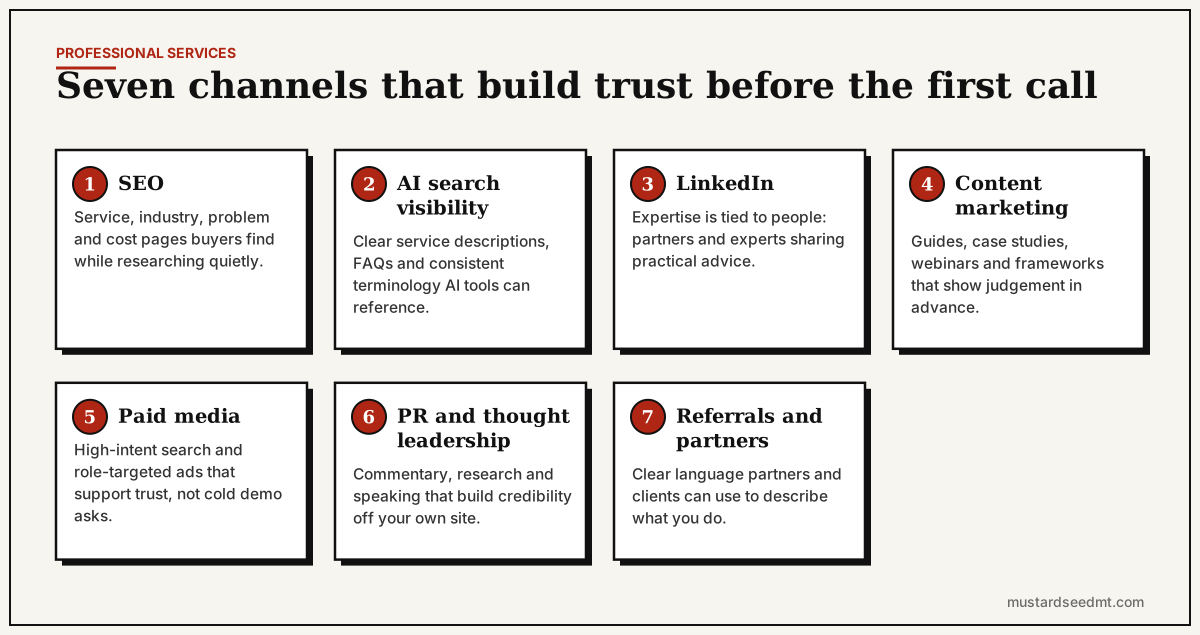
SEO
SEO helps buyers find your firm when they search for problems, services, comparisons, costs, examples, and advisory topics. Buyers often research quietly before asking for help. For professional services, SEO content can educate buyers and build credibility before the first conversation.
AI Search Visibility
AI Search visibility helps your firm become easier to understand and reference in AI-assisted buyer research. Buyers using ChatGPT, Perplexity, or AI overviews may encounter your firm through well-structured educational content, FAQs, and consistent terminology.
LinkedIn is one of the strongest channels for professional services because expertise is tied to people. Founders, partners, consultants, and subject matter experts can share practical advice, market commentary, lessons from client work, and regulatory updates.
Content Marketing
Content marketing demonstrates expertise before a buyer speaks with the firm. It should be specific, grounded in real buyer problems, and connected to clear next steps.
Paid Media
Paid media can support professional services marketing when the targeting, offer, and landing page are specific. It works best when it supports a broader trust-building system rather than asking cold audiences for demos too early.
PR and Thought Leadership
PR helps professional services firms build credibility outside their own website. Useful activities include expert commentary, industry interviews, research reports, contributed articles, and event speaking.
Referrals and Partner Marketing
Referrals are often important for professional services, but they should not be the only growth channel. Marketing can support referrals by giving partners, clients, and contacts clear language to describe what the firm does.
Marketing Strategy for Professional Services Firms
Define the Ideal Client
A firm should clearly define the clients it wants to attract. A broad message usually sounds generic. A specific message builds trust faster.
- Industry, company size, and geography
- Buyer role and decision process
- Problem type, urgency, and service fit
- Budget range and business stage
Clarify Positioning
Positioning should explain who the firm helps, what problems it solves, why those problems matter, what makes the firm different, and what proof supports the claim.
- Clear ICP definition and problem statement
- Specific differentiation — not generic claims
- Proof points and credibility signals
- Positioning that speaks to one client type clearly
Build Service Pages
Each important service should have a dedicated page with a clear problem statement, target audience, process or approach, expected outcomes, proof, and a clear CTA.
- Dedicated page per service or practice area
- Clear problem and target audience statement
- Process, approach, and typical outcomes
- Proof, case studies, and FAQ section
Build Thought Leadership
Thought leadership should demonstrate how the firm thinks, not only claim experience. Good content explains industry changes, common mistakes, decision frameworks, and practical recommendations.
- Industry and regulatory updates
- Decision frameworks and practical guides
- Risk areas and lessons from real work
- Market opportunities and strategic commentary
Connect Content to Lead Generation
Content should guide readers toward reasonable next steps — not every step needs to be aggressive. Some buyers need education before they are ready to speak.
- Read a related guide or article
- Download a checklist or template
- Register for a webinar
- Request an audit or consultation
- Subscribe to insights or newsletter
Support Sales Conversations
Marketing should make sales conversations easier through capability content, service summaries, case studies, and materials that help partners and clients recommend the firm.
- Capability decks and service one-pagers
- Case studies and outcome stories
- Comparison guides and FAQ documents
- Industry-specific pages for sales use
Measure Quality, Not Only Volume
Professional services firms should not judge marketing only by the number of form submissions. One strong opportunity can be more valuable than many weak leads.
- Qualified inquiries and consultation requests
- Proposal requests and meetings booked
- Pipeline influenced and revenue influenced
- Referral source quality and content engagement
Professional Services Marketing Examples
Consulting Firm
A consulting firm publishes problem-focused SEO content, shares partner insights on LinkedIn, runs webinars, builds industry-specific service pages, and uses retargeting to bring visitors back to consultation offers. This helps buyers understand the firm's expertise before speaking with a partner.
Accounting Firm
An accounting firm creates content around tax planning, compliance deadlines, international business setup, and financial reporting. It promotes practical checklists through email and LinkedIn. This creates recurring trust around time-sensitive business needs.
Legal Services Firm
A legal services firm publishes explainers on regulatory changes, contract risks, employment issues, and market-entry legal questions. It uses SEO and LinkedIn to reach business owners and executives before legal needs become urgent. This helps the firm become visible when buyers are researching sensitive decisions.
IT Services Firm
An IT services firm publishes guides on cybersecurity, cloud migration, backup, compliance, managed services, and infrastructure modernisation. It uses Google Ads for high-intent service keywords and retargeting for visitors who viewed service pages.
Professional Services Lead Generation
Lead generation for professional services should be trust-based. The offer should match the buyer's stage. A cold visitor may not want a sales call yet, but they may download a checklist or attend a webinar. A visitor who reads multiple service pages may be ready for a consultation.
| Offer | Best for |
|---|---|
| Consultation | Warm |
| Diagnostic call | Warm |
| Audit or assessment | Warm |
| Workshop or session | Warm |
| Checklist or guide | Cold to warm |
| Webinar | Cold to warm |
| Benchmark review | Cold to warm |
| Proposal request | Ready |
Professional Services SEO
Professional services SEO should focus on both service intent and problem intent. Service pages capture existing demand. Educational pages create demand and build trust.
How AI Search Is Changing Professional Services Marketing
Buyers of professional services now ask AI assistants for a shortlist before they ask a colleague: which firms handle this kind of work, what it usually costs, how to choose between them. The assistant answers from pages that state those things plainly, and from what other people have published about the firms. A firm whose site says it “delivers tailored solutions” gives it nothing to repeat.
Five things change for a professional services firm:
- 1
Specific service pages get quoted
A page that names who you serve, the problem, what is delivered, how long it takes and a price range answers the questions an assistant is trying to answer. General capability pages rarely get quoted.
- 2
The people are the product
Professional services are bought from people. Partner and expert bios with real experience, linked to their LinkedIn profiles and anything they have published or spoken at, give assistants a reason to trust the firm behind them.
- 3
Proof has to exist off your site
When asked for the best firms in a field, assistants lean on directories, review platforms, partner listings, industry lists and press. Your own site cannot rank you first, so client reviews and listings matter more than they did.
- 4
Pre-call questions become pages
Cost, process, timelines and what is included used to be answered on the first call. Answer them on the site, in short question-and-answer form, and the assistant can answer them for you.
- 5
One answer is not a measurement
Ask the questions your clients ask, monthly, in ChatGPT, Gemini, Perplexity and Copilot, and record which firms are named. That trend is the metric, not a single screenshot.
If your firm never comes up in AI answers, start with why ChatGPT doesn’t recommend your business and how to measure AI visibility.
Marketing a Small Consulting Firm on a Small Budget
A firm of one to twenty people cannot run every channel in this guide, and should not try. Most small firms win work through referrals and the reputation of the people doing it. The job of marketing is to make that reputation easy to find and easy to check. In order:
- One page per service, each saying who it is for, what is delivered, how long it takes and roughly what it costs.
- A real profile for everyone who sells the work, on the site and on LinkedIn, saying the same thing in both places.
- A referral habit: ask happy clients for an introduction and a short review at the end of every engagement, not once a year.
- One useful piece a month answering a question a client actually asked you, posted on the site and shared by the person who wrote it.
- Paid ads last, and only once the service pages turn visits into enquiries. Ads make a working page busier; they do not fix a page that does not convert.
What it costs to have it done for you: Mustard Seed’s packages start at $600 for a website and search foundation and at $1,000 for an inbound and AI-visibility plan. See pricing.
Professional Services Marketing for New Markets
When a professional services firm enters a new market, it may not have local recognition yet. A firm cannot assume its reputation in one market automatically transfers to another.
For new-market strategy, see also: Geo Targeting Ads and Marketing Budget Allocation.
Common Professional Services Marketing Mistakes
Relying only on referrals
Referrals are valuable but unpredictable. A marketing system should generate new opportunities consistently, not depend entirely on network introductions.
Describing services too broadly
"Management consulting" or "marketing agency" is not enough. Buyers need to understand the specific problem, industry, outcome, and buyer type.
Publishing generic thought leadership
Content that could have been written by anyone does not demonstrate expertise. Good thought leadership should show how your firm specifically approaches a problem.
Not building dedicated service pages
A single services page cannot rank well for multiple service terms or convert visitors looking for specific help.
Ignoring SEO
Many buyers research professional services firms through organic search. Without SEO, your firm is invisible to a large portion of potential clients.
Treating LinkedIn as an announcement feed
Company announcements rarely build trust or attract buyers. Practical expertise and honest insights from real people perform much better.
Running ads to generic homepages
Paid ads should connect to relevant landing pages that explain the service, target audience, and next step clearly.
Not explaining the firm's process
Buyers need to understand how the firm works, not just what it does. A clearly explained methodology reduces purchase anxiety.
Not showing proof or examples
Case studies, outcomes, and client references are especially important for high-trust professional services decisions.
Measuring only lead quantity
A lead from a poor-fit company may not be useful even if it was cheap. Qualified inquiries from right-fit clients matter more than form fill volume.
Metrics to Track
The most important metric is not raw traffic. It is qualified interest from the right clients.
Frequently Asked Questions
What is professional services marketing?
Professional services marketing is the process of promoting expertise-based services — such as consulting, legal, accounting, IT services, advisory, and other B2B services — to business buyers.
What are the most effective marketing strategies for professional services firms?
The most effective strategies make expertise visible before the first meeting: specialise by industry and problem, publish answers to real client questions, give each service its own page, make your experts visible on LinkedIn, turn client work into case studies, run referrals as a system, offer a low-risk diagnostic, email past clients regularly, and keep your firm easy to describe in search and AI answers.
What is the difference between business services marketing and professional services marketing?
Business services marketing covers any service sold to companies, including staffing, logistics, payroll and facilities. Professional services marketing is the subset where clients buy expert judgement, such as consulting, legal and accounting. Operational services are sold on reliability, coverage and price; professional services are sold on expertise, proof and trust.
Why is marketing important for professional services firms?
Marketing helps professional services firms build trust, explain expertise, attract qualified clients, support referrals, and create business opportunities beyond personal networks.
What channels work best for professional services marketing?
Common channels include SEO, LinkedIn, content marketing, email, PR, referrals, events, webinars, paid search, retargeting, and partner marketing. The right mix depends on the firm's goals, target clients, and service type.
How is professional services marketing different from product marketing?
Professional services marketing focuses more on expertise, trust, process, judgment, reputation, and client fit. Product marketing often focuses more on features, functionality, pricing, and product adoption.
How do professional services firms generate leads?
Professional services firms generate leads through referrals, SEO, thought leadership, LinkedIn, webinars, email nurture, paid media, service pages, consultations, audits, and partner relationships.
How is AI search changing professional services marketing?
Buyers now ask AI assistants which firms to consider, what the work costs and how to choose. Assistants answer from pages that state those things plainly and from third-party reviews, directories and lists. Firms need specific service pages, real expert profiles, proof that exists off their own site, and answers to the questions clients used to ask on the first call.
How should a small consulting firm market itself on a small budget?
Make the reputation that already wins referrals easy to find and check: one page per service with who it is for, what is delivered and a price range; a consistent profile for everyone who sells the work; a habit of asking for introductions and reviews; and one useful article a month. Add paid ads only once the service pages turn visits into enquiries.
How much does professional services marketing cost?
It depends on scope and on how much is done in-house. As a reference point, Mustard Seed Solutions' packages start at $600 for a website and search foundation and at $1,000 for an inbound and AI-visibility plan; the full tiers are on the pricing page.
Should professional services firms use paid ads?
Paid ads can work if the targeting, landing page, and offer are strong. Paid search can capture service intent, while LinkedIn and retargeting can support awareness and trust-building.
Related Resources
Digital Demand Generation
Core channels, five-stage framework, metrics, and mistakes for B2B demand generation.
B2B Demand Generation Strategy
Nine components, campaign framework, and 15 demand generation metrics.
Demand Generation Agency
What a demand gen agency does, when to hire one, and what to expect in 90 days.
Omnichannel Marketing
How to connect SEO, paid media, LinkedIn, email, and PR into one buyer journey.
Geo Targeting Ads
Location targeting strategy for B2B market entry and regional campaigns.
Retargeting vs Remarketing
How to use ad-based and contact-based follow-up in B2B demand generation.
Professional services growth
Need Marketing Strategy for a Professional Services Firm?
Mustard Seed Solutions helps B2B service firms build practical marketing systems across positioning, SEO, AI Search visibility, LinkedIn, content, paid media, PR, referrals, and demand generation. If your firm relies too heavily on referrals, has unclear positioning, or needs more qualified inquiries from the right clients, we can help.
Request a Professional Services Marketing Review