
How to Validate a Business Idea
Validating a business idea means confirming real people will pay for it before you spend months building it. The fastest, cheapest tests are talking to prospects directly, collecting pre-commitment signals — a waitlist, a deposit, a preorder — and checking whether people already pay for a worse version of the same solution. Skip this, and the build itself becomes the expensive way to find out nobody wanted it.
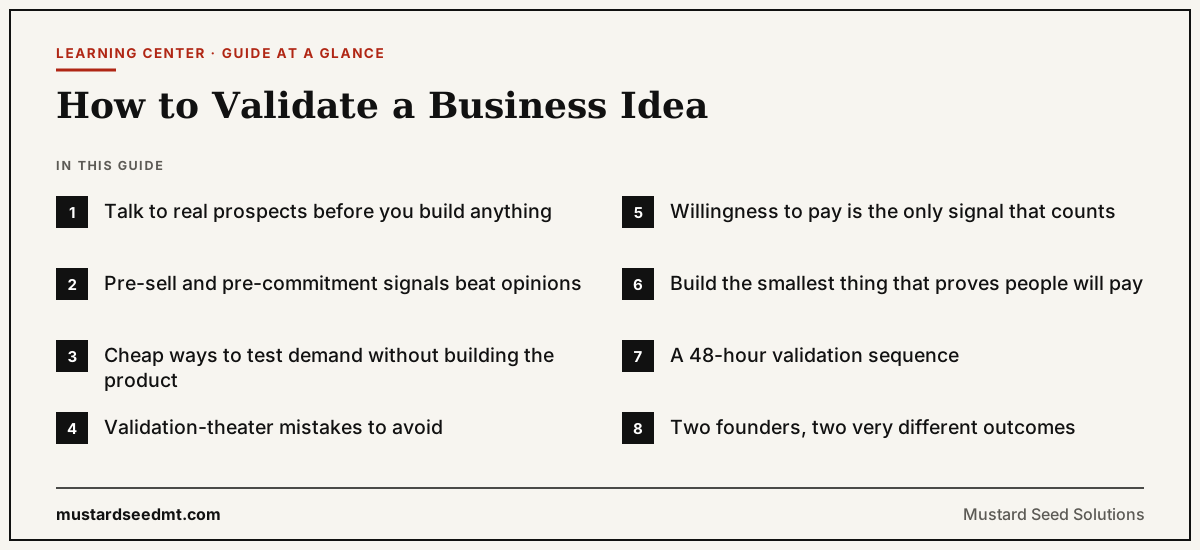
This guide is built from real founders describing exactly how they validated — or failed to validate — before building. The same mistake shows up across dropshipping, SaaS, and content businesses alike: building first, and asking later. The fix is the same regardless of what you're building.
1. Talk to real prospects before you build anything
One founder in the research described failing at five separate business ideas — SaaS, dropshipping, Amazon FBA — for the same underlying reason each time: never talking to a real, breathing prospect one-on-one to check if they actually needed the thing and would pay for it. Validation, in his framing, is just confirming that someone besides you is genuinely interested, before you spend the time and money to build it. Build second. Validate first.
- A rookie mistake repeats itself across business models — the fix is the same regardless of what you're building
- Talking to people is uncomfortable, which is exactly why it gets skipped in favor of building
- Validating cheap and fast means spending time or a small amount of money, not months and your savings
- If 100 people see an offer and nobody bites, that's information — not a reason to build anyway
2. Pre-sell and pre-commitment signals beat opinions
A 'that sounds great' is nearly worthless; a waitlist signup, a deposit, or a preorder is real signal. The pattern one founder called a smoke test: before spending money, build a simple landing page describing the offer and ask people to join a waitlist — either paying a little to reach the right audience with ads, or spending time finding and asking people directly. Dropbox famously validated demand this way with a simple demo video before writing a line of production code, collecting tens of thousands of signups first.
- A landing page plus a waitlist costs almost nothing and takes a day, not months
- Money and time are substitutes here — spend one or the other, not neither
- A dead 'sorry, sold out' button after a fake checkout is one blunt but effective way to measure real purchase intent
- Zero signups from a fair-sized audience is a saved $5,000, not a failure
3. Cheap ways to test demand without building the product
One founder described a 48-hour validation loop: search Reddit and forums for people already asking 'is there a tool for X' or 'how do I solve Y' — three or more people asking the same thing is a real signal. Build a mock landing page in an afternoon (a simple explainer plus a Stripe 'preorder' button), share it honestly in relevant threads rather than spamming, and cold-message a handful of people directly. His rule: a few real Stripe pings and it's a go; no pings and the idea gets killed before a line of code is written.
- Search for recurring complaints on Reddit, niche forums, and low-star reviews on sites like G2 and Capterra
- One person complaining is noise; fifty people describing the identical problem across multiple platforms is signal
- A mock landing page with a real payment button beats a survey — money moving (or not) is the honest test
- Check whether people are already paying a freelancer on a site like Upwork to do the thing manually — that's a business waiting to happen
4. Validation-theater mistakes to avoid
The most common trap isn't skipping validation entirely — it's doing something that feels like validation but isn't. One founder spent six months and published 127 pieces of educational content, gaining 340 followers and exactly zero clients, before realizing that demonstrating expertise isn't the same as confirming demand. Another described three months of solo building where posting the project publicly felt harder than building it — staying in the 'build loop' is a comfortable way to avoid the one step (asking strangers to react, or pay) that actually validates anything. Both mistakes share the same root cause: they generate the feeling of forward motion without ever putting the offer in front of someone who could say no.
- Publishing content, polishing a landing page, or refining a pitch deck all feel like progress but validate nothing on their own
- SEO and paid ads are growth channels, not validation methods — they're slow and expensive ways to find out if anyone wants what you're selling
- If you keep improving the product without ever showing it to a stranger, that's avoidance, not diligence
- Free trial users who never convert to paying customers are a validation failure being mistaken for traction
5. Willingness to pay is the only signal that counts
Interest is common; money is rare, which is exactly why it's the useful signal. One founder's filter for a real opportunity: is someone already paying for a bad solution to this problem? If people are tolerating a tool they dislike or paying a freelancer repeatedly to do something manually, you don't need to convince them to spend money — you only need to be less painful than what they're already using.
- A person tolerating a flawed paid tool is a warmer lead than someone who has never spent a cent on the problem
- Free-tier signups and 'this looks cool' comments are not validation — a card number is
- If nobody who says they'd pay actually pays when asked, believe the payment, not the compliment
- Testimonials from a small free cohort can be used to convert the next batch into paying customers, once the product actually works
6. Build the smallest thing that proves people will pay
Once real demand signals show up, the next step isn't a polished product — it's the smallest version that proves the core problem gets solved. One founder described an intentionally rough, undesigned first version offered free to an initial small cohort in exchange for feedback and testimonials, then used that proof to convert a second batch, and only started charging the third batch once the offer was proven. The same founder ran his first paid version at roughly $20 a day in recurring revenue, built in three days total — small, but real money changing hands, which is the entire point of the exercise.
- An embarrassing-looking first version is normal, not a red flag, if it solves the core problem
- Give an early cohort the product free in exchange for honest feedback and a testimonial, not silence
- Use early proof (real usage, real testimonials) to earn the next, paying batch of users
- Resist adding features before you've proven anyone will pay for the smallest version
A 48-hour validation sequence
One founder's exact process for testing a SaaS idea without building anything — compressed into two days, not two months.
Hour 0–8
Search for pain
Search Reddit and niche forums for people already asking 'is there a tool for X' — three or more independent askers is a real signal
Hour 8–20
Mock the offer
Build a bare landing page: a 3-line explainer and a Stripe 'preorder' button — no design, no logo needed
Hour 20–36
Share honestly
Drop it into relevant threads without spamming, and message a handful of people directly with a low-pressure note
Hour 36–48
Read the signal
A few real preorders is a go; silence means the idea gets killed before a line of product code is written
Two founders, two very different outcomes
One founder spent the first year of building brainstorming ideas alone in a notebook — thirty ideas over six months, two of them actually built, both making exactly zero dollars. What changed everything was flipping the process: instead of inventing problems from inside his own head, he went looking for people already complaining about something specific, filtering one-star reviews on sites like G2 and Capterra, app store complaints, and niche subreddit threads for patterns rather than one-off gripes. His filter for a real opportunity was blunt — is someone already paying for a bad solution to this? — and it led to 680 paying users off a process he could repeat on command. Along the way he learned that SEO and paid ads were a near-total waste of early effort: blog posts took months to rank and ad spend disappeared before a landing page that described features instead of outcomes ever converted anyone.
Compare that to a different founder's six months spent almost entirely on content — 127 LinkedIn posts, Twitter threads, and long-form articles demonstrating real expertise. The output looked identical to genuine business-building from the outside: consistent, effortful, expert. The actual result was 340 followers and zero clients, because expertise-sharing answers a question nobody who's just scrolling actually asked. It took switching from teaching a framework to naming a specific, uncomfortable pain point before the same effort started converting into paying retainers. Both founders worked hard for months. Only one of them was validating anything during that time.
When "no one signed up" actually means something else
Validation methods aren't universal, and the research shows real disagreement about exactly this. When one founder recommended a waitlist smoke test, several people pushed back specifically on regional differences — in some markets, the argument went, people don't sign up for waitlists at all; they expect to buy now and receive the product immediately, so a quiet waitlist may say more about local buying habits than about actual demand. The practical fix suggested in that same thread was to skip the waitlist and go straight to a real, if crude, purchase test: a checkout button that leads to an honest "sold out, join the list for the next batch" message. That still measures real intent to buy, without assuming everyone validates the same way.
The lesson isn't that any one validation method is broken — it's that the method needs to match how your specific audience actually behaves. A B2B buyer researching a $500/month tool behaves differently from a retail shopper expecting same-day delivery, and a validation test built for one will understandably underperform for the other. Before concluding "nobody wants this" from a quiet test, it's worth asking whether the test itself matched how your prospects actually make buying decisions.
Same pattern, different founders
This mistake shows up constantly in the research
Building before validating is one of the most frequently repeated patterns across 270 real founder discussions analyzed for this site — right alongside the marketing and distribution struggles that usually follow it. See how it ranks against the other biggest challenges solopreneurs report.
See the 50 Biggest Solopreneur ChallengesRelated resources
Frequently Asked Questions
What does it mean to validate a business idea?
Validating means confirming, before you build, that real people have the problem you think they have and will actually pay to solve it — not just that they find the idea interesting. The research is consistent: opinions and encouragement are common, but a waitlist signup, a deposit, or an existing payment for a worse solution are the signals that actually predict a business.
How do I validate a business idea with no money?
Spend time instead of money: search Reddit and niche forums for people already describing the problem, build a free landing page with a waitlist or a mock 'preorder' button, and directly message or reply to a handful of people who show the pain. One founder ran this entire loop in 48 hours before writing any code.
What is a smoke test and how do I run one?
A smoke test borrows its name from plumbers pumping smoke through pipes to find leaks before running water. In business, it means creating a simple landing page or offer and measuring real interest — a waitlist, a preorder, a deposit — before spending real money building the product. If nobody bites, you've saved the cost of building it.
Do I need to build an MVP to validate demand?
Not necessarily, and often not first. Several founders in the research validated demand with nothing more than a landing page, a Notion page with a Stripe preorder button, or direct outreach — before writing a single line of the actual product. An MVP comes after you've confirmed people will pay, not instead of confirming it.
How many people do I need to talk to before building?
There's no fixed number, but the pattern that repeats is small: a handful of direct conversations or messages (ten was one commonly cited number) is usually enough to tell whether you're onto something or not. The key is talking to people who actually have the problem, not friends who are inclined to be supportive.
What's the difference between real validation and validation theater?
Real validation involves asking strangers to commit something — money, a signup, a reply confirming the pain — and being willing to hear no. Validation theater is work that feels productive but avoids that ask: publishing content, polishing a pitch deck, or refining a product nobody has seen yet. One founder spent six months on the former and got zero clients from it.
Should I use paid ads to validate demand?
Ads can work as one way to drive traffic to a smoke test, but they're a distribution tool, not proof of demand by themselves. Several founders described SEO and paid ads as early-stage waste — slow, expensive ways to discover whether anyone wants the offer, when direct outreach and forum research would have answered the same question faster and cheaper.
What if nobody signs up for my waitlist or preorder?
That's a valid, useful result — it means you likely just avoided spending months and real money building something with no demand. The founders in the research treated a quiet smoke test as good news relative to the alternative, and moved on to test the next idea rather than building anyway.
Validated the idea? Now get it in front of people
Turn real demand into a real launch
Validation proves people want it. Mustard Seed's Solo Business Marketing advisory helps solopreneurs turn that proof into positioning, a website, and content that actually gets found.
Book a consultation