
Most "nobody wants my product" stories share the same root cause: the builder tested their own conviction, not the market. Across dozens of founder accounts, the failure rarely comes from a bad idea — it comes from skipping the step where a real stranger commits money or a real conversation before the building starts.
One founder who described failing at several ventures — a SaaS tool, a dropshipping store, an Amazon FBA attempt — put it plainly: none of them had failed because the business model was wrong. They failed because he had never talked to a real, breathing human being about whether they would actually pay for it. He called it the classic rookie mistake, and said he had made it five separate times before it stuck.
That pattern shows up again and again once you start looking for it: conviction stands in for evidence, and the gap between the two only becomes visible after months of work are already spent. Our full guide to validating a business idea walks through the sequence in detail — this post focuses on how the failure itself tends to happen.
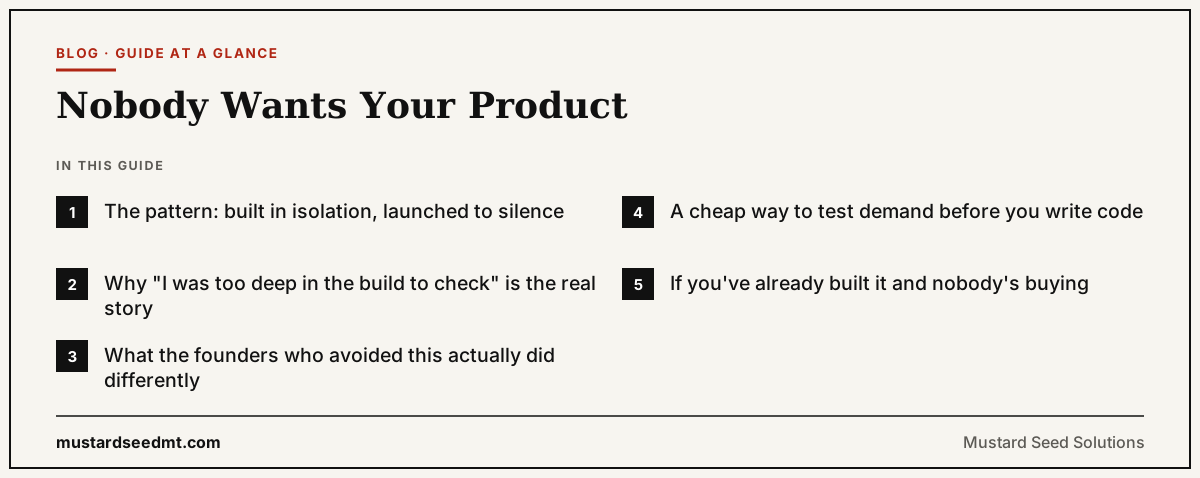
The pattern: built in isolation, launched to silence
The specific mechanics repeat across accounts. A builder spots a company doing something similar elsewhere, decides the concept should transplant into their own market, and spends months building a version of it without checking whether the local audience wants it at all. One founder described spending six months cloning a "text-to-buy" e-commerce concept for a new region, launching the MVP, and getting nothing — not disappointing traction, literally nobody. He called the region "not ready" for the model, but readiness was never tested before the six months were spent.
A different account described a full year of nights-and-weekends work spent building four separate projects — an expense tracker, an AI video tool, an AI story generator, a photo importer — each one chosen because it felt exciting to build, not because anyone had asked for it. None of them worked. The founder said he "didn't feel proud" of any of it. The pattern only broke when he responded to an actual Reddit post from someone looking for a specific, narrow tool, built a rough version in about a week, and made his first sale from a person who already wanted exactly that thing.
Why "I was too deep in the build to check" is the real story
A recurring, less obvious version of the same failure is emotional rather than strategic: builders who keep improving a product for months specifically because shipping it publicly feels riskier than continuing to build. One founder described three months of solo work on an app, tweaking details and telling himself he was "getting closer," while quietly avoiding the moment a stranger would react to it. He admitted that nobody tells you, when you work alone, when to stop building and put the thing in front of real people — so the loop can continue indefinitely, always feeling productive.
Several people responding to that account described the identical trap in their own work. One described building a tool for more than four months, using it successfully inside his own agency, with clients who genuinely liked it — and still freezing the moment he had to write the sentence "hey, I made this thing" for strangers. He said he rewrote the launch post six times before publishing it. The build itself was never the hard part. Finding out whether anyone outside the builder's own head wanted it was.
This matters for validation specifically because the delay is invisible from the inside. It feels like diligence — one more feature, one more polish pass — but it is functionally identical to never testing demand at all. A product that only exists on a hard drive has not been validated, no matter how many months went into it.
What the founders who avoided this actually did differently
The accounts that describe skipping this failure entirely follow a noticeably different sequence. Rather than generating ideas from inside their own head, they described spending time reading where people already complain in public — niche subreddits, review sites, app store complaints — and looking specifically for the same frustration showing up independently across many people, not just one loud post. One founder called a single complaint "noise" and fifty similar ones a business. Another described a simple 48-hour test: search for the problem being asked about repeatedly, build a three-line explainer with a preorder link instead of a real product, and treat silence — zero preorders — as a signal to kill the idea before writing any code.
One founder who described switching to this approach after a year of ideas that made zero dollars said the resulting concepts were deliberately unglamorous: people already paying a larger tool for one feature they'd switch to a smaller, cheaper single-purpose tool for; people stitching together several free tools and still complaining about the seams; niche trades — plumbers, tutors, small gym owners — with no decent software built for them at all because nobody wanted to build for a "small" market. None of these ideas would win a pitch competition. All of them came from a pattern of real people already spending money or effort on a worse version of the same problem.
The through-line in every version of this approach is the same: money or a real, specific conversation has to move before the build does. A "yes, that sounds nice" from a friend does not count. A stranger paying a few dollars for something that does not exist yet, or a stranger describing the exact same pain unprompted, does.
A cheap way to test demand before you write code
Stripped down, the methods described above form a workable sequence for a solo builder testing a new idea this week rather than this quarter:
- Search the relevant subreddits and communities for the exact problem, phrased the way a customer would phrase it — not the way you would pitch a solution.
- Treat one complaint as noise and a pattern of several independent, unprompted complaints as a real signal worth acting on.
- Put up a plain, unstyled explainer — a few lines describing the offer — with a real way to pay, such as a preorder or deposit link, before any product exists.
- Share it in the same places the complaints came from, framed as "I was building this for myself, it might help," rather than as a pitch.
- Message a small number of people who described the problem directly, without pressure, and count how many actually respond and commit.
None of this requires a designer, a logo, or working software. It requires being willing to hear "no" or, worse, silence — before months of work are on the line instead of a few days.
If you've already built it and nobody's buying
The instinct after a launch goes quiet is to defend the idea — better marketing, better design, more features. The more useful instinct, based on how the recoveries above actually happened, is to go back to a small number of real people close to the problem and ask direct questions before assuming the whole concept is dead. Sometimes the audience was wrong, or the price, or the framing — not the underlying problem. But if a pattern of real indifference holds after those conversations, the healthiest move is to treat the build as a paid lesson in what the market does not want, apply it to the next attempt, and stop trying to force interest that was never tested for in the first place.
Validation failures are rarely about talent or execution. They are almost always about sequencing — building before asking, instead of asking before building. Get a fuller picture of where this shows up across the wider solopreneur journey in The 50 Biggest Solopreneur Challenges, our full research report.