
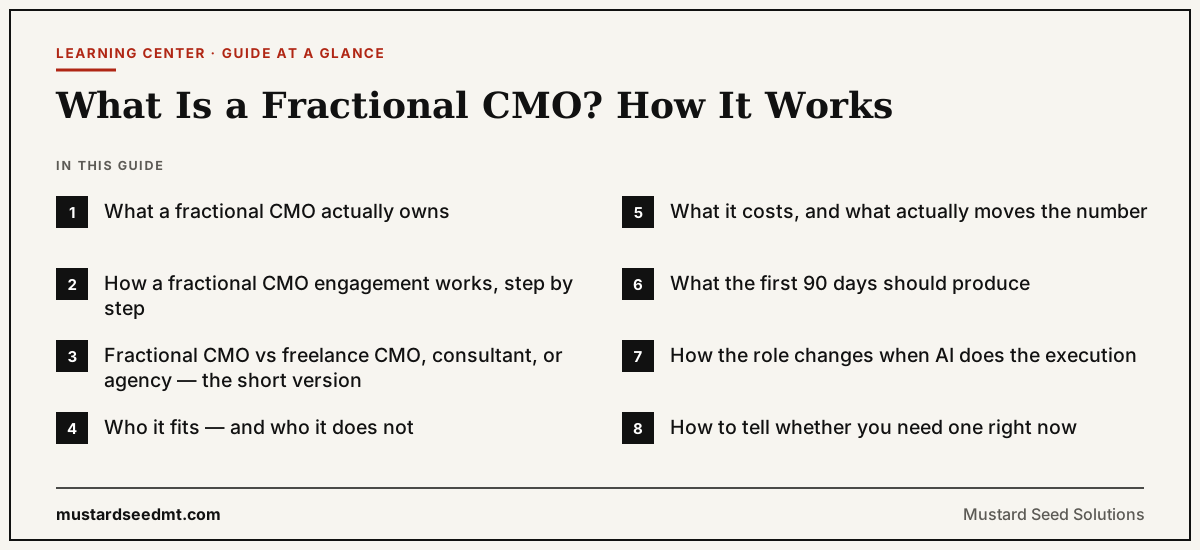
A fractional CMO is an experienced marketing executive who leads a company's marketing function part time and on an ongoing basis — usually a few days a month — owning positioning, budget allocation, channel decisions and measurement while execution stays with in-house staff, contractors or agencies. It is defined by decisions owned, not hours bought.
The model exists because the arithmetic of a full-time hire rarely works below a certain size. A full-time chief marketing officer in the United States costs well into six figures once salary, equity, benefits and employer overhead are counted, and most companies under $20M in revenue need CMO-grade decisions far more often than they need CMO-grade hours. Marketing leadership is decision-dense and execution-light: the positioning call, the channel call and the budget call take a handful of hours a month and determine most of the result.
If you are a founder still acting as your own head of marketing, or a CEO with a junior marketer and an agency but nobody above them, this page is written for you. It covers what the role owns, how a typical engagement runs, what it should have produced by day 90, and when hiring one is the wrong move. A different question — what authority the title has to carry and where it sits on an org chart — is answered separately.
What a fractional CMO actually owns
The clearest way to understand the role is as a list of decisions with a name attached to each one. These are the decisions a fractional CMO owns:
- Positioning and message. What the company is, who it is for, and why it wins. Every other marketing decision inherits from this one, which is why it cannot be delegated to a copywriter.
- ICP and segment priority. Which customers get pursued first, which get pursued later, and which get politely declined. Priority is a decision, not a preference.
- Input into pricing and packaging. Not sole authority, but a seat at the table. How an offer is packaged and priced does more to move conversion than most campaigns do.
- The channel portfolio. What to start, what to keep, and what to kill. The stop-doing list is the part most companies never get, and it is usually where the budget is hiding.
- Budget allocation. Where the money goes and the rationale for each line. A budget without a written rationale is a habit, not a plan.
- Hiring and vendor decisions. Which roles to hire, which agencies or freelancers to appoint, and when to end a vendor relationship that is producing activity instead of results.
- The measurement model. What counts as a lead, what each funnel stage means, and which numbers the company will actually be run on. Most reporting arguments are really definition arguments.
- The quarterly plan the CEO is held to. One document, agreed in advance, that says what marketing will attempt this quarter and what evidence will prove it worked.
Now the mirror image, which matters just as much. A fractional CMO does not own campaign production. Not ad-account button-pushing, not the daily content calendar, not sales follow-up, not the social inbox. Where those things are done personally in a small engagement, they are done because they are the highest-leverage work available that month, not because they are the job.
The load-bearing line: you are buying a decision-maker with accountability for the outcome, not a senior pair of hands. If what you actually need is hands, a fractional CMO is an expensive way to get them and a frustrating person to manage.
How a fractional CMO engagement works, step by step
Engagements vary, but the shape is consistent enough to describe. Four phases, each with something written at the end of it.
- Diagnostic (Weeks 1-2). Interviews with the founder, with whoever sells, and with five to ten customers. An audit of the site, the funnel, the CRM data and current spend. It ends with an honest written read on what is broken, in priority order.
- Plan (Weeks 3-4). A positioning statement, a written ICP definition, a channel plan with an explicit stop-doing list, a budget allocation with a rationale per line, and a measurement model everyone has agreed to.
- Operating rhythm (Month 2 onward). A fixed weekly or biweekly working session with the founder, a monthly review against the numbers, a quarterly re-plan, and async availability between sessions for decisions that cannot wait.
- Handover (When it ends). The point at which an in-house hire or a lean AI-assisted team takes the operating load, with the working documents, accounts and templates left in the company's own hands.
Then the mechanics a buyer needs before signing anything. The engagement is normally sold as a fixed monthly retainer against a defined scope rather than an hourly rate, because hourly billing turns a leadership relationship into a timesheet argument and quietly discourages the short conversations that produce the best decisions. Commitment is expressed in days per month, so both sides know what has been bought. And it is explicitly multi-client: the same fractional CMO works with other companies at the same time. That is the source of both the cost saving and the pattern recognition, and any engagement that pretends otherwise is really a part-time employment contract with worse terms.
Fractional CMO vs freelance CMO, consultant, or agency — the short version
Freelance CMO is a search phrase, not a distinct role. It describes an employment status. Fractional CMO describes a mandate. A person can be both at once, and most are.
The real dividing line across all four options is accountability. A freelancer or a consultant delivers a recommendation and leaves; the recommendation is the deliverable. A fractional CMO stays and is measured on whether the recommendation worked. An agency owns a channel and is measured inside it; a fractional CMO owns the whole portfolio and can fire the agency.
Fractional CMO vs freelancer, consultant, agency, and full-time CMO
| Option | What you're buying | Accountable for results? | Scope |
|---|---|---|---|
| Freelance CMO | Same person, different label — describes an employment status, not a distinct role | — | — |
| Consultant | A recommendation, then the consultant leaves | No — the recommendation is the deliverable | — |
| Agency | Execution inside one channel | Measured inside that channel | One channel |
| Fractional CMO | Ongoing ownership of positioning, budget and channel decisions | Yes — stays, is measured on whether the recommendation worked, and can fire the agency | The whole portfolio |
That is deliberately the short version. The detailed comparisons already exist and do a better job than a summary here would:
- Fractional CMO vs marketing consultant
- Fractional CMO vs marketing agency
- Fractional CMO vs full-time CMO
Who it fits — and who it does not
A fractional CMO usually fits when:
- Revenue already exists but growth has plateaued, and nobody can say why with evidence.
- The founder is still the de facto CMO and has become the bottleneck on every marketing decision.
- There is a junior marketer or an agency executing competently with no strategy above them.
- A funding round or a new market entry needs a credible plan that survives diligence.
- The company has marketing decisions to make monthly, but not daily.
It is usually the wrong hire when:
- Pre-product or pre-first-customer. There is nothing to position yet, and no evidence to position against.
- You want hands to execute a plan you already have. That is a hiring problem or an agency problem, not a leadership one.
- There is no budget to execute whatever the plan recommends. A strategy you cannot fund is a document, not a result.
- The founder will not actually delegate marketing authority. A leader without authority produces meeting notes.
The second list is the more useful one. Most pages written about this role are sales pages that quietly assume everyone is a fit, and the fastest way to waste two quarters and a five-figure budget is to hire senior direction for a problem that was really a capacity problem. If more than one item on the bad-fit list describes you, fix that first.
What it costs, and what actually moves the number
There is no honest single answer, and any page quoting a typical hourly rate without naming a source is guessing. What is reliable is the list of things that move the number: days per month, breadth of scope, whether the fractional CMO also manages people or vendors, company complexity (multi-product, multi-market, regulated), and reporting obligations to a board or an investor. Compare the price against the responsibility being transferred, not against an hourly rate — a cheaper person who cannot make the positioning call is not cheaper.
What this costs at Mustard Seed Solutions
Retained fractional marketing leadership starts at $3,000 per month — the published Channel Growth level — and is scoped individually above that. If you do not need a retained leader, two fixed-scope alternatives are published instead: Visibility Starter at $600 and the SMB Growth Plan at $1,000. Both are defined one-off deliverables rather than ongoing leadership. Enterprise scope is custom.
What the first 90 days should produce
Agree the acceptance criteria before the engagement starts, not after. By day 90 you should be able to point at:
- A written positioning statement and ICP that the founder and the salesperson both recognise.
- A channel plan with an explicit stop-doing list, not just a list of new things to try.
- A measurement model where everyone agrees what a lead is.
- A budget allocation with a stated rationale per line.
- At least one channel moved from opinion to evidence.
And the counter-signal, which matters more than the checklist. If 90 days have produced workshops, decks and alignment but none of the five artefacts above, the engagement is failing. Say so out loud in the month-three review rather than waiting for month six. A good fractional CMO will agree with you, because the same evidence is what they are using to judge themselves.
The full sequence, week by week, is written up separately: the first 90 days of a fractional CMO engagement, and the version specific to how I run it is on the fractional CMO services page.
How the role changes when AI does the execution
The classic version of this model assumed the strategy would be executed by a team you still had to hire. That assumption is where most of the cost lived, and it is the assumption that has changed. Research, first-draft content, ad variants, list building, competitive monitoring and reporting no longer require headcount. A senior leader with a small AI-assisted stack can now carry work that genuinely used to need four or five people.
Being specific about the limits is what keeps that claim honest. AI does not decide positioning. It cannot own a customer conversation. It produces confident, plausible noise without a senior editor deciding what is true and what is worth saying. Anything a customer will read as a promise — a claim, a price, a differentiator — is a human decision and stays one.
There is a newer consequence too. Buyers increasingly find and shortlist vendors through ChatGPT, Claude, Perplexity and AI Overviews rather than through a page of blue links. That makes whether your company is citable by AI assistants a CMO-level decision about how the company is described and where that description lives, not a technical SEO chore to be handed down. It is one of the few genuinely new items on the marketing leadership agenda in the last decade.
How to tell whether you need one right now
A 60-second self-check. Four questions, answered honestly:
- Is marketing the constraint on growth right now, or is it sales capacity?
- Is anyone accountable for the number, or only for activity?
- Can the founder name the ideal customer profile in one sentence, the same way twice?
- Has any spending decision been justified by evidence in the last two quarters?
If marketing is the constraint, nobody owns the number, the ICP answer changes depending on who is asked, and spend is running on habit, then the gap is leadership and a fractional CMO is a reasonable answer. If the answers point the other way, buy something else.