
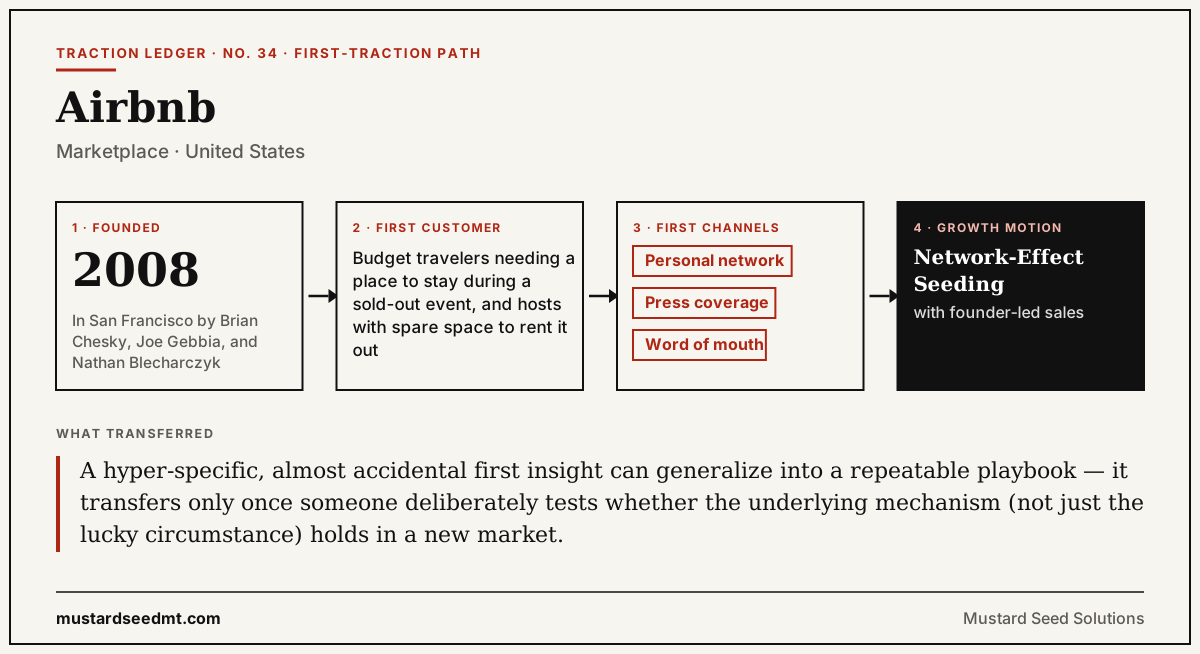
The Wedge: How Airbnb Got Its First Customers
Airbnb's actual first customers were attendees of a design conference in San Francisco in 2007, in a year when local hotels had sold out; Brian Chesky and Joe Gebbia rented air mattresses in their own apartment and served breakfast, calling the experiment "Air Bed and Breakfast" — a name soon shortened to "Airbnb" once the idea grew into a company.
The insight that generalized from that one event was specific: sold-out hotel capacity during high-demand events created a real, dated need for alternative lodging, and the founders' apartment was proof the concept could work at all before it was proof of a business.
Founded in San Francisco by Brian Chesky, Joe Gebbia, and Nathan Blecharczyk (2008).
Airbnb's First Channel
Early growth relied heavily on the founders' own direct involvement — famously, Chesky and Gebbia personally visited early New York hosts to take professional-quality photographs of their listings, having identified that poor photos were suppressing bookings.
Cross-posting listings to Craigslist, tapping into that site's existing housing-classifieds traffic, is a widely retold early growth tactic that gave Airbnb access to an audience already searching for exactly the kind of listings it needed to fill both sides of its marketplace.
The Motion: Network-Effect Seeding
The company deliberately seeded supply (hosts) city by city rather than attempting to grow broadly and evenly, concentrating early effort on markets — starting with New York — where enough host density could be reached to make the marketplace genuinely useful to guests.
The percentage-based service fee, charged to both sides of each transaction, aligned Airbnb's revenue directly with successful bookings rather than with listings alone, meaning the company's incentives matched the outcome its users — both guests and hosts — actually cared about.
Demand surged in bursts tied to specific events (conferences, and later disaster-driven displacement bookings), which the company learned to anticipate and seed supply ahead of, turning what began as one conference-driven insight into a repeatable playbook for entering new markets.
The Turn
The turn was generalization: what began as a one-time, almost accidental response to a single sold-out event became a deliberate, structured playbook — identify markets with a supply-demand imbalance, seed host supply directly, then let the marketplace's own network effects take over.
Era: 2005-2014
Where It Ended Up: Public (Nasdaq: ABNB) since 2020
What Transferred
"A hyper-specific, almost accidental first insight can generalize into a repeatable playbook — it transfers only once someone deliberately tests whether the underlying mechanism (not just the lucky circumstance) holds in a new market."
Sources
Related Entries
Shopify
An online snowboard shop whose founders built their own ecommerce software because nothing else was good enough — then sold the software instead.
SEO / contentSpotify
A free, ad-supported streaming tier used as the negotiating chip to get record labels to abandon piracy fears.
Press coverageSubstack
A publishing platform that launched with exactly one writer, recruited personally by a co-founder, and earned nothing until he did.
Personal network