
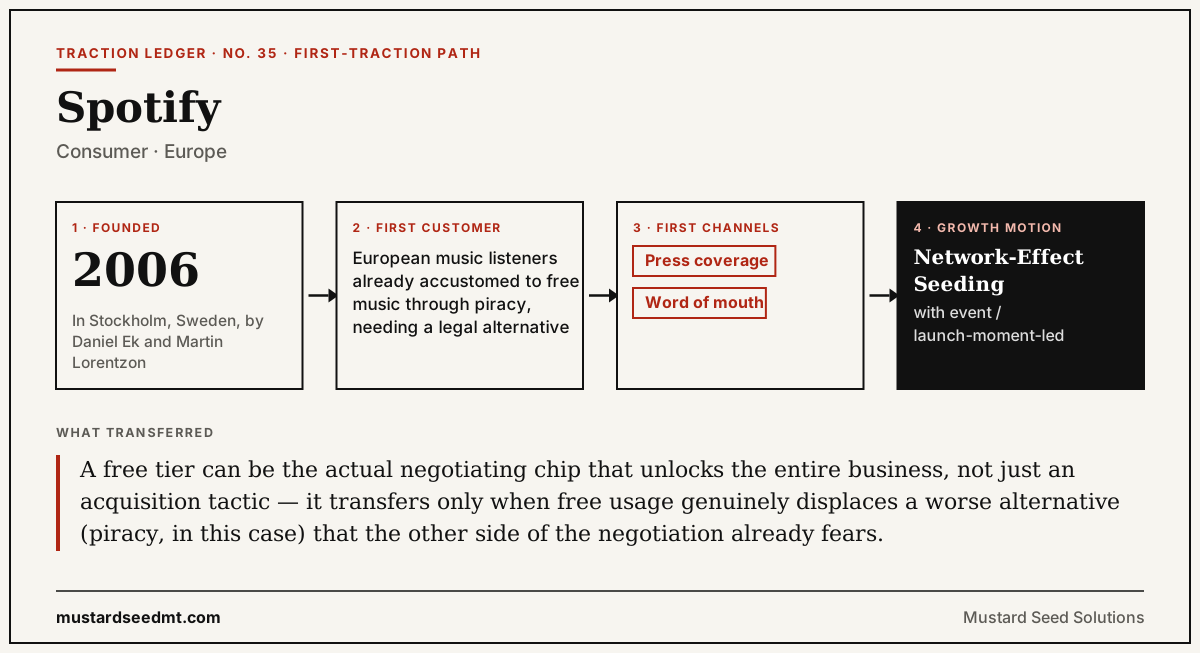
The Wedge: How Spotify Got Its First Customers
Spotify got its first users through an invite-only beta launch in Sweden, deliberately limited in scale — a constraint driven largely by the difficulty of licensing music catalogs, which meant the company could only grow as fast as it could negotiate rights.
Daniel Ek's earlier experience running an advertising network connected to piracy-adjacent sites gave him direct insight into just how large the pent-up demand for free, easy music access already was — informing Spotify's freemium model as a legal channel for demand that otherwise went to piracy.
Founded in Stockholm, Sweden, by Daniel Ek and Martin Lorentzon (2006).
Spotify's First Channel
The invite-only structure of the beta itself, combined with press coverage of a Swedish startup attempting to solve music piracy legally, generated outsized attention relative to the company's actual initial user count.
Word of mouth inside the invite-only beta compounded interest, with existing users effectively gatekeeping and distributing a limited number of additional invitations, adding a layer of manufactured scarcity to the launch.
The Motion: Network-Effect Seeding
The freemium model — a free, ad-supported tier alongside a paid ad-free Premium tier — was not simply a growth tactic but the core commercial argument used to persuade record labels to license music at all: replacing piracy with a monetized, license-compliant free alternative.
Spotify sequenced its market entry deliberately, launching first in Sweden and the broader Nordic region, then the UK, and only entering the United States in 2011 after years of licensing negotiation — a market-by-market rollout dictated by rights availability rather than user demand alone.
Because the free tier's ad-supported model directly answered the labels' central fear (that legal streaming would cannibalize existing revenue with nothing to show for it), that pricing structure functioned simultaneously as a growth mechanism and a licensing negotiation tool.
The Turn — the motion held
The motion held. Spotify's freemium structure and its geography-by-geography expansion sequencing, both established out of licensing necessity at the Swedish launch, remained the company's core playbook through its long-delayed US entry and its subsequent global expansion.
Era: 2005-2014
Where It Ended Up: Public (NYSE: SPOT, via direct listing) since 2018
What Transferred
"A free tier can be the actual negotiating chip that unlocks the entire business, not just an acquisition tactic — it transfers only when free usage genuinely displaces a worse alternative (piracy, in this case) that the other side of the negotiation already fears."
Sources
Related Entries
Canva
A design tool that started as a simple way to make school yearbooks, before becoming design software for everyone.
Freemium viralityDropbox
A demo video posted to Hacker News grew a waitlist from 5,000 to 75,000 people overnight.
Hacker NewsAirbnb
Air mattresses in the founders' own apartment during a sold-out design conference, seeded city by city afterward.
Personal network