
The Wedge: How Buffer Got Its First Customers
Buffer got its first paying customer from a website that was not yet a product. Before writing the application, Joel Gascoigne put up two pages: the first explained what Buffer would do, and a "plans and pricing" link led to the second, which listed prices. Anyone who clicked through to a plan was told the product wasn't quite ready and asked for an email address — which turned an ordinary landing page into a test of willingness to pay rather than willingness to nod.
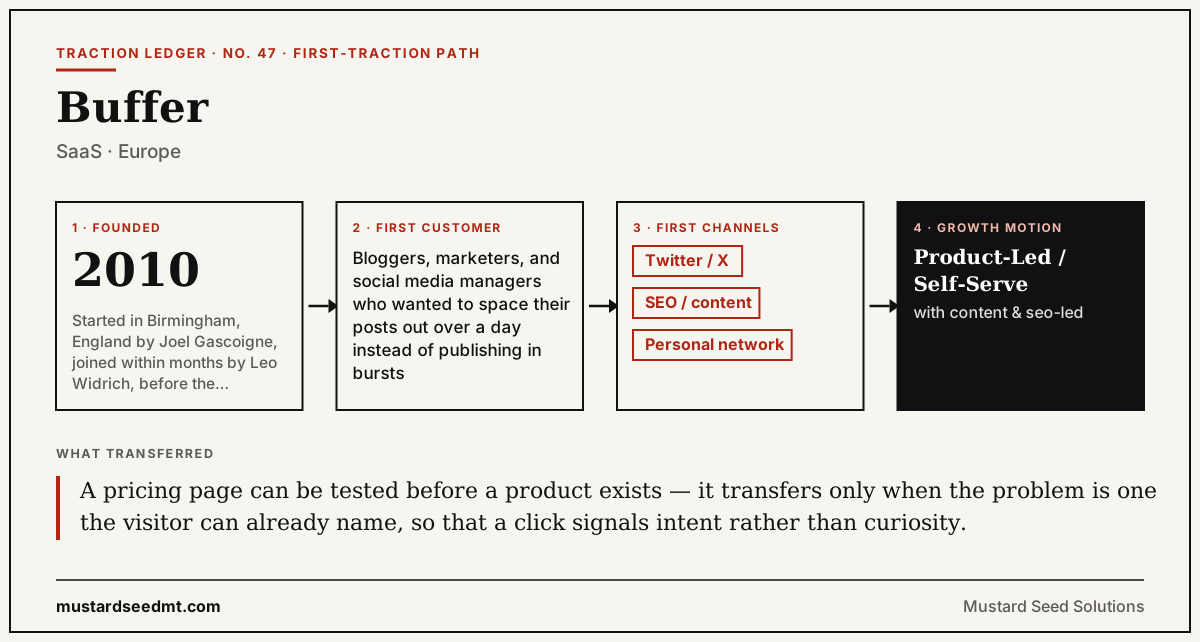
The wedge was narrow on purpose: not social media management, just spacing out tweets. A single-purpose scheduling queue addressed a problem bloggers and marketers already had and already knew they had, which is the precondition the pricing test depended on — a visitor did not need the concept explained before deciding whether it was worth money.
Started in Birmingham, England by Joel Gascoigne, joined within months by Leo Widrich, before the company relocated to San Francisco (2010).
Buffer's First Channel
The first channel was the founder's own audience. Gascoigne blogged and tweeted about what he was building while he built it, so the traffic arriving at the two-page test was already predisposed to care, and the roughly seven-week build that followed shipped to people who had raised their hands. The first paying customer arrived within days of the November 2010 launch — a small number, but the right kind of number, because it was revenue rather than signups.
The channel that scaled it was other people's audiences. After Leo Widrich joined as co-founder, Buffer's first year of growth ran largely on guest posts — a sustained, unglamorous campaign of writing for established blogs whose readers were exactly Buffer's users, with a link back doing the acquisition. It was content marketing executed as volume rather than as a flagship, and in the company's own retellings it is what carried Buffer past its first hundred thousand users.
The Motion: Product-Led / Self-Serve
The motion was self-serve freemium in its plainest form: a free plan that genuinely worked, a cheap paid plan for people who needed more accounts or more scheduling, and no human anywhere in the funnel. The product's value was legible inside one session — you queued a post, and it went out later — which is the condition product-led growth actually requires and which many products claiming the motion do not meet.
Transparency then became a channel in its own right. Buffer published its salary formula, its equity terms, its revenue dashboard, and its internal decisions in public, and the attention that generated brought users and press the company had not paid for. It is worth naming the mechanism precisely: this worked as marketing because the numbers were unusual and verifiable, not because openness is inherently persuasive — the advantage was a willingness to publish figures competitors would not.
Content kept compounding underneath both. The Buffer blog grew into a substantial organic-search asset on social media marketing, so the same kind of writing that had earned attention on other people's sites eventually earned it on the company's own.
The Turn — the motion held
The motion held. Buffer's defining decisions were about ownership and dependence rather than acquisition: in 2018 it bought out its venture investors and returned to founder and employee ownership, choosing a slower profitable trajectory over the growth path that funding implies. The structural risk it never escaped was platform dependence — a scheduling tool lives inside social networks' APIs, and when Twitter sharply repriced API access in 2023, every company in the category had to absorb a decision it had no vote in. The go-to-market motion was Buffer's to choose; the supply of the thing it scheduled was not.
Era: 2005-2014
Where It Ended Up: Private; independent and profitable after buying out its venture investors in 2018
What Transferred
"A pricing page can be tested before a product exists — it transfers only when the problem is one the visitor can already name, so that a click signals intent rather than curiosity."
Sources
Related Entries
Twilio
SMS and voice as an API — pay per call, no sales conversation required.
Hacker NewsGitHub
Git hosting that made open-source collaboration social, starting with the Ruby community.
Open-source repoDatadog
Unified monitoring for DevOps teams juggling too many separate dashboards.
Webinars