
The Wedge: How GitHub Got Its First Customers
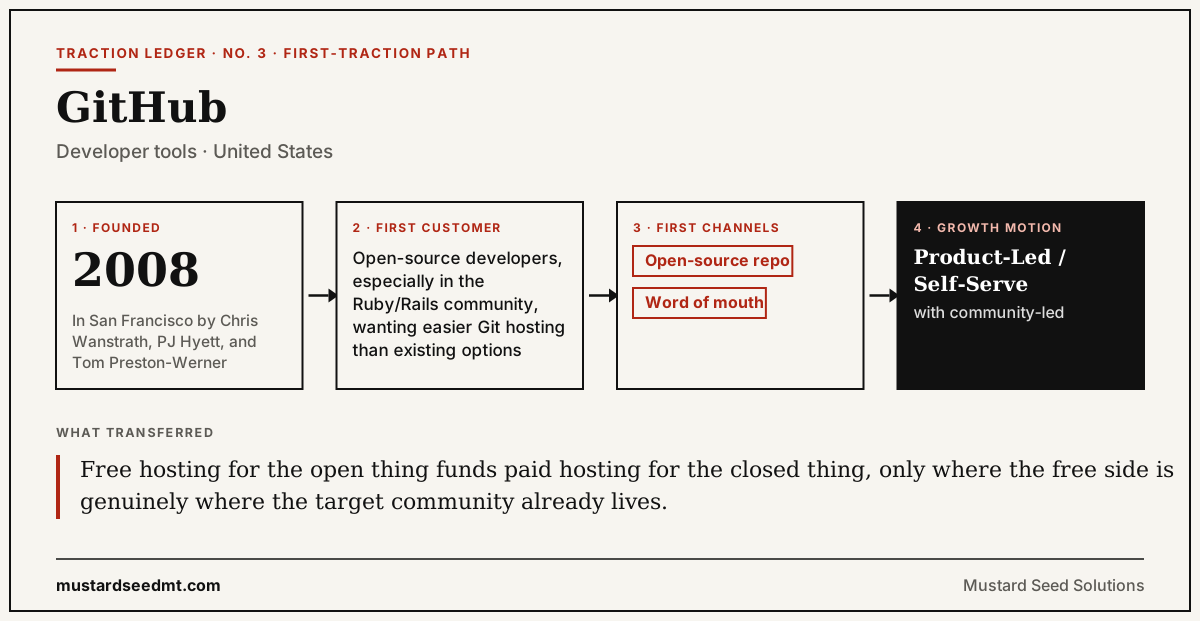
GitHub got its first customers by being easier and more pleasant to use than the alternatives available to Git users in 2008, at a moment when Git itself was a young and clunky tool with almost no accessible hosting options. Chris Wanstrath and PJ Hyett built it originally to scratch their own itch as working developers who wanted a better way to share code.
The earliest adopters were drawn heavily from the Ruby and Rails community, where the founders already had visibility and credibility from their own open-source contributions — the first repositories hosted were often the founders' own projects and those of developers they already knew.
Founded in San Francisco by Chris Wanstrath, PJ Hyett, and Tom Preston-Werner (2008).
GitHub's First Channel
The channel was the open-source ecosystem itself: once a handful of visible Ruby projects moved their code to GitHub, other developers followed because that's where the code and the community conversation already were. Hosting a popular open-source project on GitHub was, in effect, free advertising for GitHub inside exactly the audience it needed.
This spread with no paid acquisition — a developer discovering an interesting open-source project would land on GitHub to read the code, and some fraction would end up hosting their own projects there next.
The Motion: Product-Led / Self-Serve
The monetization logic was simple and product-led: public repositories were free, which maximized the open-source flywheel described above, while private repositories carried a subscription fee — aimed at the many developers and small teams who wanted the same collaboration tools for code they couldn't make public.
Because the free public tier was the acquisition engine and the paid private tier was the business model, the two reinforced each other: the bigger and more visible the free ecosystem grew, the more natural it felt for a team's private, paid work to live in the same place.
GitHub added social and collaboration features — pull requests, forks, issues, visible contributor profiles — that turned hosting into participation, giving developers a reputation-building reason to be active on the platform beyond simply storing code.
The Turn
The pull-request and social-profile features were the real turn: what began as "easier Git hosting" became a platform where a developer's public activity was itself valuable — visible, citable, and portable between employers — which is a materially different product than a hosting utility and is largely what made GitHub durable enough to be acquired by Microsoft for $7.5 billion a decade later.
Era: 2005-2014
Where It Ended Up: Acquired by Microsoft in 2018; operates as a semi-independent subsidiary
What Transferred
"Free hosting for the open thing funds paid hosting for the closed thing, only where the free side is genuinely where the target community already lives."
Sources
Related Entries
Twilio
SMS and voice as an API — pay per call, no sales conversation required.
Hacker NewsGitLab
A self-hosted, open-source alternative to GitHub, built by a distributed team from day one.
Open-source repoMongoDB
A flexible-schema database open-sourced for web developers frustrated with rigid relational databases.
Open-source repo