
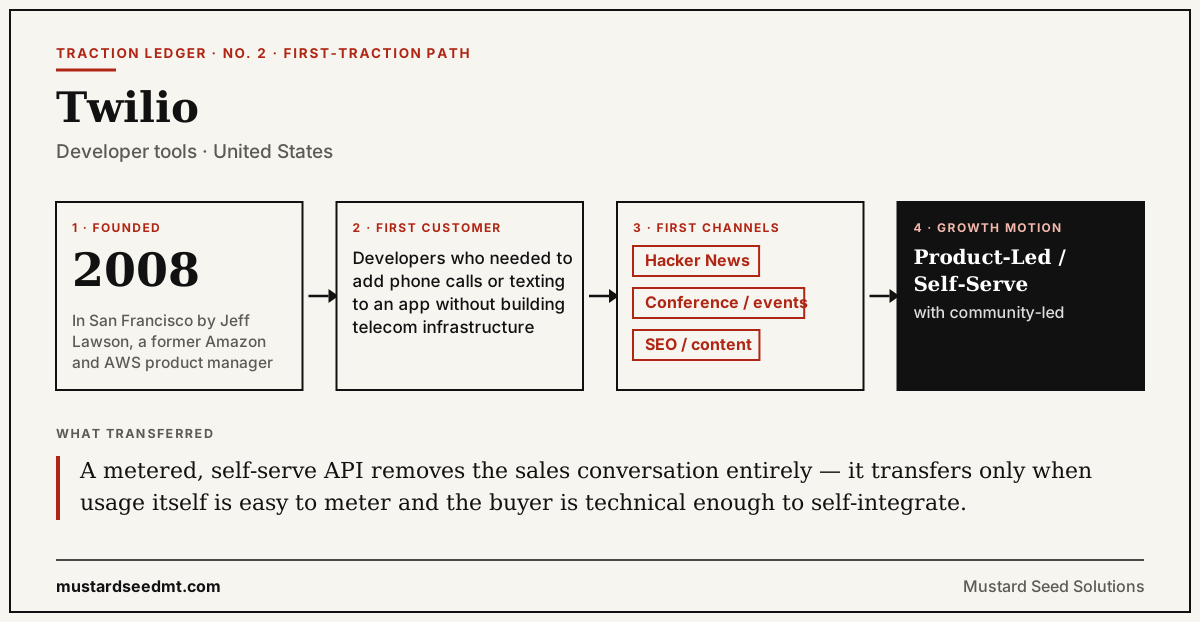
The Wedge: How Twilio Got Its First Customers
Twilio got its first customers by letting a developer go from "I have an idea" to "I just sent a text message from code" in under fifteen minutes, with no phone call to a salesperson anywhere in that path. Jeff Lawson modeled the product explicitly on AWS's own self-serve, pay-as-you-go developer experience, which he'd seen from the inside.
The first buyers weren't telecom companies or enterprises — they were individual developers and small engineering teams who needed SMS or voice as a feature inside something else they were building, and who had previously faced a telecom industry built entirely around enterprise contracts and carrier relationships that a solo developer had no way to access.
Founded in San Francisco by Jeff Lawson, a former Amazon and AWS product manager (2008).
Twilio's First Channel
The primary channel was the product's own documentation, discovered through developer forums, Hacker News threads, and word of mouth at hackathons and developer conferences. Twilio sponsored and showed up at hackathons specifically because that was where its actual buyer — someone building something over a weekend — could be reached directly.
This channel worked because it required no gatekeeper: a developer could sign up, get an API key, and be charged in cents for their first test call, which meant the decision to try Twilio never had to clear a purchasing process.
The Motion: Product-Led / Self-Serve
The core motion was self-serve, usage-based adoption: sign up, get a key, pay only for what's used, scale usage as the underlying app scales. This removed the two costliest parts of enterprise telecom sales — the negotiated contract and the minimum commitment — and replaced them with a metered API call.
Documentation itself functioned as a sales asset: clear, example-driven docs meant a developer's first successful API call often happened before any human at Twilio was aware the account existed, and usage naturally expanded as that developer's own product grew.
As adoption moved from individual developers into larger engineering organizations, a sales-assisted layer was added for enterprise contracts and volume pricing, but it sat on top of the self-serve motion rather than replacing it — most large customers had started as a small self-serve account first.
The Turn — the motion held
The motion held. Twilio's expansion into adjacent products (video, email through the SendGrid acquisition, a full contact center suite) consistently re-used the same self-serve, usage-metered entry point rather than requiring a new sales motion for each new product line.
Era: 2005-2014
Where It Ended Up: Public (NYSE: TWLO) since 2016
What Transferred
"A metered, self-serve API removes the sales conversation entirely — it transfers only when usage itself is easy to meter and the buyer is technical enough to self-integrate."
Sources
Related Entries
GitHub
Git hosting that made open-source collaboration social, starting with the Ruby community.
Open-source repoGitLab
A self-hosted, open-source alternative to GitHub, built by a distributed team from day one.
Open-source repoMongoDB
A flexible-schema database open-sourced for web developers frustrated with rigid relational databases.
Open-source repo