
The Wedge: How ConvertKit Got Its First Customers
ConvertKit got its first customers the least scalable way available. After the product had existed for a year and barely moved, founder Nathan Barry sent roughly a hundred personal emails to the top sellers on Leanpub and Udemy — people he could see were already earning money from an audience — and converted somewhere between five and seven of them. The emails moved what a year of waiting for signups had not.
The wedge sat in a gap between two kinds of tool. Newsletter products were built for broadcasting to a list; marketing automation platforms were built for companies with marketing departments. A professional blogger selling their own courses and books needed the automation and the tagging without the enterprise apparatus, and ConvertKit positioned itself at exactly that person — narrow enough that the pitch named the buyer's job rather than a software category.
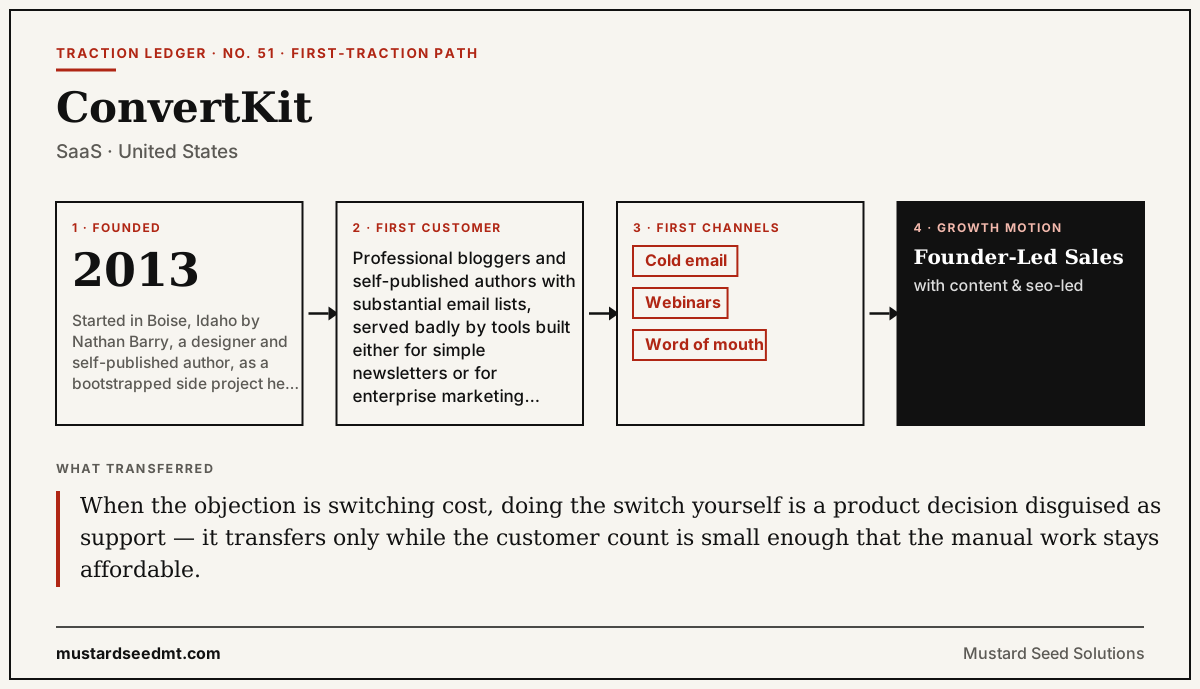
Started in Boise, Idaho by Nathan Barry, a designer and self-published author, as a bootstrapped side project he documented publicly as it grew (2013).
ConvertKit's First Channel
The first channel was cold email, written one at a time to people the founder could identify by name and by revenue. This is the founder-led motion at its most literal, and the conversion rate is worth stating plainly — five to seven customers from about a hundred emails is unimpressive as a percentage and decisive as an outcome for a company at that stage.
The objection those conversations kept hitting was not price or features but switching cost: bloggers agreed the product sounded good and said that moving an existing list, forms, and sequences was more work than it was worth. Barry's answer became the company's actual growth mechanism — ConvertKit would perform the migration by hand, free, for anyone who agreed to switch. Concierge migration removed the one objection no amount of product work could have removed, by moving the cost onto the seller's side of the transaction.
The Motion: Founder-Led Sales
Direct sales remained the motion far longer than most software companies would tolerate, because the buyer list was finite and identifiable: there are only so many professional bloggers with lists in the tens or hundreds of thousands, and each one was worth an individual conversation rather than an impression.
Webinars supplied the leverage. Rather than selling to one blogger at a time indefinitely, ConvertKit ran joint webinars with bloggers who already had large audiences — teaching those readers something genuinely useful about email and, in the same session, demonstrating the product to a room the host had assembled. A generous affiliate program then gave those hosts a durable commercial reason to keep recommending it after the webinar ended.
Building in public was the third leg. Barry published ConvertKit's monthly revenue, its mistakes, and its tactics as they happened, which drew an audience of precisely the bootstrapped creators the product was for and turned the company's own growth into marketing that cost nothing to produce.
The Turn
The turn ran in the opposite direction to most entries in this ledger: from self-serve to direct. ConvertKit launched as a product you could simply sign up for, and sat near a thousand dollars a month for over a year while its founder waited for that to work. It began growing when he stopped waiting and started emailing — and the mechanism that followed, migrations done by hand, was chosen precisely because it did not scale and therefore did not have to be proven first. Self-serve growth returned later, on top of a customer base and a reputation that direct selling had built.
Era: 2005-2014
Where It Ended Up: Private and bootstrapped, with no outside funding; rebranded as Kit in 2024
What Transferred
"When the objection is switching cost, doing the switch yourself is a product decision disguised as support — it transfers only while the customer count is small enough that the manual work stays affordable."
Sources
Related Entries
Stripe
Payments for developers who'd rather write seven lines of code than sign a bank contract.
Personal networkSlack
An internal messaging tool built for one gaming studio's own team, released after the game itself failed.
Personal networkZoom
Reliable video calling built by a former WebEx engineer who thought existing video conferencing was too frustrating.
Freemium virality