
The Wedge: How Slack Got Its First Customers
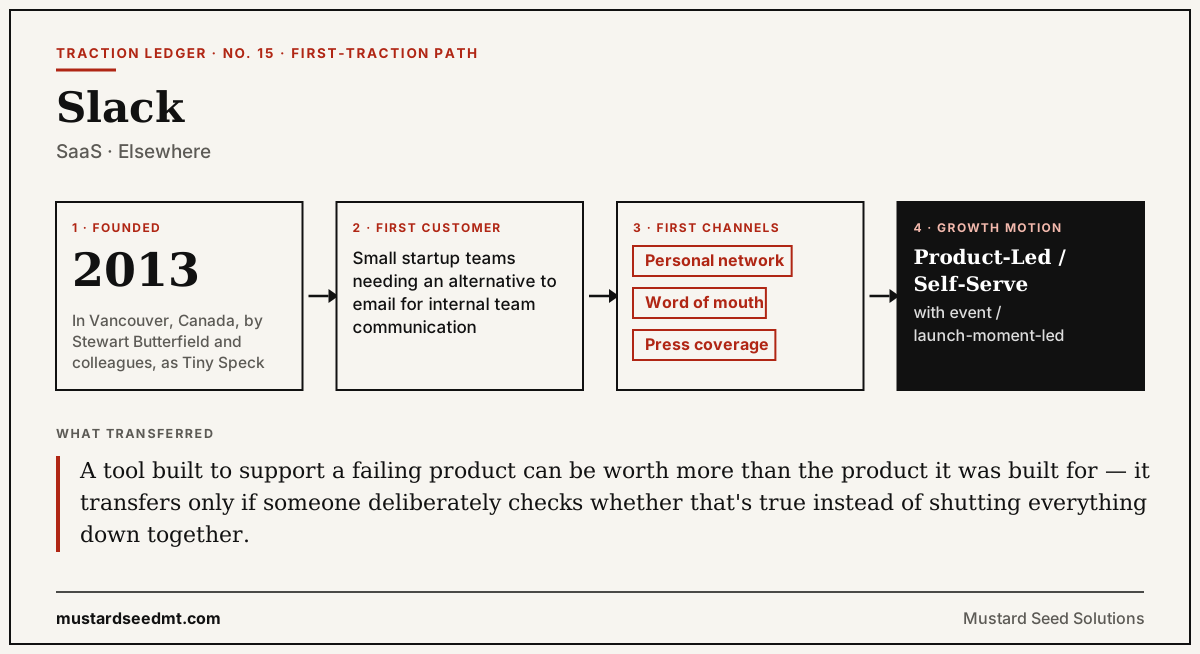
Slack's actual first user was Tiny Speck's own team: Stewart Butterfield's company built an internal messaging and search tool to coordinate work while developing a multiplayer game called Glitch, and used it internally for their own daily communication long before it was a product anyone else could buy.
When Glitch shut down after failing to find a market, the team recognized that the internal communication tool built to support the game was more valuable than the game itself, and gave early access to friends running other startups to see if the same value held outside Tiny Speck.
Founded in Vancouver, Canada, by Stewart Butterfield and colleagues, as Tiny Speck (2013).
Slack's First Channel
The first channel was personal relationships — other startup founders in Butterfield's network were given early access before any public launch, providing real usage feedback from teams with no connection to the original gaming product.
The public 2013 launch generated an unusually large wave of press coverage and word-of-mouth attention, in part because Butterfield already had a known track record (he had previously co-founded Flickr), which gave the launch immediate credibility among technology press and early adopters.
The Motion: Product-Led / Self-Serve
The product was designed to spread virally within a team and between teams: adding a colleague to a Slack workspace required no separate purchasing decision at first, and a small startup team could adopt it in an afternoon with no procurement process at all.
Freemium pricing — free for small teams and basic usage, paid tiers billed per active user as message history and integrations scaled — matched exactly how a startup team's own usage and willingness to pay grew over time.
Growth compounded because Slack was inherently multiplayer: an employee who used it at one job would often ask for it at the next, carrying the product between companies in a way that pure single-player software couldn't replicate.
The Turn
The pivot from a failed multiplayer game to a standalone messaging product is one of the most direct examples of "the turn" in this entire ledger — the name Slack itself is commonly explained as an acronym for "Searchable Log of All Conversation and Knowledge," describing the internal tool, not the game it was built to support.
Era: 2005-2014
Where It Ended Up: Acquired by Salesforce in 2021, after operating as a public company via direct listing since 2019
What Transferred
"A tool built to support a failing product can be worth more than the product it was built for — it transfers only if someone deliberately checks whether that's true instead of shutting everything down together."
Sources
Related Entries
Twilio
SMS and voice as an API — pay per call, no sales conversation required.
Hacker NewsGitHub
Git hosting that made open-source collaboration social, starting with the Ruby community.
Open-source repoDatadog
Unified monitoring for DevOps teams juggling too many separate dashboards.
Webinars