
The Wedge: How Zoom Got Its First Customers
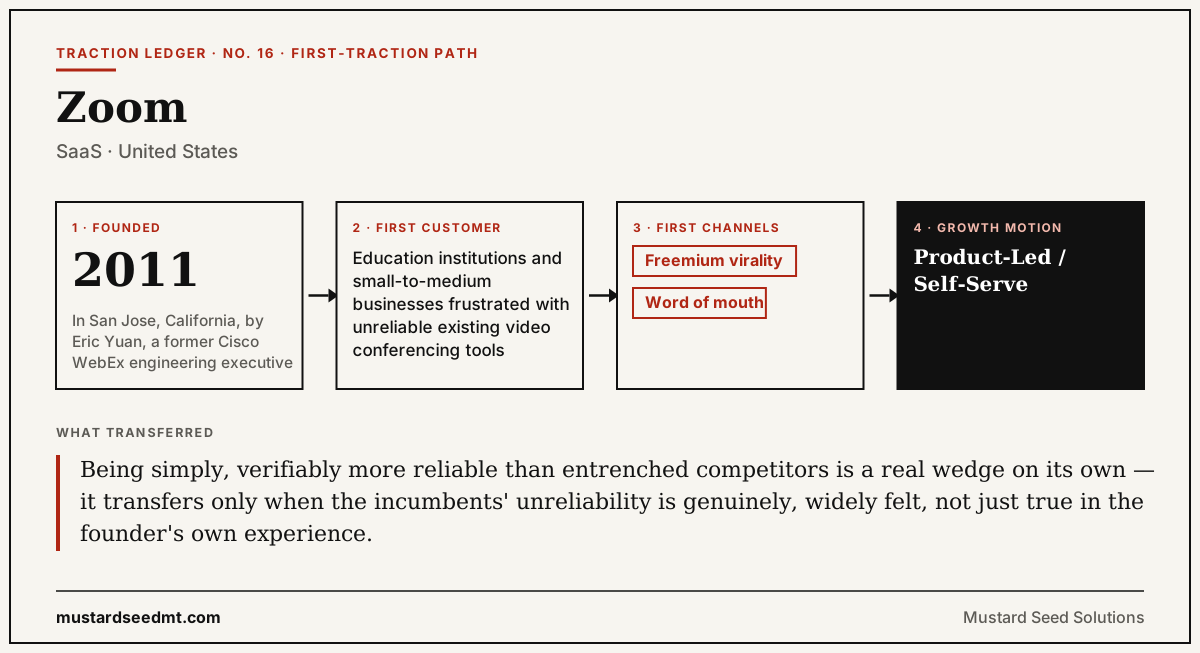
Zoom got its first customers by being simply more reliable than the video conferencing tools already on the market. Eric Yuan built the company after growing frustrated, as an engineering leader at Cisco's WebEx, with the technical limitations of the product he'd spent years helping build.
The earliest adopters were education institutions and small-to-medium businesses — buyers for whom a video call that reliably connected without dropped connections or confusing setup was a meaningfully better experience than what they already had, and who were price-sensitive enough that Zoom's free tier mattered.
Founded in San Jose, California, by Eric Yuan, a former Cisco WebEx engineering executive (2011).
Zoom's First Channel
The primary channel was the free tier itself: anyone could start a meeting of up to 40 minutes at no cost, which meant a single satisfied user inside an organization could invite colleagues, clients, or students into a working product with zero approval process.
Word of mouth compounded this because video calls are inherently multi-party — every meeting exposed every participant to the product, turning ordinary usage into continuous, built-in exposure to new potential adopters outside the original buyer's organization.
The Motion: Product-Led / Self-Serve
The free-to-paid conversion mechanism was simple: teams needing longer or larger meetings than the free tier allowed converted to a paid per-host subscription, a natural upgrade point directly tied to real usage rather than an artificial feature gate.
Because the product worked reliably across a wide range of devices and network conditions, it required minimal onboarding or technical support to succeed with — removing a common hidden cost of enterprise-grade software that competitors often pushed onto the buyer.
As adoption grew, Zoom added integrations (calendar tools, Zoom Rooms hardware) and enterprise features, but the free-trial-into-paid-subscription core motion, and the emphasis on reliability as the central promise, remained constant.
The Turn — the motion held
The motion held. The enormous acceleration in Zoom's usage during 2020 was an external demand shock, not a strategic pivot — the underlying self-serve, freemium growth mechanism that had driven adoption since 2011 simply operated at a vastly larger scale once remote work became a near-universal necessity.
Era: 2005-2014
Where It Ended Up: Public (Nasdaq: ZM) since 2019
What Transferred
"Being simply, verifiably more reliable than entrenched competitors is a real wedge on its own — it transfers only when the incumbents' unreliability is genuinely, widely felt, not just true in the founder's own experience."
Sources
Related Entries
Twilio
SMS and voice as an API — pay per call, no sales conversation required.
Hacker NewsGitHub
Git hosting that made open-source collaboration social, starting with the Ruby community.
Open-source repoDatadog
Unified monitoring for DevOps teams juggling too many separate dashboards.
Webinars